Anurag Thakur Champions Stronger Panchayats for Himachal
Synopsis
BJP MP Anurag Thakur posted on 31 October 2026 that empowered panchayats are the foundation of a stronger Himachal Pradesh, crediting the Modi government's digital, transparency, and infrastructure push at the grassroots level.
Key Takeaways
BJP MP Anurag Thakur posted on 31 October 2026 emphasising that strong panchayats underpin strong villages and a stronger Himachal Pradesh .
He credited the Modi government with multiple steps to strengthen Panchayati Raj institutions through digital technology, transparency, and public participation.
The 73rd Constitutional Amendment Act, 1992 gave Panchayati Raj bodies their constitutional foundation and devolved powers to local self-governance units.
The e-Panchayat Mission Mode Project under Digital India and the Rashtriya Gram Swaraj Abhiyan (2018) are key central schemes building digital and capacity infrastructure in panchayats.
Thakur specifically called on panchayat representatives to participate actively to make development efforts more effective across Himachal Pradesh's difficult terrain.
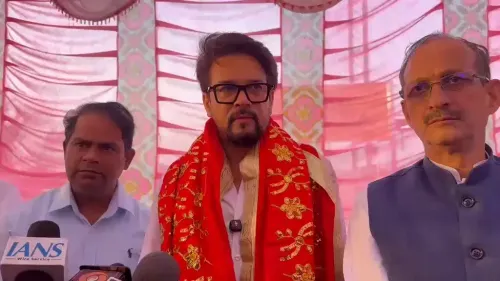
Strong panchayats are the foundation of strong villages — and, by extension, a stronger Himachal Pradesh. That is the case BJP MP Anurag Thakur made on Saturday, 31 October 2026, in a post underlining the Modi government's efforts to empower Panchayati Raj institutions through digital tools, transparency, and community participation.
Thakur wrote, in Hindi: 'सशक्त पंचायतें ही सशक्त गांव और सशक्त हिमाचल की नींव रखती हैं' — 'Empowered panchayats alone lay the foundation of empowered villages and an empowered Himachal.' He credited the central government's steps in building rural infrastructure and accelerating grassroots development, pointing to digital technology, transparency, and public participation as the three pillars reshaping how panchayats function today.
Three Decades of Constitutional Roots
The argument Thakur is making stands on well-established ground. The 73rd Constitutional Amendment Act of 1992 gave Panchayati Raj institutions their constitutional status and devolved powers directly to elected local bodies — a structural shift that placed self-governance at the heart of India's rural architecture. What has changed since 2014 is the pace and the tools brought to bear on that framework.
The e-Panchayat Mission Mode Project, rolled out under the Digital India initiative, pushed digital governance into gram panchayat offices — from online records to financial tracking. The Rashtriya Gram Swaraj Abhiyan (RGSA), launched in 2018, went further: it targeted the capacity of panchayat representatives themselves, training elected members to plan, execute, and monitor development work at the village level. Both schemes directly underpin the 'digital technology and transparency' arc that Thakur's post highlights.
Why Himachal's Terrain Makes This Urgent
Himachal Pradesh's mountainous geography makes decentralised governance not a policy preference but a practical necessity. Connectivity gaps, dispersed populations, and the sheer distance between administrative headquarters and remote villages mean that a functional, digitally-enabled panchayat is often the only government institution a household meaningfully interacts with. Active participation by panchayat representatives — the closing note of Thakur's post — carries particular weight in this context.
The Hamirpur MP's emphasis on 'jan bhagidari' (public participation) echoes a consistent thread in the Centre's rural governance messaging: that infrastructure and technology alone are insufficient without elected representatives actively driving implementation on the ground.
The Pace of Village Development, in the MP's Words
Thakur closed with a pointed observation: the pace of development in villages today is 'far faster than before,' and active engagement by panchayat representatives can make these efforts still more effective. The framing is both a tribute to existing momentum and a quiet call to action for local leaders in Himachal Pradesh.
With RGSA implementation and state-level digital governance rollouts continuing to evolve, the role of gram panchayats as frontline delivery units for central schemes will only grow. The question is no longer whether the framework exists — it does, constitutionally and programmatically. The question is whether local capacity keeps pace.
Point of View
' the party links its tech-governance brand directly to the oldest institution of Indian self-rule. In Himachal Pradesh, where local body elections and RGSA implementation are perennial political flashpoints, such messaging also functions as a signal to panchayat-level cadre. The broader arc is consistent: grassroots empowerment as electoral as much as administrative strategy.
NationPress
31 Oct 2026
Frequently Asked Questions
What did Anurag Thakur say about panchayats in Himachal Pradesh?
On 31 October 2026, BJP MP Anurag Thakur stated that empowered panchayats are the foundation of strong villages and a stronger Himachal Pradesh, crediting the Modi government's push on digital governance, transparency, and community participation in rural local bodies.
What is the Rashtriya Gram Swaraj Abhiyan?
The Rashtriya Gram Swaraj Abhiyan (RGSA), launched in 2018, is a central government scheme aimed at building the capacity of Gram Panchayats and their elected representatives to plan and implement rural development programmes more effectively.
What is the e-Panchayat Mission Mode Project?
The e-Panchayat Mission Mode Project is a Digital India initiative that promotes digital governance and transparency in panchayats, enabling online record-keeping, financial tracking, and service delivery at the gram panchayat level across India.
What powers do panchayats have under the Indian Constitution?
The 73rd Constitutional Amendment Act of 1992 gave Panchayati Raj institutions their constitutional status, devolved powers to elected local bodies, and mandated their role in rural self-governance across India.
Why is panchayat empowerment important for Himachal Pradesh?
Himachal Pradesh's mountainous and dispersed geography means gram panchayats are often the primary point of government contact for remote communities, making functional and digitally-enabled panchayats essential for delivering infrastructure and development schemes.