Anurag Thakur Credits BJP's Antyodaya Policy for 25 Crore Poverty Exit
Synopsis
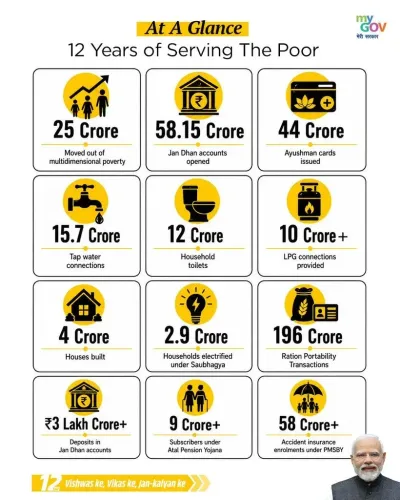
BJP MP Anurag Thakur, posting from Himachal Pradesh on 26 September 2026, credited BJP's Antyodaya and welfare policies for lifting 25 crore Indians out of poverty — citing the achievement as a landmark of the party's governance record.
Key Takeaways
BJP MP Anurag Thakur posted from Himachal Pradesh on 26 September 2026 , claiming 25 crore poor people have exited poverty under BJP rule.
He attributed the achievement directly to the party's Antyodaya philosophy and Jan Kalyan (welfare) policies.
The 25-crore figure aligns with a NITI Aayog Multidimensional Poverty Index (2023) report covering the period 2013–14 to 2022–23 .
The Antyodaya Anna Yojana , launched in 2000 , along with post-2014 schemes such as PM Garib Kalyan Anna Yojana and PM Awas Yojana , form the policy backbone of this claim.
Thakur, the Lok Sabha MP from Hamirpur , framed the national poverty data in the context of his home state, signalling its political salience for Himachal Pradesh.
The next NITI Aayog MPI update will be the critical data checkpoint for verifying whether the poverty-reduction trajectory has continued beyond 2023.
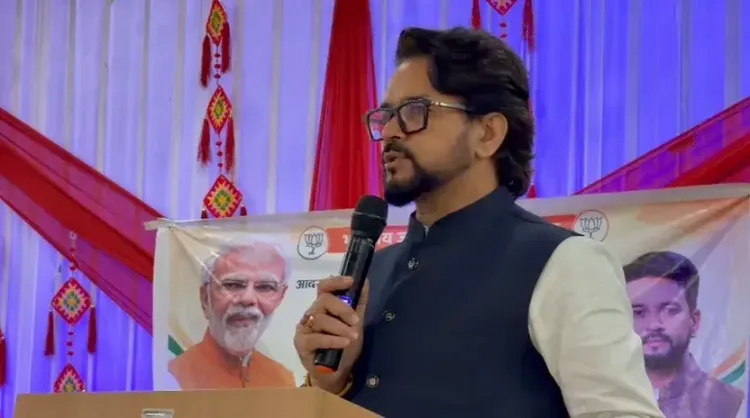
A figure as large as 25 crore people lifting themselves out of poverty is not a statistic — it is a civilisational shift. Speaking from Himachal Pradesh on Saturday, 26 September 2026, BJP MP Anurag Thakur invoked that number to make the case that the BJP's Antyodaya and welfare-first policies are directly responsible for one of the largest poverty-reduction episodes in modern Indian history.
Thakur posted in Hindi: 'भाजपा की अंत्योदय व जनकल्याणकारी नीतियों के चलते ही 25 करोड़ ग़रीब, गरीबी रेखा से बाहर आए ये हमारी सरकार की उपलब्धि है' — ('It is because of BJP's Antyodaya and welfare policies that 25 crore poor people have come out from below the poverty line — this is the achievement of our government.')
The Antyodaya thread running through BJP's welfare architecture
The Antyodaya philosophy — literally, 'the rise of the last person' — has been a load-bearing pillar of BJP governance for over two decades. It found its first programmatic expression in the Antyodaya Anna Yojana, launched in 2000, which guaranteed subsidised foodgrains to the poorest families. Since 2014, the central government has layered on scheme after scheme — PM Garib Kalyan Anna Yojana, PM Awas Yojana, and a sprawling direct-benefit-transfer architecture — each designed to reach beneficiaries without leakage.
The 25-crore figure Thakur cites draws its credibility from a NITI Aayog Multidimensional Poverty Index report (2023), which recorded a decline of approximately 25 crore people from multidimensional poverty between 2013–14 and 2022–23. The Multidimensional Poverty Index measures deprivation across health, education, and living standards — a broader lens than income alone, which is why the number tends to be larger than single-dimension poverty headcounts.
Why Thakur is making this argument in Himachal Pradesh
Thakur represents Hamirpur, a constituency in Himachal Pradesh, and the location tag on his post is deliberate. Himachal Pradesh has long been a BJP stronghold, and welfare delivery — ration cards, housing, cooking gas connections — has been central to the party's ground narrative in the hill state. By anchoring a national achievement to a state audience, Thakur is translating macro-policy numbers into local political currency.
It is also a reminder that the Antyodaya framework is not abstract ideology. Across India's northern states, it maps onto real households — families that received a subsidised grain allocation, a new pucca house, or a bank account for the first time. The sheer scale of 25 crore is what makes the claim both powerful and contested: critics argue that multidimensional poverty metrics can mask persistent income poverty, while the government points to the breadth of the index as proof that deprivation is being attacked on multiple fronts simultaneously.
What the next poverty index update will reveal
The NITI Aayog is expected to publish updated Multidimensional Poverty Index data in the coming period, and that release will be the next definitive checkpoint on whether the trend documented through 2022–23 has held or accelerated. State-level disaggregation, including figures for Himachal Pradesh, will be watched closely to see whether the mountain state's welfare outcomes match the national trajectory.
For now, Thakur's message from the hills is unambiguous: in the BJP's telling, Antyodaya is not a legacy slogan — it is a live, measurable programme. And 25 crore is the number they intend to put on every hoarding between here and the next election.
Point of View
The 'last person first' principle, that cuts across caste and regional lines. However, the gap between multidimensional poverty reduction and income poverty relief remains a live debate in Indian policy circles, and opposition parties are likely to contest whether headline numbers translate into durable economic security for the poorest households. The next MPI update will either reinforce or complicate this narrative significantly.
NationPress
26 Sept 2026
Frequently Asked Questions
What is the claim Anurag Thakur made about poverty reduction?
Anurag Thakur claimed that BJP's Antyodaya and welfare policies have lifted 25 crore people out of poverty in India, describing it as the government's achievement.
What is the Antyodaya philosophy in Indian politics?
Antyodaya means 'rise of the last person' — it is a welfare philosophy focused on uplifting the poorest segments of society first. It underpins schemes like the Antyodaya Anna Yojana (launched 2000) and shapes BJP's broader social-policy agenda.
Where does the 25 crore poverty reduction figure come from?
The figure aligns with a NITI Aayog Multidimensional Poverty Index report (2023) , which documented a decline of approximately 25 crore people from multidimensional poverty between 2013–14 and 2022–23 .
What is the Multidimensional Poverty Index and how is it different from regular poverty measurement?
The Multidimensional Poverty Index measures deprivation across health, education, and living standards — not just income — giving a broader picture of poverty. This typically results in larger reduction numbers compared to single-dimension income-poverty headcounts.
Why did Anurag Thakur post this from Himachal Pradesh?
Thakur is the BJP Lok Sabha MP from Hamirpur, Himachal Pradesh , and linking national welfare achievements to his home state is a way of translating macro-policy outcomes into locally relevant political messaging for his constituency.