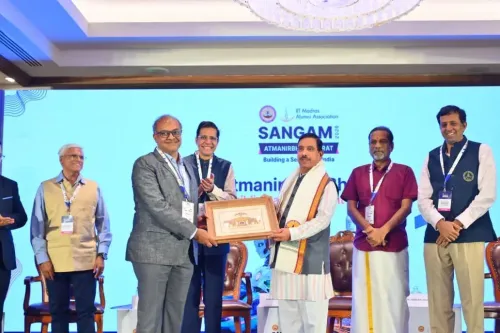
Pralhad Joshi at IIT Madras SANGAM 2026 on Atmanirbhar Bharat

Synopsis
Union Minister Pralhad Joshi joined IIT Madras's SANGAM 2026 on September 26, engaging alumni, scientists, entrepreneurs, and faculty to exchange ideas on strengthening India's innovation ecosystem and advancing the Atmanirbhar Bharat vision.
Key Takeaways
Union Minister Pralhad Joshi attended SANGAM 2026 at IIT Madras on September 26, 2026 .
The event brought together distinguished alumni, scientists, industry leaders, entrepreneurs, faculty, and students.
Discussions centred on strengthening India's innovation ecosystem and advancing Atmanirbhar Bharat .
Atmanirbhar Bharat was launched by PM Modi in May 2020 to build domestic capability across technology, manufacturing, and R&D.
Joshi's dual portfolios — consumer affairs and New and Renewable Energy — connect directly to domestic manufacturing and clean energy indigenisation goals.
Follow-up policy inputs or collaboration announcements from the engagement are the key indicator to watch.
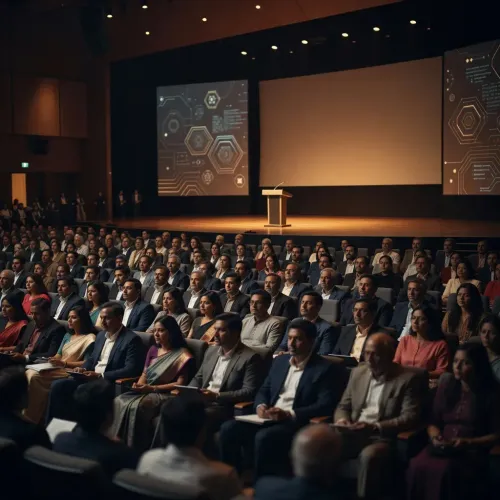
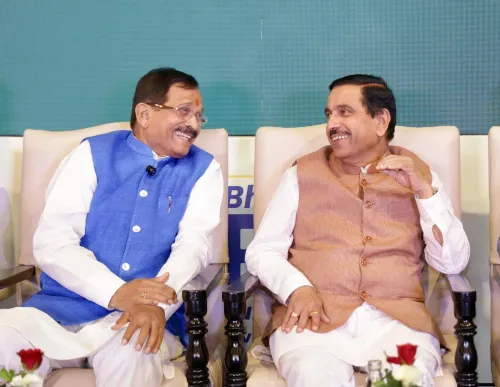
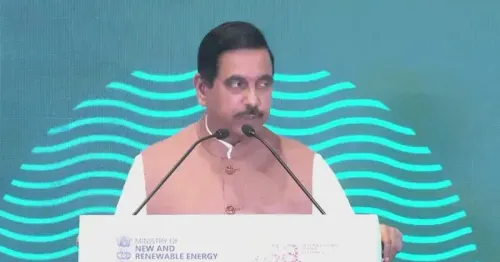
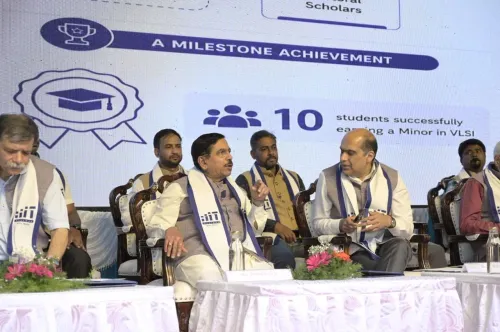
Where does India's next leap in self-reliance actually get engineered? On Saturday, September 26, 2026, Union Minister Pralhad Joshi walked into IIT Madras for SANGAM 2026 — a gathering of the institute's distinguished alumni, scientists, industry leaders, entrepreneurs, faculty and students — to do exactly what the moment demands: trade ideas on hardwiring innovation into India's national ambition.
Joshi, who holds the portfolios of Consumer Affairs, Food and Public Distribution and New and Renewable Energy, described the engagement as an exchange of ideas aimed at 'strengthening India's innovation ecosystem and advancing the vision of #AtmanirbharBharat.' The setting was deliberate — IIT Madras sits at the crossroads of deep-tech research, startup culture, and global academic credibility, making it one of the most potent rooms a minister can walk into when the conversation is about homegrown capability.
What SANGAM 2026 represents for industry-academia linkage
IIT Madras has built a reputation as one of India's most entrepreneurially active institutes, with a technology business incubator that has seeded hundreds of startups across deep-tech, energy, and manufacturing verticals — precisely the sectors where Atmanirbhar Bharat seeks structural depth. SANGAM, as a confluence of alumni and current ecosystem players, offers something a policy seminar rarely can: unfiltered feedback from those who have actually tried to build in India, hit regulatory walls, or scaled past them. That Joshi — a minister overseeing both energy transition and supply-chain resilience in consumer goods — was present signals that the government sees IIT engagements as more than ceremonial. The New and Renewable Energy portfolio, in particular, intersects sharply with domestic manufacturing ambitions: solar panel production, green hydrogen, and battery storage are all areas where India is racing to replace import dependence with domestic capacity.Atmanirbhar Bharat's technology arc, six years on
When Prime Minister Narendra Modi launched Atmanirbhar Bharat in May 2020, the immediate trigger was a pandemic-exposed supply chain. Six years later, the initiative has evolved into a sprawling policy architecture spanning semiconductor fabrication, defence indigenisation, space commercialisation, and clean energy manufacturing. Forums like SANGAM 2026 feed directly into that architecture — not through executive orders, but through the slower, stickier work of aligning what researchers are building with what policymakers need scaled. Successive governments have encouraged this pattern of ministerial engagement with IITs precisely because the institutes sit at a rare intersection: globally competitive research output, a pipeline of technically trained founders, and close ties with industry. The risk, of course, is that such interactions remain symbolic. The signal to watch is whether SANGAM 2026 produces any concrete follow-up — a research collaboration MoU, a policy input on innovation funding, or a regulatory tweak that one of those entrepreneurs in the room has been pushing for. The ideas exchanged at Chennai on Saturday now need to find their way into the policy pipeline — and that is where the real test of engagement begins.Point of View
Straddling energy transition and supply-chain portfolios, suggests the government is trying to align clean-energy manufacturing ambitions with academic R&D pipelines. The Atmanirbhar Bharat framework has matured past its pandemic-era origins into a serious industrial policy posture, and IIT engagements are increasingly the mechanism for grounding that policy in technical reality. The real measure of such forums is not the optics of the interaction but the specific, actionable outputs that emerge in the weeks that follow.
NationPress
26 Sept 2026
Frequently Asked Questions
What is SANGAM 2026 at IIT Madras?
SANGAM 2026 is a gathering hosted by IIT Madras that brings together distinguished alumni, scientists, industry leaders, entrepreneurs, faculty, and students to exchange ideas on innovation and national development priorities.
Why did Pralhad Joshi visit IIT Madras?
Union Minister Pralhad Joshi attended SANGAM 2026 to engage with the IIT Madras ecosystem and exchange ideas on strengthening India's innovation ecosystem in line with the Atmanirbhar Bharat vision.
What is Atmanirbhar Bharat?
Atmanirbhar Bharat is a national self-reliance initiative launched by Prime Minister Narendra Modi in May 2020, covering domestic capability-building in technology, manufacturing, defence, and R&D.
What portfolios does Pralhad Joshi hold?
Pralhad Joshi is the Union Minister of Consumer Affairs, Food and Public Distribution, and Minister of New and Renewable Energy. He is a senior BJP leader from Karnataka.
How does IIT Madras contribute to India's innovation ecosystem?
IIT Madras is one of India's premier engineering and research institutes, known for its technology business incubator that has seeded hundreds of startups in deep-tech, energy, and manufacturing — sectors central to the Atmanirbhar Bharat agenda.