Anurag Thakur: First Diwali after India's Naxal fight won
Synopsis
BJP MP Anurag Thakur on Diwali 2026 declared India has won its nearly six-decade fight against Naxalism and Maoist terror. The claim aligns with a long-term documented decline in left-wing extremist violence, though independent verification of complete victory by November 2026 is pending.
Key Takeaways
BJP MP Anurag Thakur posted on 8 November 2026 declaring this Diwali the first after India's decisive victory over Naxalism and Maoist terror.
The Naxalite movement originated in 1967 in Naxalbari, West Bengal, and evolved into one of India's longest-running internal insurgencies.
The CPI(Maoist) , formed in 2004 , was the primary organisation behind armed left-wing extremism across central and eastern India.
The Ministry of Home Affairs has documented a consistent decline in Naxal-related incidents and affected districts since 2014 .
A dual strategy of paramilitary operations and development programmes — including Operation Green Hunt from 2009–10 — drove the long-term reduction in Maoist influence.
The claim of complete victory by November 2026 is a political declaration; official MHA updates will be key to independent verification.
Sixty years after the first armed Maoist cadres emerged from the forests of Naxalbari, BJP MP Anurag Thakur is marking this Diwali 2026 as a watershed — declaring that India has finally won its decades-long war against Naxalism and Maoist terror.
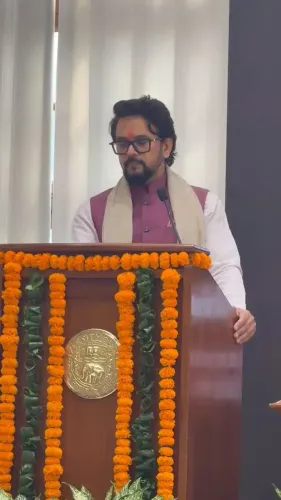
Posting on Sunday, 8 November 2026, Thakur wrote in Hindi: 'Yeh pehli Diwali hai jab desh, Naxalwad aur Maowaadi aatank ke khilaf dashakon purani ladai jeet chuka hai.' ('This is the first Diwali when the country has won its decades-old battle against Naxalism and Maoist terror.') The statement frames the festival of lights as a moment of genuine national reckoning — one lit not just by diyas, but by what he calls a decisive security triumph.
A 59-year insurgency and the long road to this claim
The Naxalite movement was born in 1967 in the Naxalbari village of West Bengal, a peasant uprising that grew into one of India's most persistent internal-security crises. By 2004, disparate armed groups merged into the Communist Party of India (Maoist) — the CPI(Maoist) — and extended their influence across a vast swath of central and eastern India, a corridor spanning parts of Chhattisgarh, Jharkhand, Odisha, Maharashtra and beyond.
The state's fightback has been long and costly. Operation Green Hunt, launched around 2009–10, deployed central paramilitary forces at scale into Naxal heartlands. Since 2014, the Ministry of Home Affairs has tracked a consistent, publicly reported decline in Naxal-related incidents, affected districts, and territorial control — driven by a twin strategy of intensified security operations and infrastructure investment in remote tribal districts.
What 'victory' looks like on the ground
Violence metrics have trended sharply downward over the past decade, with several states progressively removed from the official red-zone list. Roads, mobile towers, and welfare schemes reached villages that had been battlegrounds. Tribal communities, long caught between the state and armed cadres, have been the central — and often overlooked — stakeholders in every phase of this conflict.
Thakur's post does not detail a specific operation or government order; it is a political and symbolic declaration, timed to Diwali, that the BJP frames as a civilisational milestone. The claim of complete victory by November 2026 goes beyond what publicly available pre-2024 data confirmed — pockets of Maoist activity persisted in parts of Chhattisgarh and neighbouring states in those records. Official MHA updates and parliamentary statements in the coming weeks will be the place to watch for verification.
The politics of declaring a war over
Declaring an end to an insurgency is as much a political act as a security one. It signals to voters, to affected communities, and to the international community that the state has prevailed. For the BJP, closing the chapter on left-wing extremism would sit alongside border infrastructure and anti-terror operations as a pillar of the party's internal-security narrative. The timing — a festival synonymous with the victory of light over darkness — is deliberate and unmistakable.
India has carried this fight for nearly six decades. If the claim holds, the lights this Diwali mean something far larger than the season.
Point of View
Not an incidental detail. Whether or not every contested district is fully pacified, the political signal — that the state has won — is itself consequential, shaping public perception and potentially the terms of any future security or rehabilitation policy. The statement is also a pressure point: it sets a benchmark against which any future Maoist incident will be measured and contested.
NationPress
8 Nov 2026
Frequently Asked Questions
What did Anurag Thakur say about Naxalism on Diwali 2026?
Anurag Thakur posted on 8 November 2026 that this Diwali is the first since India won its decades-long battle against Naxalism and Maoist terror, calling it a historic national achievement.
When did the Naxalite movement start in India?
The Naxalite movement began in 1967 with an armed peasant uprising in Naxalbari, West Bengal , and evolved over decades into an organised Maoist insurgency spanning central and eastern India.
What is CPI(Maoist) and when was it formed?
CPI(Maoist) , or the Communist Party of India (Maoist), was formed in 2004 through the merger of major Naxal factions and became the primary organisation behind left-wing extremist violence in India.
What was Operation Green Hunt?
Operation Green Hunt was a major counter-insurgency offensive launched around 2009–10 by the Indian government, deploying central paramilitary forces in Naxal-affected states to dismantle Maoist networks.
Has India officially declared an end to Naxalism?
As of this post, the declaration is a political statement by BJP MP Anurag Thakur. The Ministry of Home Affairs has documented a long-term decline in Naxal violence and affected districts since 2014; an official government proclamation of complete victory would require MHA confirmation.