Anurag Thakur targets 'intellectual Naxals' at Delhi University
Synopsis
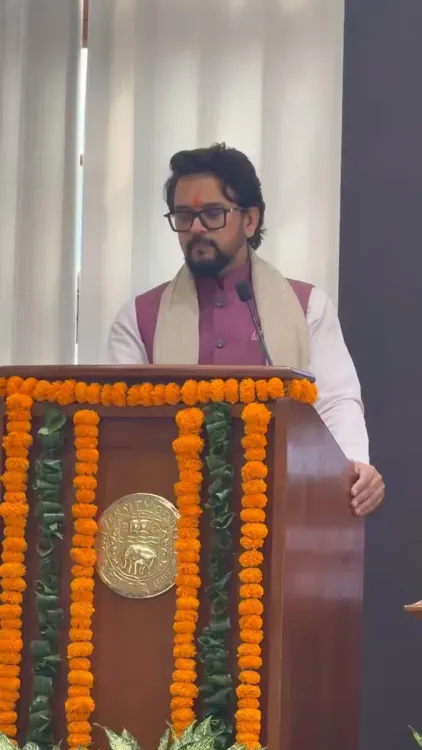
BJP MP Anurag Thakur, at Delhi University on 25 September 2026, declared the Modi government had finished Naxalism and called for a collective ideological fight against 'intellectual Naxals' in universities and institutions — extending a familiar BJP framing from forests to campuses.
Key Takeaways
Anurag Thakur addressed Delhi University on 25 September 2026 , calling for an ideological battle against 'dimagi Naxal' in educational institutions.
He credited the Modi government with eliminating Naxalism from India — a political assertion; security data through recent periods showed residual LWE activity in parts of Chhattisgarh and Jharkhand .
The term 'intellectual Naxal' extends the BJP's anti-insurgency narrative from rural conflict zones to university campuses.
Delhi University is a flashpoint for student-politics rivalry between ABVP and NSUI , giving the speech direct political resonance.
Similar rhetoric has historically preceded debates over faculty appointments and academic guidelines in central universities including JNU .
Whether the Ministry of Education or UGC acts on this framing with formal policy measures remains to be watched.
With Naxal insurgency waning in its traditional heartland, BJP MP Anurag Thakur has opened a new front — turning the ideological gun toward university campuses. Speaking at Delhi University on Friday, 25 September 2026, the former Union Minister declared that while the Modi government had finished Naxalism on the ground, the battle against what he called 'dimagi Naxal' — intellectual Naxals — sitting inside universities and institutions was just beginning.
Thakur's post in Hindi read: 'Modi sarkar ne Bharat se Naxalwad toh khatam kar diya, ab baari vishwavidyalayon va sansthaaon mein baithe dimaagi Naxal ki hai..jinse vaicharik ladaai hum sabhi ko milkar ladni hai.' — 'The Modi government has eliminated Naxalism from India; now it is the turn of the intellectual Naxals sitting in universities and institutions, against whom all of us must together fight an ideological battle.'
The claim: Naxalism 'eliminated' from India
The central government has, since 2014, pursued a twin-track strategy against Left Wing Extremism (LWE) — security operations paired with development schemes in affected districts. Officials have repeatedly cited a shrinking geographical footprint of Maoist violence, with the number of affected districts falling sharply over a decade. Thakur's assertion that Naxalism has been 'finished' amplifies that official narrative, framing it as a mission accomplished under Prime Minister Narendra Modi.
That claim, however, is a political characterisation. Security and intelligence assessments through the most recent available period indicated that residual Maoist activity persisted in parts of Chhattisgarh, Jharkhand and neighbouring forest belts, even as large-scale incidents declined significantly.
The new target: campuses and 'ideological battle'
The phrase 'intellectual Naxal' — or dimaagi Naxal — is not new in Indian political discourse, but its invocation at a central university carries pointed weight. Delhi University, like JNU before it, has long been a contested site in debates over academic freedom, campus protests, and faculty appointments at central institutions. Thakur's framing extends the anti-insurgency frame from forests to lecture halls, recasting ideological disagreement in universities as a form of insurgency requiring collective pushback.
BJP leaders have used similar language in parliamentary debates and public addresses over the past decade, arguing that certain strands of left-leaning scholarship provide intellectual cover for Maoist violence. Critics — including teachers' associations and student unions — have consistently contested that conflation, calling it a tool to delegitimise academic dissent.
Why Delhi University, why now
Thakur's choice of venue matters. Delhi University is one of India's largest central universities, enrolling hundreds of thousands of students and housing faculty bodies with significant influence over national academic policy. The National Students' Union of India (NSUI) and Akhil Bharatiya Vidyarthi Parishad (ABVP) perennially contest its student union elections, making it a live political battleground. A call for a collective 'ideological battle' at this address is as much a mobilisation signal to student and faculty wings as it is a policy statement.
Whether the Ministry of Education or the University Grants Commission (UGC) follows up with any formal guidelines on campus ideology — as Thakur's rhetoric implies — will be the real test of how far this framing translates into institutional action.
The forests may be quieter. The argument about who controls the classroom is just getting louder.
Point of View
Harder-to-quantify front — this time in the ideological space of higher education. By coupling a concrete (if contested) anti-Naxal security record with the diffuse charge of 'intellectual Naxalism,' the framing makes academic dissent difficult to defend publicly without appearing to side with an insurgency. The Delhi University setting signals a deliberate push into student-politics territory ahead of campus union elections and any upcoming UGC or education-ministry decisions. For opposition parties and faculty unions, the challenge is rebutting the rhetorical link between left-leaning scholarship and armed Maoism — a link the government has consistently leveraged to shape university governance.
NationPress
25 Sept 2026
Frequently Asked Questions
What did Anurag Thakur say about Naxalism at Delhi University?
Thakur said the Modi government had eliminated Naxalism from India and called for a collective ideological battle against 'intellectual Naxals' — his term for perceived left-leaning ideologues — sitting inside universities and institutions.
What is 'intellectual Naxal' or 'dimaagi Naxal'?
'Intellectual Naxal' or dimaagi Naxal is a term used, primarily by BJP leaders, to describe academics, activists, or public figures they accuse of providing ideological support to Maoist or left-extremist movements without direct participation in violence.
Has the Modi government actually eliminated Naxalism in India?
The government has reported a sharp decline in Left Wing Extremism-affected districts and violence since 2014, but characterising Naxalism as fully 'eliminated' is a political claim; security assessments through the most recent available period noted residual activity in parts of Chhattisgarh and Jharkhand.
Why did Anurag Thakur choose Delhi University for this statement?
Delhi University is one of India's largest central universities and a live political battleground between ABVP (BJP-linked) and NSUI (Congress-linked) student unions, making it a high-visibility venue for signalling an ideological push into higher education.
Could this lead to new education ministry or UGC guidelines on campus ideology?
No formal policy has been announced. Analysts and teachers' associations will watch for follow-up statements from the Ministry of Education or UGC, as past BJP rhetoric on campus ideology has occasionally preceded changes to academic appointments and institutional guidelines.