Anurag Thakur Joins JPC Study Visit on Viksit Bharat Education Bill in Goa
Synopsis
BJP MP Anurag Thakur joined the Joint Parliamentary Committee's study visit in Goa for the Viksit Bharat Shiksha Adhishthan Bill, consulting IIT Goa, Goa University, C-DAC, NABARD, defence shipyards and banks — drawing cross-sector linkages critical to India's higher education reform agenda under the Viksit Bharat 2047 vision.
Key Takeaways
BJP MP Anurag Thakur attended the JPC study visit on the Viksit Bharat Shiksha Adhishthan Bill in Goa on 30 September 2026 .
Academic and research institutions consulted included IIT Goa , Goa University , C-DAC , and IIG-DST , along with officials from the Ministry of Education , DSIR , and MeitY .
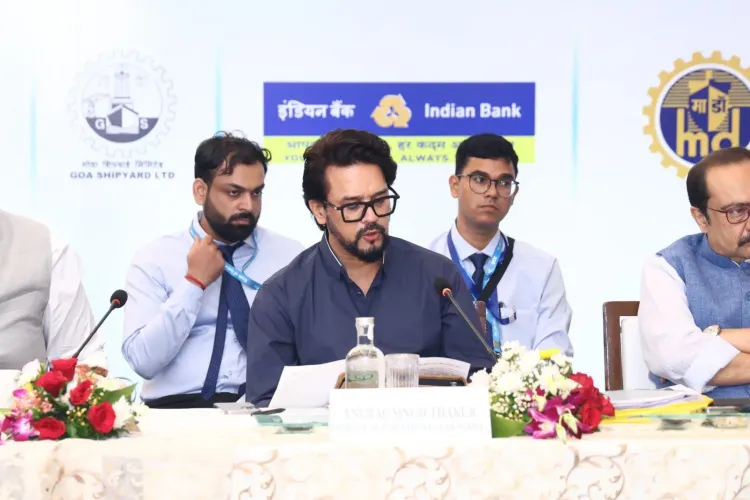
Finance and defence stakeholders — NABARD , Bank of India , UCO Bank , Mazagon Dock Shipbuilders , and Goa Shipyard Limited — also participated, highlighting cross-sector integration in the bill's design.
The bill aligns with the Viksit Bharat 2047 vision and builds on the framework established by the National Education Policy 2020 .
The JPC's report and any recommended amendments will determine the bill's shape when it returns to Parliament for debate.
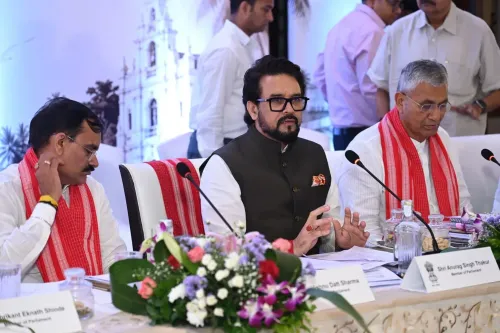
A parliamentary committee landed in Goa on Wednesday, 30 September 2026 for a multi-sector consultation that could shape the future of India's higher education architecture — and BJP MP Anurag Thakur, a member of the Joint Parliamentary Committee examining the Viksit Bharat Shiksha Adhishthan Bill, was at the centre of it.
From IIT Goa to Mazagon Dock: Who Was in the Room
The study visit brought together a strikingly diverse set of institutions. On the academic and research side, the committee held consultations with IIT Goa, Goa University, C-DAC (Centre for Development of Advanced Computing), and the Indian Institute of Geomagnetism (IIG-DST), alongside officials from the Ministry of Education, DSIR, and MeitY. The breadth signals that the bill is being conceived as far more than a conventional education reform.
Then came the less expected voices. NABARD, Bank of India, UCO Bank, Mazagon Dock Shipbuilders, and Goa Shipyard Limited also put their inputs on the table — drawing explicit linkages between higher education, rural finance, and strategic defence manufacturing. The message: a unified education system cannot be designed in an academic silo.
What the Viksit Bharat Shiksha Adhishthan Bill Is Trying to Do
The bill sits squarely within the Viksit Bharat 2047 framework — the central government's vision for India to achieve developed-nation status by the centenary of independence. Education has been identified as a core pillar of that ambition, and the legislation under examination is understood to pursue institutional consolidation and multidisciplinary integration, themes that trace directly to the National Education Policy 2020.
The NEP 2020 called for overhauling India's fragmented higher education landscape — reducing regulatory silos, encouraging research linkages with industry, and building institutions capable of competing globally. The Viksit Bharat Shiksha Adhishthan Bill appears to be a legislative vehicle for giving those goals institutional and statutory form, though its precise provisions remain under committee deliberation.
Why Parliamentary Study Visits Matter for a Bill Like This
Joint Parliamentary Committees don't draft legislation in Parliament's corridors alone. Study visits — where members travel to states, meet institutions on the ground, and hear from stakeholders who will actually live with the law — are a critical part of how complex bills get stress-tested before they return to the floor. For a bill touching higher education, finance, and defence in a single frame, the Goa consultation is exactly the kind of ground-truthing that can make or break a reform's real-world credibility.
Thakur, who as former Union Minister of Information and Broadcasting and Youth Affairs and Sports has navigated large institutional mandates before, described every stakeholder's input as 'a vital step toward a stronger, unified higher education system for a #ViksitBharat2047.' The committee's eventual report — and any amendments it recommends — will be closely watched when the bill returns to Parliament for debate.
Point of View
Active participation in the JPC signals a pivot toward legislative influence after his ministerial tenure, keeping him prominent in a policy domain — youth and education — where he built his public profile. The bill's eventual shape will be a litmus test for whether NEP 2020's multidisciplinary ambitions can be translated into durable statutory architecture.
NationPress
1 Oct 2026
Frequently Asked Questions
What is the Viksit Bharat Shiksha Adhishthan Bill?
The Viksit Bharat Shiksha Adhishthan Bill is proposed legislation being examined by a Joint Parliamentary Committee that aims to reform and consolidate India's higher education system in line with the Viksit Bharat 2047 vision and the principles of the National Education Policy 2020. Its precise provisions are still under committee deliberation.
What is the role of Anurag Thakur in the JPC on the education bill?
Anurag Thakur is a BJP Lok Sabha MP from Hamirpur, Himachal Pradesh and a member of the Joint Parliamentary Committee examining the Viksit Bharat Shiksha Adhishthan Bill. He participated in the committee's study visit to Goa on 30 September 2026.
Why were NABARD and defence shipyards consulted for an education bill?
The JPC is exploring linkages between higher education and sectors like rural finance and defence manufacturing, reflecting the bill's broader ambition to integrate India's education system with economic and strategic development goals under the Viksit Bharat 2047 framework.
What is the Viksit Bharat 2047 vision?
Viksit Bharat 2047 is the central government's long-term vision for India to achieve developed-nation status by 2047, the centenary of its independence, with education, technology, and economic growth identified as core pillars.
What happens after the JPC study visit on the education bill?
After completing consultations and study visits, the Joint Parliamentary Committee will compile its findings into a report with recommendations. The bill will then return to Parliament for debate, where the committee's suggested amendments could significantly shape the final legislation.