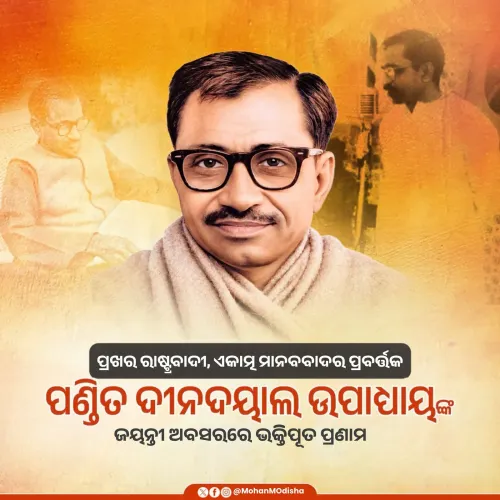
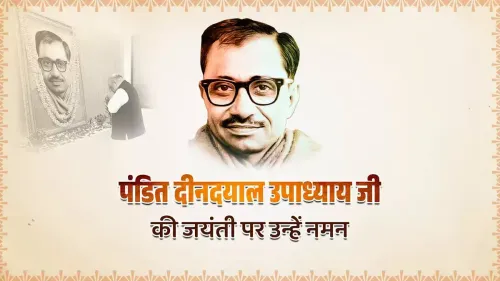
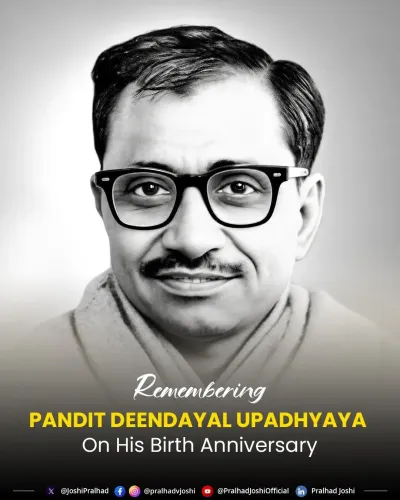
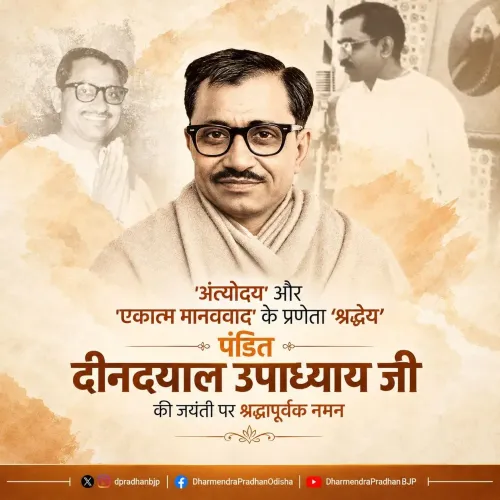
Anurag Thakur pays tribute to Deendayal Upadhyay on birth anniversary
Synopsis
BJP MP Anurag Thakur paid tribute to Pandit Deendayal Upadhyay on his 109th birth anniversary, hailing the Bharatiya Jana Sangh founder and Antyodaya pioneer as a lifelong servant of the nation whose philosophy endures in India's welfare policy today.
Key Takeaways
Anurag Thakur , BJP Lok Sabha MP from Hamirpur , posted a tribute to Pandit Deendayal Upadhyay on 25 September 2026 .
Upadhyay was born on 25 September 1916 — making this his 109th birth anniversary .
He founded the Bharatiya Jana Sangh in 1951 , the direct ideological predecessor of the BJP.
His concept of Antyodaya — welfare of the last person — remains embedded in schemes like the Deendayal Antyodaya Yojana .
Tributes on this date form part of the Sangh Parivar's annual ideological commemoration calendar.
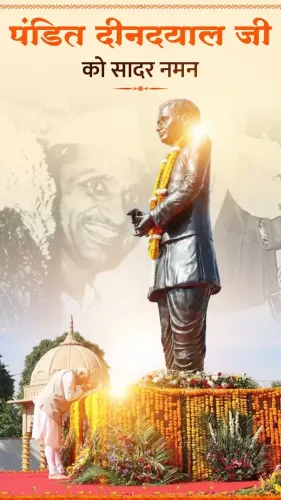
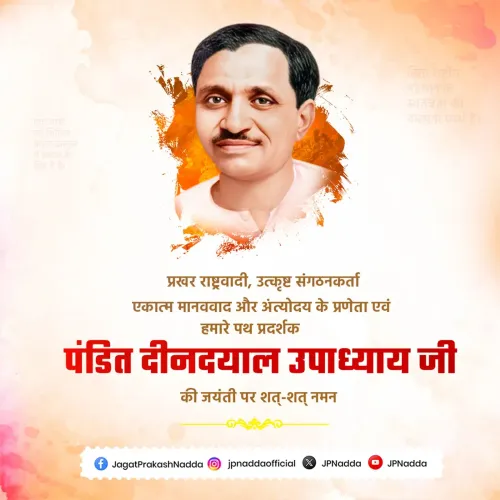
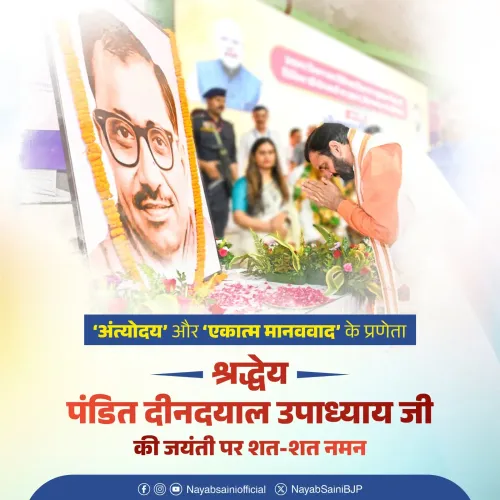
On the 109th birth anniversary of Pandit Deendayal Upadhyay, BJP MP Anurag Thakur offered a reverential tribute on Friday, 25 September 2026, honouring the ideological architect whose philosophy continues to animate the party he inspired.
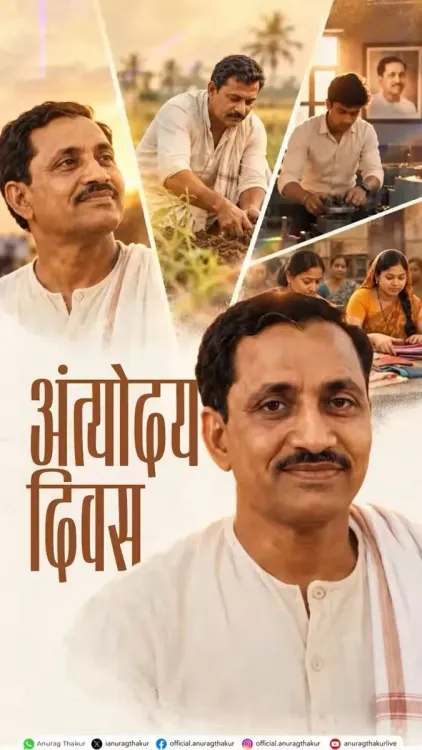
In Hindi, Thakur wrote — 'मां भारती की सेवा में जीवनपर्यंत समर्पित रहे अंत्योदय के प्रणेता' — saluting Upadhyay as 'the lifelong devotee of Mother India, pioneer of Antyodaya, founder of Bharatiya Jana Sangh, and nationalist thinker,' closing with a traditional gesture of bowed-hands respect.
The man who gave India 'Antyodaya'
Born on 25 September 1916, Pandit Deendayal Upadhyay became one of independent India's most consequential ideological voices. He founded the Bharatiya Jana Sangh in 1951, channelling cultural nationalism and economic self-reliance into an organised political force. His doctrine of Integral Humanism argued that development must be measured not by aggregate growth but by the welfare of the very last person in line — a principle he distilled into the single word Antyodaya, 'uplift of the last man.'
That word has outlived him by decades. The Deendayal Antyodaya Yojana, a flagship central scheme targeting urban and rural poverty, directly invokes his name and framework, embedding his thought into contemporary welfare architecture long after the Jana Sangh was dissolved and reconstituted as the BJP in 1980.
An annual ritual of ideological memory
Across the Sangh Parivar, 25 September is observed as a calendar moment of deliberate rededication. BJP workers, ministers, and MPs mark the day with tributes that serve a dual purpose: personal reverence and a public reaffirmation of the ideological lineage that runs from Upadhyay's Jana Sangh to today's ruling party. Thakur's post fits that pattern — warm in register, consistent in message.
For Thakur, the tribute carries particular resonance. As a former Union Minister of Information and Broadcasting, he has frequently invoked cultural-nationalist themes, and his constituency of Hamirpur, Himachal Pradesh places him within a state organisation that traces its roots directly to the Jana Sangh era. The homage is, in that sense, both personal and institutional.
Point of View
Serving as an annual occasion to draw a continuous line from the Jana Sangh's 1951 founding to the current government's welfare programmes. When senior figures like Anurag Thakur invoke Antyodaya publicly, they are reinforcing a political narrative that frames BJP governance as the fulfilment of a decades-old civilisational mission. The ceremony of commemoration also has an internal-party function: it signals fidelity to the Sangh Parivar's ideological core at a time when parties must constantly manage their grassroots identity. The longevity of Upadhyay's vocabulary in mainstream policy discourse — from scheme names to budget speeches — is a measure of how thoroughly that mission has been institutionalised.
NationPress
25 Sept 2026
Frequently Asked Questions
Who was Pandit Deendayal Upadhyay?
Pandit Deendayal Upadhyay was an Indian thinker and politician born on 25 September 1916 . He founded the Bharatiya Jana Sangh in 1951 and developed the philosophy of Integral Humanism , which emphasised welfare for the last person in society — a concept he called Antyodaya . The BJP regards him as its foremost ideological ancestor.
What is Antyodaya and why is it associated with Deendayal Upadhyay?
Antyodaya means 'rise of the last man' and is Upadhyay's central contribution to Indian political thought. He argued that true national development could only be measured by the condition of the poorest and most marginalised citizen. The term lives on in the Deendayal Antyodaya Yojana , a central government poverty-alleviation scheme.
What is Bharatiya Jana Sangh and how is it related to the BJP?
The Bharatiya Jana Sangh was a nationalist political party founded in 1951 by Upadhyay and associates to promote cultural nationalism and economic self-reliance. It was dissolved in 1977, and many of its members went on to form the BJP in 1980 , which considers itself the Jana Sangh's ideological successor.
Why did Anurag Thakur post a tribute to Deendayal Upadhyay?
Anurag Thakur , BJP MP from Hamirpur, Himachal Pradesh , posted the tribute on 25 September , Upadhyay's birth anniversary. Paying homage on this date is a well-established practice across the BJP and Sangh Parivar as a reaffirmation of ideological continuity.
What events are held on Deendayal Upadhyay's birth anniversary?
Across India, BJP and Sangh Parivar units hold state-level ceremonies, public meetings, and social-welfare drives on 25 September each year. Leaders at all levels post tributes, and the occasion is sometimes used to announce or highlight Antyodaya-linked welfare programmes.