CM Pema Khandu Hails Army's Free Yak AI Drive Near Tawang
Synopsis
The Indian Army, ICAR–NRC Yak and Arunachal Pradesh's animal husbandry department ran a free artificial insemination programme for yaks and cattle near Bumla, Taktsang and Chema in Tawang, targeting genetic improvement for the Brokpa pastoral community. CM Pema Khandu lauded the effort on 25 September 2026.
Key Takeaways
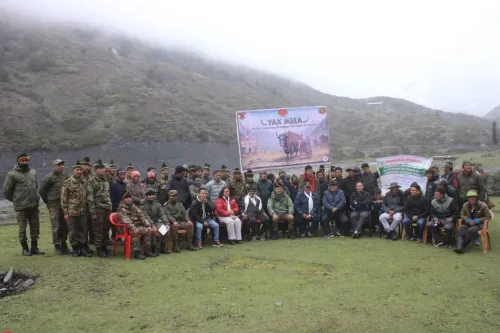
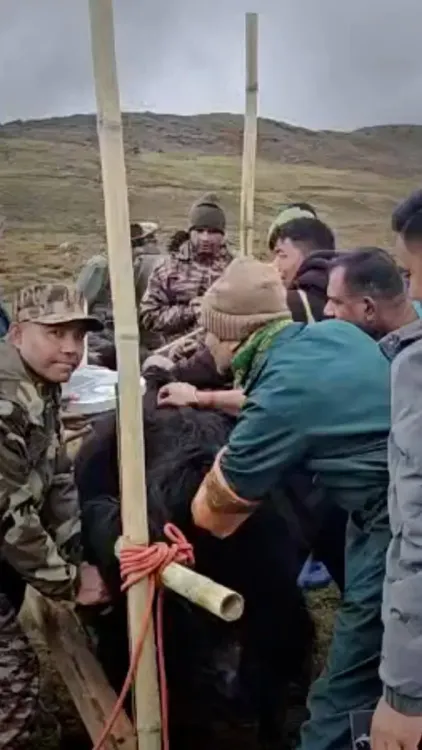
The Indian Army conducted a free artificial insemination programme for yaks and cattle in remote areas near Bumla, Taktsang and Chema in Tawang district .
The initiative was carried out in collaboration with ICAR–National Research Centre on Yak, Dirang , the state Department of Animal Husbandry , and the District Administration, Tawang .
The programme targets the Brokpa pastoral community, aiming to improve genetic quality, health and productivity while addressing inbreeding.
The service was provided free of cost to herders.
ICAR–NRC Yak at Dirang has been operational since 1989 , focused on high-altitude yak research in the eastern Himalayas.
Arunachal Pradesh CM Pema Khandu publicly commended the initiative on 25 September 2026 .
Deep in the high-altitude pastures near Bumla, Taktsang and Chema — some of the most remote terrain in Arunachal Pradesh — herders from the Brokpa pastoral community recently received a rare and consequential service: free artificial insemination for their yaks and cattle, delivered by the Indian Army in partnership with three specialist agencies. Arunachal Pradesh Chief Minister Pema Khandu called the initiative 'commendable' in a post on X on Friday, 25 September 2026.
What the programme does — and why it matters for Brokpa herders
The campaign was conducted in collaboration with the ICAR–National Research Centre on Yak, Dirang, the state's Department of Animal Husbandry, Veterinary and Dairy Development, and the District Administration, Tawang. Its stated goals are to improve the genetic quality, health and productivity of livestock while tackling inbreeding — a persistent challenge in geographically isolated high-altitude communities where herd diversity is limited.
For Brokpa herders, whose livelihoods depend almost entirely on their animals, inbreeding quietly erodes both milk yields and herd resilience over generations. A targeted artificial insemination drive, delivered free of cost, directly attacks that problem at source.
ICAR Dirang's role and a three-decade research mandate
The ICAR–National Research Centre on Yak has been stationed at Dirang since 1989, specifically to address the breeding, health and productivity needs of yak-rearing communities across the eastern Himalayas. Its involvement gives the programme scientific credibility — field application of decades of high-altitude animal husbandry research. The Army's civic action muscle, meanwhile, ensures that camps can actually reach villages near the Line of Actual Control that most government vehicles cannot.
Civil-military engagement at a strategically sensitive frontier
Tawang borders China and sits at the heart of long-running territorial sensitivities. The Indian Army has periodically partnered with central research institutes and state departments for livestock improvement across Arunachal Pradesh's border areas — programmes that simultaneously address genuine livelihood gaps and deepen trust between security forces and frontier communities.
The choice of locations underscores that dual purpose. Bumla, in particular, is a high-altitude pass well-known as a venue for India-China border personnel meetings. Running a pastoral welfare camp in its shadow is a pointed signal that development, not just defence, defines the state's presence on the frontier.
Whether conception rates climb and calf health improves across participating herds will be the true measure of this initiative — and advocates are already watching for evidence that the model can scale to other yak-rearing districts across Arunachal Pradesh.
Point of View
The initiative avoids the ad-hoc quality of one-off civic action events and instead plugs into a research mandate that dates back to 1989. CM Khandu's public endorsement signals that Itanagar views such tri-agency collaborations — army, central institute, state department — as a replicable model for border-area welfare. The real test will come when herd data from Tawang's Brokpa pastures either validates or challenges that optimism.
NationPress
26 Sept 2026
Frequently Asked Questions
What is the Indian Army's artificial insemination programme for yaks in Tawang?
The Indian Army, in partnership with ICAR–National Research Centre on Yak at Dirang, the state Department of Animal Husbandry, and the District Administration of Tawang, conducted a free artificial insemination programme for yaks and cattle in remote areas near Bumla, Taktsang and Chema to help Brokpa herders improve livestock genetic quality and productivity.
Who are the Brokpa people of Tawang?
The Brokpa are a pastoral community living in the high-altitude areas of Tawang district in Arunachal Pradesh. Their livelihoods are closely tied to yak and cattle herding, making livestock health and productivity a critical economic concern for them.
What is ICAR–National Research Centre on Yak at Dirang?
Established in 1989 at Dirang in Arunachal Pradesh, the ICAR–National Research Centre on Yak conducts research on yak breeding, health and productivity to support yak-rearing communities across the eastern Himalayas.
Why is the Tawang livestock programme strategically significant?
Tawang borders China and is home to sensitive frontier terrain. Running welfare and livelihood programmes in areas near Bumla — a pass used for India-China border personnel meetings — reinforces civil-military engagement and demonstrates a development-focused state presence on the frontier.
What problem does artificial insemination solve for yak herders in Arunachal Pradesh?
In geographically isolated high-altitude communities, limited herd diversity leads to inbreeding, which gradually reduces milk yields, calf health and overall herd resilience. Artificial insemination introduces improved genetics without the need to physically transport bulls to remote areas.