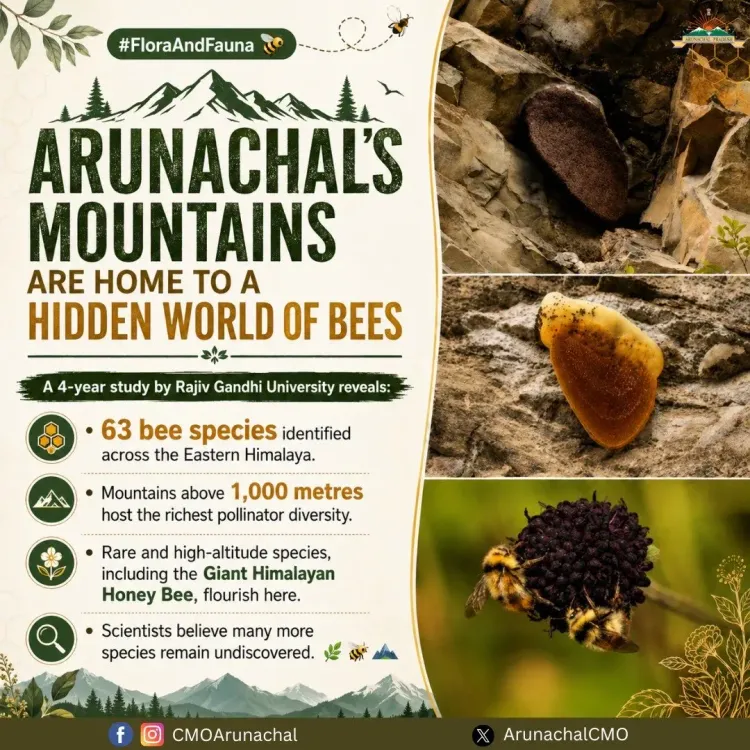
Arunachal CMO highlights 63 bee species found in Eastern Himalaya
Synopsis
The Chief Minister's Office of Arunachal Pradesh has highlighted a Rajiv Gandhi University study documenting 63 bee species across the Eastern Himalaya, drawing attention to the region's critical role in pollinator conservation and ecological sustainability under India's biodiversity frameworks.
Key Takeaways
The Chief Minister's Office of Arunachal Pradesh shared the findings on 24 June 2026 .
A study led by Rajiv Gandhi University , a central university in Itanagar , documented 63 bee species across the Eastern Himalaya .
The Eastern Himalaya is a globally recognised biodiversity hotspot and home to a wide range of endemic species.
India has been committed to pollinator and ecosystem conservation since ratifying the Convention on Biological Diversity in 1992 .
The National Mission for Sustaining the Himalayan Ecosystem (launched 2010 ) provides a policy framework for such biodiversity research in Arunachal Pradesh .
Indigenous communities and ecological researchers are among the key stakeholders who stand to benefit from this documentation.
The Chief Minister's Office of Arunachal Pradesh on Wednesday, 24 June 2026 shared findings from a study led by Rajiv Gandhi University that documented 63 bee species across the Eastern Himalaya, underscoring the region's significance as a hub for pollinator diversity and ecological sustainability.
Context
The official CMO post stated that Arunachal Pradesh's forests and mountains 'continue to showcase extraordinary biodiversity,' anchoring the announcement in the state's long-recognised identity as one of India's most ecologically rich territories. The study, attributed to Rajiv Gandhi University — a central university based in Itanagar — focused specifically on bee species distribution across the Eastern Himalayan landscape.
Bees are among the most critical pollinators globally, directly supporting agricultural productivity, forest regeneration, and ecosystem balance. Documenting their diversity in a region as biologically complex as the Eastern Himalaya carries significance well beyond academic interest.
Policy Backdrop
India ratified the Convention on Biological Diversity in 1992, committing the country to the conservation of ecosystems and the protection of pollinators as part of its international obligations. The National Mission for Sustaining the Himalayan Ecosystem, launched in 2010 under the National Action Plan on Climate Change, specifically targets biodiversity research and climate resilience in Himalayan states, including Arunachal Pradesh.
These frameworks have created institutional pathways for universities and state governments to document and publicise biodiversity findings. Research outputs from institutions like Rajiv Gandhi University feed directly into the evidence base that informs conservation policy at both state and national levels.
Stakeholders and Impact
The primary beneficiaries of pollinator research are ecological researchers, conservation planners, and the indigenous communities of Arunachal Pradesh whose livelihoods and food systems are intertwined with forest health. The Eastern Himalaya is a recognised global biodiversity hotspot, and bee diversity data can guide habitat protection decisions under existing biodiversity missions.
Beyond conservation, pollinator health has direct implications for agricultural output in the region. Arunachal Pradesh's diverse agro-ecological zones — ranging from subtropical valleys to alpine meadows — provide varied habitats that may support distinct pollinator communities, making species-level documentation especially valuable.
What's Next
Attention will now turn to whether Rajiv Gandhi University releases peer-reviewed publications detailing the methodology and full species inventory from this study. Equally important is whether the Arunachal Pradesh government translates this research into concrete proposals for pollinator habitat protection under existing biodiversity and Himalayan ecosystem missions.
The broader pattern of northeastern state governments publicising academic biodiversity findings suggests this announcement may be a precursor to policy conversations around protected area management or community-based conservation initiatives in the Eastern Himalaya.
Point of View
The state positions itself as a steward of nationally and internationally significant ecosystems. This move also quietly builds a case for greater central allocation under Himalayan ecosystem missions. The real test will be whether such announcements translate into enforceable habitat protections or remain in the realm of soft environmental diplomacy.
NationPress
23 Sept 2026
Frequently Asked Questions
How many bee species were found in the Eastern Himalaya study?
The study led by Rajiv Gandhi University documented 63 bee species across the Eastern Himalaya, as highlighted by the Arunachal Pradesh Chief Minister's Office on 24 June 2026.
What is Rajiv Gandhi University known for?
Rajiv Gandhi University is a central university located in Itanagar, Arunachal Pradesh , and is known for conducting research on regional ecology, biodiversity, and the natural resources of the Eastern Himalayan region.
Why is the Eastern Himalaya important for biodiversity?
The Eastern Himalaya is recognised as a global biodiversity hotspot, spanning northeast India and neighbouring countries. It is home to a large number of endemic plant and animal species, including diverse pollinator communities, making it a priority area for conservation.
What is India's policy on Himalayan ecosystem conservation?
India launched the National Mission for Sustaining the Himalayan Ecosystem in 2010 as part of its National Action Plan on Climate Change. The mission supports biodiversity research and climate resilience specifically in Himalayan states including Arunachal Pradesh .
Why does pollinator conservation matter for Arunachal Pradesh?
Pollinators like bees are essential for forest regeneration and agricultural productivity. In Arunachal Pradesh , where indigenous communities depend heavily on forest ecosystems, protecting pollinator habitats directly supports both ecological balance and local livelihoods.