Arunachal CMO Pledges Youth Skill Push on World Skills Day
Synopsis
On World Youth Skills Day, 15 July 2026, the Chief Minister's Office of Arunachal Pradesh reaffirmed its commitment to empowering youth with skills and opportunities, echoing India's Atmanirbhar Bharat and Skill India frameworks for the state's diverse tribal population.
Key Takeaways
The Chief Minister's Office of Arunachal Pradesh marked World Youth Skills Day on 15 July 2026 with a formal pledge to empower state youth.
World Youth Skills Day has been observed annually on 15 July since a UN General Assembly proclamation in 2014 .
The statement echoes India's Atmanirbhar Bharat self-reliance framework launched in 2020 , connecting state-level skill efforts to national policy.
The Skill India Mission (launched 2015 ) and the National Skill Development Corporation are the primary central instruments for skill delivery in Arunachal Pradesh .
Key stakeholders include the state's tribal youth population and central ministries overseeing vocational education in the Northeast.
Upcoming state budget allocations or MoUs with central ministries will be the concrete test of this commitment.
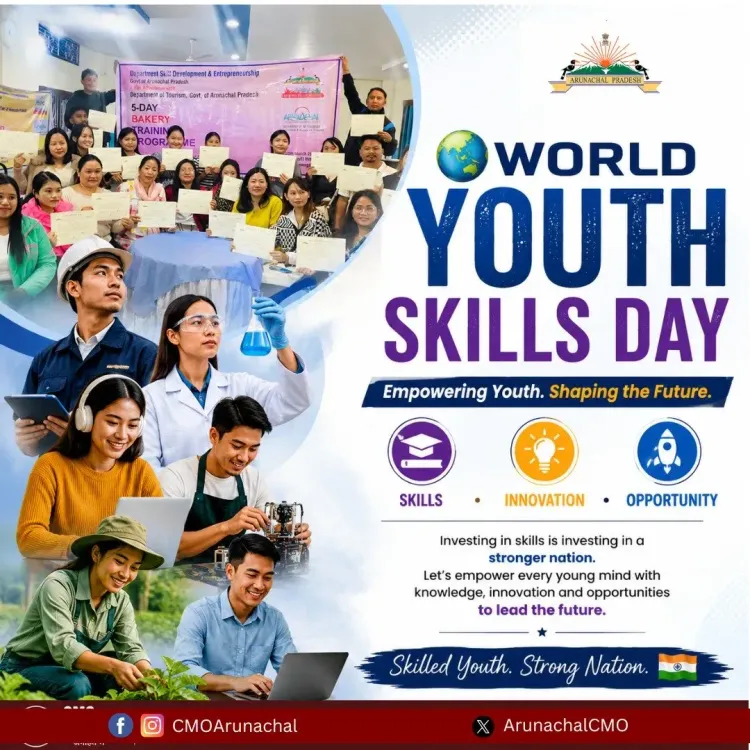
The Chief Minister's Office of Arunachal Pradesh on Wednesday, 15 July 2026 marked World Youth Skills Day by reaffirming the state government's commitment to equipping young people with skills, knowledge and opportunities for a self-reliant future.
The official post read: 'On World Youth Skills Day, let us reaffirm our commitment to empowering every young person with the skills, knowledge and opportunities needed to build a brighter, more innovative and self-reliant Arunachal Pradesh.'
Context
World Youth Skills Day is observed every year on 15 July, following a United Nations General Assembly proclamation in 2014. The day is dedicated to raising awareness about the importance of skills training for youth employment, entrepreneurship and sustainable development globally.
For Arunachal Pradesh — India's northeasternmost state bordering China, Myanmar and Bhutan — the observance carries particular weight given its diverse tribal youth population and the state's ongoing integration into national skill-development frameworks.
Policy Backdrop
The Chief Minister's Office invocation of a 'self-reliant Arunachal Pradesh' aligns closely with the Atmanirbhar Bharat framework launched by the Government of India in 2020, which explicitly links vocational training and local innovation to economic independence at both the state and national level.
The Skill India Mission, launched in 2015, has served as the primary vehicle for expanding vocational education across the country, including the Northeast, through the National Skill Development Corporation and sector skill councils. Since the mid-2010s, India has steadily widened this infrastructure in remote northeastern states to address youth unemployment and connect these regions to national growth targets.
Stakeholders and Impact
The primary beneficiaries of any strengthened skill agenda in Arunachal Pradesh are the state's young population, particularly those from tribal communities in districts with limited access to formal higher education or urban employment markets.
The state's education sector and central ministries responsible for skill development are the institutional stakeholders most directly engaged with translating such commitments into programme delivery. Skill centres, apprenticeship linkages and industry partnerships are the typical instruments through which such pledges are operationalised.
What's Next
Observers will watch for concrete follow-through in the form of state budget allocations, new skill centre announcements or memoranda of understanding between the Arunachal Pradesh government and central ministries. The alignment of state-level rhetoric with Atmanirbhar Bharat objectives suggests that forthcoming programme announcements, if any, are likely to be framed within that national policy architecture.
As India's northeastern frontier continues to attract policy attention, the emphasis on youth skills in Arunachal Pradesh signals a broader intent to ensure that geographic remoteness does not translate into economic marginalisation for the state's next generation.
Point of View
But its framing around 'self-reliance' and 'innovation' is deliberate — it anchors state ambition within the Centre's Atmanirbhar Bharat narrative, signalling alignment rather than divergence from Delhi's policy priorities. For a frontier state heavily dependent on central transfers, such rhetorical alignment often precedes or accompanies requests for enhanced central funding for skill infrastructure. The Northeast has historically lagged in translating skill-mission allocations into on-ground outcomes, making this a space where intent and execution remain meaningfully apart. Whether the pledge translates into measurable programme announcements before the next budget cycle will determine its political and policy weight.
NationPress
15 Jul 2026
Frequently Asked Questions
What is World Youth Skills Day and when is it observed?
World Youth Skills Day is an annual United Nations observance held on 15 July each year, proclaimed by the UN General Assembly in 2014 to highlight the importance of equipping youth with skills for employment and entrepreneurship.
What did the Arunachal Pradesh government say on World Youth Skills Day 2026?
The Chief Minister's Office of Arunachal Pradesh reaffirmed its commitment to empowering every young person in the state with skills, knowledge and opportunities to build a 'brighter, more innovative and self-reliant Arunachal Pradesh.'
What is the Skill India Mission and does it cover Arunachal Pradesh?
The Skill India Mission , launched in 2015 , aims to train millions of Indians through the National Skill Development Corporation and sector skill councils, and it does cover northeastern states including Arunachal Pradesh .
How does Atmanirbhar Bharat relate to skill development in the Northeast?
Atmanirbhar Bharat , launched in 2020 , links vocational training and local innovation to economic self-reliance, providing the national policy framework within which state-level skill commitments in the Northeast are increasingly positioned.
What should we watch for after Arunachal Pradesh's youth skills pledge?
Concrete follow-through will likely appear as state budget allocations, new skill centre openings or MoUs between the Arunachal Pradesh government and central ministries responsible for skill and vocational education.