What Led to the Downfall of Arya Rajendran, the Youngest Mayor?

Synopsis
The rise and fall of Arya Rajendran, once heralded as a beacon of change in Thiruvananthapuram, reflects the shifting dynamics of Kerala's politics. As the youngest mayor, her journey turned sour amid controversies and internal party dissent, revealing deeper issues within the CPI(M). What does this mean for the future of Kerala's Left leadership?
Key Takeaways
Arya Rajendran's rise to power was marked by significant public support.
Her downfall illustrates the importance of maintaining grassroots connections .
Internal dissent within the CPI(M) has surfaced, questioning leadership strategies.
Public controversies and missteps can severely affect political standing.
The BJP's victory indicates a potential shift in Kerala's political landscape.
Thiruvananthapuram, December 13 (NationPress) – Five years prior, Arya Rajendran was hailed as a beacon of generational change. At the tender age of 21, she became the youngest mayor in India, embodying the CPI(M)’s assertion that a fresh, responsive Left leadership had emerged in Kerala's capital.
However, by 2025, as the Left Democratic Front faced the loss of the Thiruvananthapuram Corporation for the first time in nearly fifty years, this narrative has drastically crumbled.
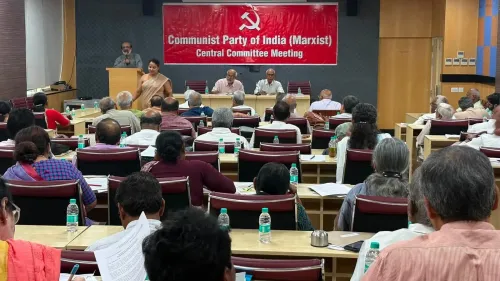
In an unusual and revealing instance of public dissent, Rajendran’s leadership has faced sharp criticism from within her own party.
Gayathri Babu, a young CPI-M leader and outgoing councilor, launched a fierce critique on Facebook following the defeat, accusing the party leadership of arrogance, disconnection from grassroots realities, and a significant decline in the Left’s traditional public rapport in the capital.
This intervention carries noteworthy political implications.
Although Gayathri Babu opted not to contest this election, her father—who ran from her ward—successfully won his seat and was widely regarded as a potential mayoral candidate had the CPI-M maintained control of the Corporation.
The fact that a leader closely linked to the internal power dynamics of the party chose to openly challenge the outgoing mayor has intensified the atmosphere of introspection within the Left.
While not directly naming Arya Rajendran, Gayathri’s remarks highlighted shortcomings in accessibility, teamwork, and responsiveness to local citizens and leaders.
Many within the party concede that public discontent had been mounting, particularly following a series of controversies that tarnished the mayor's image.
Prominent among these was a widely criticized incident where Rajendran and her husband, MLA Sachin Dev, were accused of obstructing a state-run KSRTC bus—an episode that came to symbolize political naivety and misuse of authority in the public eye.
Allegations of administrative overreach and a lack of visible civic accomplishments further eroded her standing.
Notably, Rajendran refrained from active campaigning during the elections, a move interpreted as an attempt by the party to mitigate voter backlash.
This strategy proved ineffective.
The BJP’s significant victory in the capital marked the Left’s most considerable civic setback in decades.
For the CPI(M), the decline of its youngest mayor has transformed into more than a mere personal narrative.
It serves as a cautionary tale illustrating how power, when divorced from humility and public engagement, can morph a once-celebrated symbol of change into an emblem of political decline—especially during a period of profound transformation in Kerala’s urban politics.
Point of View
It is clear that Arya Rajendran's tenure has sparked significant introspection within the CPI(M). As the party grapples with the loss of a stronghold, it reflects a broader narrative of political challenges facing the Left in Kerala. The need for reconnecting with the grassroots and addressing public grievances has never been more critical.
NationPress
8 Oct 2026
Frequently Asked Questions
What sparked Arya Rajendran's downfall as mayor?
Arya Rajendran's downfall was sparked by public dissent within her party, a series of controversies, and dwindling public support.
What criticisms did Gayathri Babu raise against Rajendran?
Gayathri Babu criticized Rajendran for arrogance, a lack of grassroots connection, and a decline in the Left's public rapport.
How did the BJP's victory affect the CPI(M)?
The BJP's victory marked a significant setback for the CPI(M), indicating a shift in the political landscape of Thiruvananthapuram.
What lessons can be learned from Rajendran's tenure?
Rajendran's experience highlights the importance of humility and public engagement in political leadership.
What does this mean for Kerala's political future?
The events surrounding Rajendran's leadership suggest a critical need for the Left to reconnect with the public and address emerging challenges.