Assam CM Himanta allocates Guardian Districts to cabinet ministers
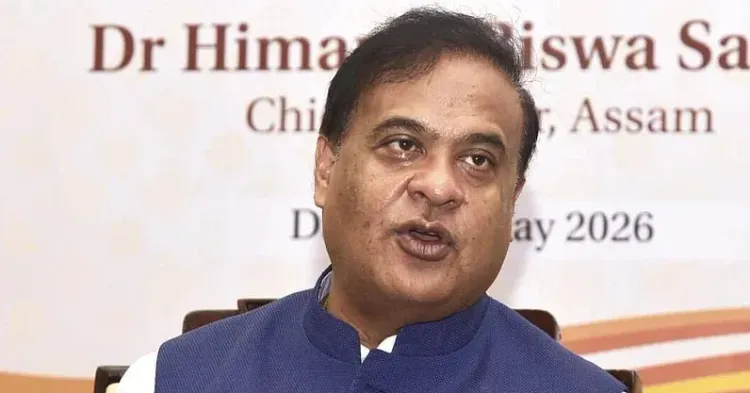
Synopsis
The Chief Minister's Office of Assam announced on June 8, 2026, that Guardian Districts have been allocated to state cabinet ministers under Chief Minister Himanta Biswa Sarma, renewing a district-level oversight mechanism introduced in 2021 to strengthen grassroots delivery of government schemes.
Key Takeaways
The Chief Minister's Office of Assam announced on June 8, 2026 , that Guardian Districts have been allocated to all cabinet ministers.
The Guardian Districts scheme assigns each minister direct supervisory responsibility over one or more of Assam's 35 districts .
The framework was first introduced in Assam in 2021 following the BJP-led government's assumption of office under CM Himanta Biswa Sarma .
Ministers are expected to conduct field visits, monitor welfare schemes, and act as a liaison between district administrations and the state cabinet.
Similar guardian or nodal minister systems have been adopted across several Indian states to improve accountability for infrastructure, health, and education outcomes.
The specific minister-district pairings are expected to be released formally; periodic review meetings will serve as the key test of implementation.
The Chief Minister's Office of Assam announced on Monday, June 8, 2026, that Guardian Districts have been formally allocated to the ministers of the Government of Assam, deepening the state's district-level oversight framework under Chief Minister Himanta Biswa Sarma.
Context
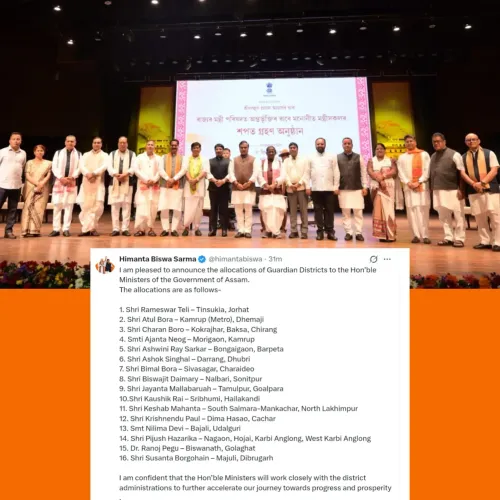
The official post from the Chief Minister's Office of Assam stated: 'Guardian Districts have been allocated to the Hon'ble Ministers of the Government of Assam.' The announcement signals a fresh or revised round of ministerial assignments under the Guardian Districts scheme, which tasks each cabinet minister with direct supervisory responsibility over one or more districts.
Under this system, ministers are expected to visit their assigned districts, monitor the implementation of welfare programmes, and serve as a bridge between the district administration and the state cabinet. The mechanism is designed to move accountability from Dispur down to the grassroots level.
Policy Backdrop
The Guardian Districts concept was introduced in Assam shortly after the BJP-led government assumed office in May 2021. Chief Minister Himanta Biswa Sarma positioned it as a key administrative reform to tighten the delivery of centrally sponsored and state-funded schemes across Assam's 35 districts.
The practice is not unique to Assam. Several Indian states have adopted comparable guardian or nodal minister arrangements to strengthen oversight of infrastructure, health, and education outcomes at the district level. In Assam, the scheme forms part of a wider push to make ministers directly answerable for on-ground results rather than confining their role to secretariat-level decision-making.
Periodic performance reviews of assigned districts have been a stated feature of the programme, with allocations subject to revision following cabinet reshuffles or when administrative priorities shift.
Stakeholders and Impact
District administrations across Assam are the primary operational stakeholders, as the guardian minister becomes the political point-of-contact for flagging bottlenecks in scheme implementation. Local communities in areas covered by flagship programmes — ranging from rural housing and drinking water to road connectivity — stand to benefit if ministerial oversight translates into faster resolution of field-level problems.
For the Assam Cabinet, the allocation also functions as a signal of political trust, with ministers assigned to strategically important or electorally sensitive districts often seen as carrying additional responsibility within the ruling dispensation.
What's Next
Attention will now turn to the specific list of minister-district pairings, which the government is expected to release formally. Observers will watch whether the allocation reflects any rebalancing of political weight within the cabinet, particularly given changes in ministerial composition since the scheme was last revised.
Periodic district review meetings chaired by the respective guardian ministers will be the practical test of the framework's effectiveness. Any adjustments to allocations are likely to surface in subsequent cabinet meetings, making future official communications from the Chief Minister's Office a key indicator of how the scheme evolves through the remainder of the government's term.
Point of View
The government creates a clear chain of political responsibility that can be invoked during both performance reviews and electoral cycles. The move fits a broader national pattern of state governments using guardian or nodal minister frameworks to demonstrate proactive governance, particularly in states where the ruling party faces scrutiny over scheme delivery. Whether the mechanism produces measurable improvements depends on how rigorously the review process is enforced in the months ahead.
NationPress
23 Oct 2026
Frequently Asked Questions
What is the Guardian Districts scheme in Assam?
The Guardian Districts scheme assigns each cabinet minister of the Government of Assam supervisory responsibility over one or more districts, requiring them to monitor welfare scheme implementation and coordinate with district administrations.
When was the Guardian Districts scheme introduced in Assam?
The scheme was introduced in Assam in 2021 shortly after the BJP-led government under Chief Minister Himanta Biswa Sarma assumed office in May of that year.
Which ministers have been allocated Guardian Districts in Assam in 2026?
The Chief Minister's Office of Assam announced the allocation on June 8, 2026, but the specific list of minister-district pairings is expected to be released formally by the government.
What is the purpose of allocating Guardian Districts to ministers?
The purpose is to improve ministerial accountability at the grassroots level, ensuring faster delivery of government schemes in areas such as infrastructure, health, and education across Assam's districts.
Do other Indian states have a similar guardian minister system?
Yes, several Indian states have adopted comparable guardian or nodal minister arrangements for districts to strengthen oversight of centrally sponsored and state-funded programmes.