Assam Cabinet Eases Land Conversion Norms, Approves ATCL VRS

Synopsis
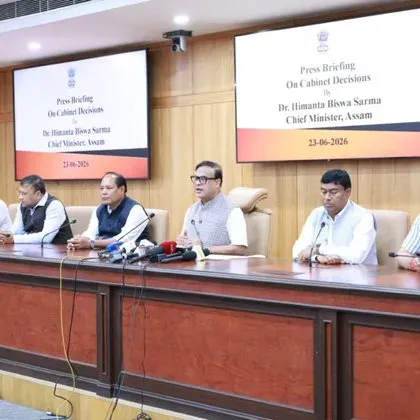
The Assam Cabinet on 25 June 2026 approved amendments to simplify land conversion norms to boost investment and enterprise, and cleared a Voluntary Retirement Scheme for Assam Tea Corporation Limited executives, under Chief Minister Dr. Himanta Biswa Sarma's leadership.
Key Takeaways
The Assam Cabinet approved amendments to simplify land conversion norms on 25 June 2026 .
The move is aimed at reducing procedural barriers for investors and entrepreneurs setting up businesses in Assam .
A Voluntary Retirement Scheme (VRS) was approved for executives of Assam Tea Corporation Limited (ATCL) , a state public-sector undertaking.
The decisions align with Assam's Industrial and Investment Policy first notified in 2020 and the state's push to improve ease-of-doing-business rankings.
Exact amendment notifications are expected to be published in the Assam Gazette ; ATCL VRS timelines and payout details are yet to be formally announced.
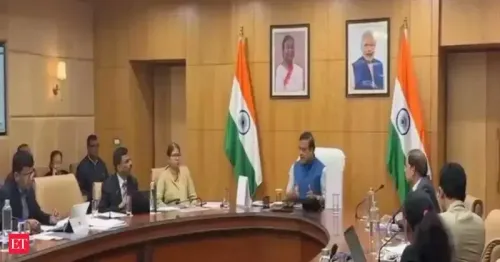
The Chief Minister's Office of Assam announced on Thursday, 25 June 2026 that the Assam Cabinet, under the leadership of Chief Minister Dr. Himanta Biswa Sarma, has approved amendments to simplify land conversion norms and cleared a Voluntary Retirement Scheme (VRS) for executives of the Assam Tea Corporation Limited (ATCL).
Context
The Cabinet's official communication stated that the land conversion amendments are aimed at 'boosting enterprise and investment across Assam.' Land conversion norms govern the process by which agricultural or other-category land is reclassified for commercial or industrial use — a step that entrepreneurs and investors frequently cite as a procedural bottleneck in setting up businesses in the state.
Alongside the land reform decision, the Cabinet cleared a VRS for ATCL executives. Assam Tea Corporation Limited is a state-owned public-sector undertaking engaged in tea production and estate management, and the VRS represents a structural move to rationalise its workforce.
Policy Backdrop
The land-norm amendment fits within a broader deregulation push that Assam has pursued since at least 2020, when the state notified an Industrial and Investment Policy designed to ease regulatory requirements for new enterprises. The state government has consistently positioned incremental land-use liberalisation as a lever to improve its ranking on national ease-of-doing-business indices and draw private capital into the Northeast region.
Dr. Himanta Biswa Sarma, who has led the BJP government in Assam since May 2021, has made regulatory reform and investment attraction central planks of his administration's economic agenda. Simplifying land conversion is widely regarded as one of the more consequential procedural changes a state government can make to reduce friction for industrial projects.
The ATCL VRS follows a pattern seen across several Indian states since the early 2000s, where loss-making or underperforming public-sector units have used voluntary retirement schemes as an administrative tool to reduce wage burdens and restructure operations without resorting to forced retrenchment.
Stakeholders and Impact
The primary beneficiaries of the land conversion amendments are expected to be investors, entrepreneurs, and industrial developers seeking to set up or expand operations in Assam. Easier reclassification of land reduces the time and compliance cost involved in project initiation, which has historically deterred smaller enterprises in particular.
For ATCL executives, the approved VRS opens a voluntary exit pathway, likely with defined financial benefits. The broader implication for the corporation depends on how many executives opt in and what restructuring follows — details that will emerge once formal notifications are issued.
The decisions collectively signal the state government's intent to simultaneously attract fresh private investment and rationalise its existing public-sector footprint.
What's Next
The exact text of the land conversion amendments is expected to be published in the Assam Gazette following Cabinet approval, which will clarify the specific categories of land affected, the simplified procedure, and any conditions attached. Observers will watch whether the amendments meaningfully reduce turnaround time for conversion applications.
On the ATCL front, the timeline for VRS applications, eligibility criteria, and payout structure are yet to be formally notified. How the corporation is repositioned after the scheme concludes will be a key indicator of the government's longer-term strategy for the state's tea-sector public enterprises.
Point of View
Easing land conversion norms is politically low-risk but economically high-signal, directly addressing a complaint that has kept Northeast India underweight in national investment surveys. The ATCL VRS, meanwhile, follows a well-worn playbook of managing legacy PSU obligations through voluntary exits rather than confrontational restructuring. Together, the moves reinforce Assam's positioning as the most reform-active state in the Northeast, though the real test lies in implementation speed and uptake.
NationPress
25 Jun 2026
Frequently Asked Questions
What did the Assam Cabinet decide about land conversion norms?
The Assam Cabinet approved amendments to simplify land conversion norms, reducing the procedural complexity involved in reclassifying land for commercial or industrial use, with the stated aim of boosting enterprise and investment across Assam.
What is the ATCL VRS approved by the Assam Cabinet?
The Assam Cabinet approved a Voluntary Retirement Scheme (VRS) for executives of Assam Tea Corporation Limited (ATCL), a state-owned public-sector undertaking involved in tea production, allowing eligible executives to voluntarily exit with defined benefits.
Who is Himanta Biswa Sarma and what is his role in these decisions?
Dr. Himanta Biswa Sarma is the Chief Minister of Assam, leading a BJP government since May 2021. The Cabinet decisions were taken under his leadership as part of the state's broader regulatory reform and investment-attraction agenda.
How do the Assam land conversion amendments help investors?
Simplified land conversion norms reduce the time and compliance burden for entrepreneurs and industrial developers who need to reclassify land before setting up projects, making it easier and faster to initiate investment in Assam.
What is Assam Tea Corporation Limited (ATCL)?
Assam Tea Corporation Limited (ATCL) is a state government public-sector undertaking engaged in tea production and estate management in Assam. The Cabinet-approved VRS targets its executives as part of workforce rationalisation efforts.