Assam CM Himanta Orders Destruction of ₹472 Cr Drugs

Synopsis
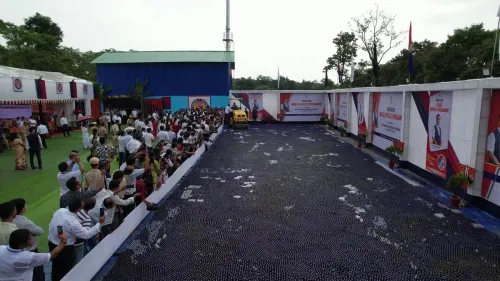
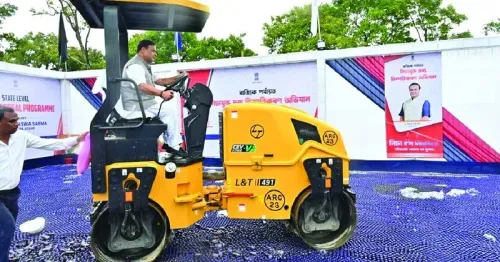
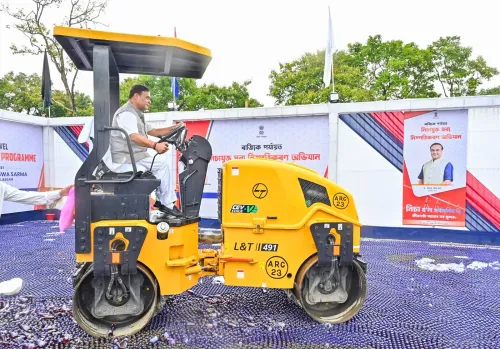
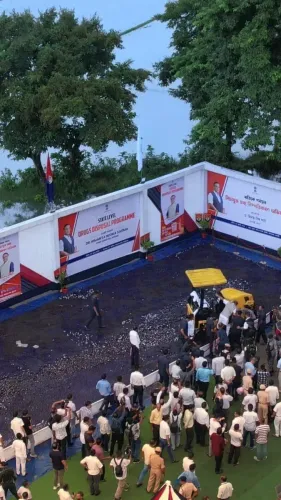
Assam Chief Minister Himanta Biswa Sarma on 12 July 2026 oversaw the public destruction of narcotics worth ₹472 crore, calling it an escalation of the state's relentless, zero-tolerance campaign against drug trafficking along its porous northeastern borders.
Key Takeaways
Assam CM Himanta Biswa Sarma announced the destruction of drugs valued at ₹472 crore on 12 July 2026 .
The Chief Minister described the event as taking the state's anti-drug fight 'to the next level' and reaffirmed a zero tolerance policy.
Assam borders Myanmar and Bangladesh , making it a key corridor for narcotics from the Golden Triangle .
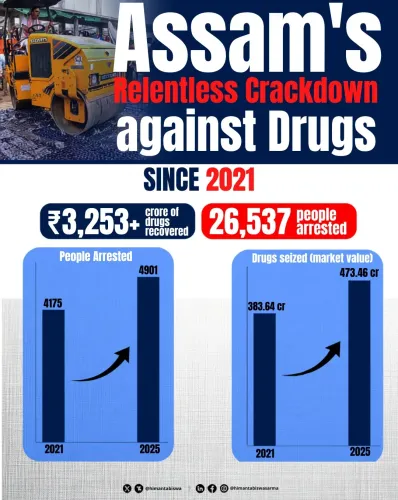
Public destructions of seized drugs have been a recurring feature of the Sarma government's enforcement strategy since 2021 .
State-level operations complement those of the central Narcotics Control Bureau (NCB) under the NDPS Act .
Full Assam Police seizure data for 2026 and new cross-border coordination announcements are expected in the coming months.
Assam Chief Minister Himanta Biswa Sarma on Sunday, 12 July 2026, announced the public destruction of narcotics valued at ₹472 crore, describing the event as an escalation of the state's campaign against drug trafficking. The announcement, made via his official X account, declared a 'zero tolerance' policy toward drugs in the state.
Context
In a bilingual post mixing Hindi and English, Sarma wrote: '₹472 करोड़ के ड्रग्स का अंतिम संस्कार' — loosely translated as 'the last rites of ₹472 crore worth of drugs' — framing the destruction in culturally resonant terms. He added that the seized narcotics 'could have destroyed precious lives' and that the state remains 'relentless' in its pursuit against drug networks. A video of the destruction event was attached to the post.
Assam shares borders with Myanmar and Bangladesh, making it a transit corridor for heroin and synthetic drugs flowing from the Golden Triangle — the region spanning parts of Myanmar, Laos, and Thailand that is among the world's largest illicit drug-producing zones. The state's geographic vulnerability has made anti-narcotics enforcement a consistent political and administrative priority.
Policy Backdrop
Since Sarma took charge as Chief Minister in 2021, the Assam government has conducted multiple public destructions of seized narcotics as a visible demonstration of its zero-tolerance stance. These events are conducted under the framework of the Narcotic Drugs and Psychotropic Substances (NDPS) Act, which mandates court-authorised disposal of confiscated contraband.
The approach mirrors a broader pattern across BJP-led northeastern states, where high-visibility drug-burn events have become a tool of both enforcement and public messaging. State police operations in this space often run in parallel with actions by the Narcotics Control Bureau (NCB), the central agency tasked with coordinating national drug-law enforcement.
Stakeholders and Impact
The primary beneficiaries cited by the administration are Assam's youth and residents of border districts, who are most exposed to drug inflows. Public destruction events are intended to signal to trafficking networks that seized consignments will not re-enter circulation, while also serving as a deterrent message to local distributors.
Civil society groups working on drug rehabilitation in the region have long noted that enforcement alone is insufficient without parallel investment in de-addiction and community support. The ₹472 crore valuation underscores the scale of narcotics that enforcement agencies are intercepting before they reach end-users in towns and villages across the northeast.
What's Next
Observers will watch for the release of Assam Police's full seizure data for 2026, which would place the ₹472 crore destruction in cumulative context. Any new coordination frameworks between the state government, the NCB, and Myanmar border authorities are also expected to be announced in the coming months as cross-border trafficking pressure continues.
The public nature of Sunday's event — with video documentation shared directly by the Chief Minister — suggests the administration intends to keep anti-drug enforcement at the centre of its governance narrative ahead of any future electoral cycle in the state.
Point of View
Such events form part of a coordinated governance narrative that links border security, youth welfare, and strong-state imagery. The critical question remains whether enforcement escalation is matched by proportionate investment in rehabilitation infrastructure for those already affected by addiction.
NationPress
11 Oct 2026
Frequently Asked Questions
What drugs were destroyed in Assam on 12 July 2026?
Assam Chief Minister Himanta Biswa Sarma announced the destruction of seized narcotics worth ₹472 crore on 12 July 2026 , though the specific types of drugs were not detailed in his public post.
What is Assam's zero tolerance drug policy?
The Assam government under CM Himanta Biswa Sarma has maintained a declared zero-tolerance stance on narcotics since 2021, involving regular seizures, public destructions of contraband, and enforcement under the NDPS Act .
Why is Assam a drug trafficking hotspot?
Assam shares borders with Myanmar and Bangladesh and lies adjacent to the Golden Triangle , one of the world's largest illicit drug-producing regions, making it a major transit corridor for heroin and synthetic drugs.
How does Assam destroy seized drugs?
Seized narcotics in Assam are destroyed through court-authorised incineration under the Narcotic Drugs and Psychotropic Substances (NDPS) Act . The government has made these events public to signal that confiscated drugs will not re-enter circulation.
Who is Himanta Biswa Sarma?
Himanta Biswa Sarma is the Chief Minister of Assam since May 2021 and a senior BJP leader. He also serves as the convenor of the North-East Democratic Alliance (NEDA) , a coalition of BJP-aligned parties across northeastern India.