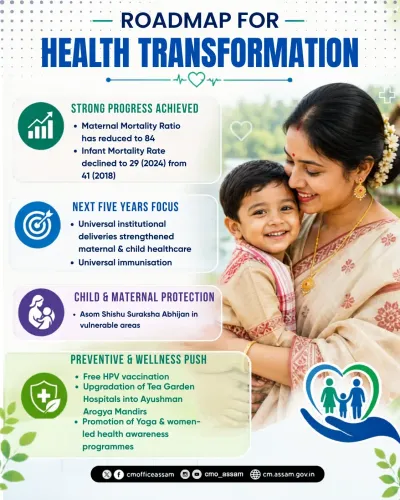
CM Assam Office Highlights State's Maternal Health Progress

Synopsis
The Chief Minister's Office of Assam spotlighted the state's quiet but significant progress on maternal health, pointing to how targeted interventions under national schemes and community-level ASHA outreach have helped one of India's historically high-burden states narrow its maternal mortality gap.
Key Takeaways
Assam has historically reported among India's highest maternal mortality ratios, driven by remote terrain and infrastructure gaps.
The Janani Suraksha Yojana (2005) incentivised institutional deliveries in high-burden states including Assam , shifting birth patterns away from home deliveries.
The National Health Mission expanded rural health infrastructure and the ASHA worker network, providing last-mile connectivity for maternal care.
Sample Registration System data from 2014–16 flagged Assam's elevated MMR, prompting intensified state-level focus on riverine and remote communities.
India's SDG commitment targets an MMR below 70 per 1,00,000 live births , with northeastern states including Assam narrowing the gap with national averages.
The next SRS bulletin and a forthcoming NFHS round will be key indicators of whether Assam's progress has sustained.
The Chief Minister's Office of Assam shared on Sunday, 14 June 2026 a commentary spotlighting how the northeastern state has steadily improved its maternal health outcomes, drawing attention to a transformation that has largely unfolded away from national headlines.
Context
Assam has historically ranked among Indian states with the highest maternal mortality ratios (MMR), a challenge rooted in its difficult terrain, dispersed riverine communities, and gaps in health infrastructure. For decades, expectant mothers in remote districts faced acute risks from the absence of skilled birth attendants and functional referral networks. The state's maternal health burden was consistently flagged in national health surveys as a priority concern.
The Chief Minister's Office sharing this commentary signals the state government's intent to put its public health record before a wider audience, framing maternal health improvements as a quiet but consequential policy achievement.
Policy Backdrop
The turnaround in Assam's maternal health indicators has been shaped by a convergence of central and state-level interventions. The Janani Suraksha Yojana (JSY), launched in 2005, offered cash incentives to women opting for institutional deliveries — a programme that proved particularly consequential in high-burden states like Assam where home births were the norm in rural areas.
Simultaneously, the National Rural Health Mission (NRHM), also initiated in 2005 and later subsumed under the National Health Mission (NHM), worked to strengthen rural health infrastructure and expand the Accredited Social Health Activist (ASHA) network. ASHAs became the frontline link between remote communities and formal health facilities, escorting women to antenatal appointments and facilitating referrals during obstetric emergencies.
Sample Registration System data from 2014–16 had specifically flagged Assam's elevated MMR, prompting more focused state-level interventions targeting riverine and forest-fringe communities that conventional health outreach had struggled to reach.
Stakeholders and Impact
The most direct beneficiaries of this shift are Assam's expectant mothers, particularly those in remote districts where geographic isolation once made institutional delivery practically inaccessible. Improved antenatal coverage, facility-based deliveries, and emergency obstetric referral systems have collectively reduced the risks associated with childbirth in these communities.
ASHA workers and rural health staff have been central to this progress, acting as the connective tissue between policy design and last-mile delivery. Their role in tracking pregnancies, ensuring antenatal check-ups, and mobilising transport during emergencies has been widely recognised as a critical variable in states that have successfully narrowed MMR gaps.
The broader pattern across India shows that northeastern states, including Assam, have made measurable progress in closing the distance between their MMR figures and the national average — a trend consistent with India's commitment under the Sustainable Development Goals (SDGs) to bring MMR below 70 per 1,00,000 live births.
What's Next
The next bulletin from the Sample Registration System will be closely watched to assess whether Assam's MMR trajectory has continued its downward movement. Findings from any forthcoming round of the National Family Health Survey (NFHS) specific to Assam will provide a more granular picture of district-level disparities that aggregate state figures can obscure.
If the improvements highlighted in the commentary are borne out by official data, Assam could emerge as a reference model for other geographically challenging states seeking to replicate gains in maternal health through community-based outreach and institutional delivery incentives.
Point of View
Long-running public health improvement as a governance achievement ahead of what will likely be renewed scrutiny of state health data. Assam's MMR story, if validated by the next SRS bulletin, would represent a meaningful vindication of community-health architecture built on ASHA networks and JSY incentives. The move also reflects a broader pattern among state governments of using social media to shape the narrative around slow-burn policy outcomes that rarely generate the same headlines as infrastructure projects. The real test will be whether district-level data, when it emerges, shows that gains have reached the most isolated riverine communities or remain concentrated in better-connected areas.
NationPress
19 Sept 2026
Frequently Asked Questions
What is the maternal mortality ratio of Assam?
Assam has historically recorded one of India's highest maternal mortality ratios, with Sample Registration System data from 2014–16 specifically flagging the state's elevated MMR. Exact current figures will be available in the next SRS bulletin.
What is Janani Suraksha Yojana and how does it help Assam?
The Janani Suraksha Yojana, launched in 2005, provides cash incentives to women who opt for institutional deliveries. In high-burden states like Assam, it has helped shift births from home settings to health facilities, directly reducing maternal deaths.
What role do ASHA workers play in reducing maternal deaths in Assam?
ASHA workers act as frontline community health links, tracking pregnancies, facilitating antenatal check-ups, and arranging referrals during obstetric emergencies — particularly critical in Assam's remote riverine and forest-fringe communities.
What is India's SDG target for maternal mortality?
India's Sustainable Development Goal commitment is to reduce the national maternal mortality ratio to below 70 per 1,00,000 live births. Northeastern states including Assam have been narrowing the gap with the national average.
How has the National Health Mission helped improve maternal health in Assam?
The National Health Mission has strengthened rural health infrastructure, expanded the ASHA worker network, and supported emergency obstetric care services, all of which have improved antenatal coverage and facility-based delivery rates in Assam.