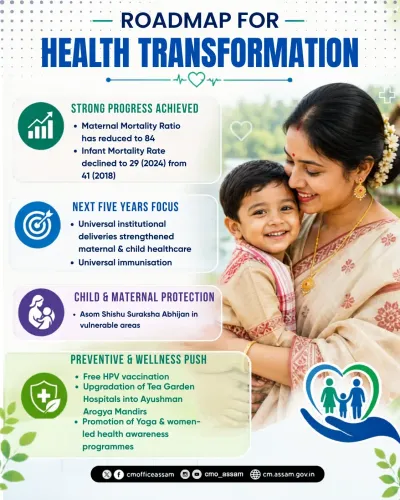
Assam Budget 2026: MMR Falls to 84, Below National Average

Synopsis
The Chief Minister's Office of Assam announced during Budget 2026 that the state's Maternal Mortality Ratio has fallen to 84 per lakh live births — below the national average — reflecting a 65% reduction over a decade, alongside rising institutional deliveries and a 62% drop in child marriage.
Key Takeaways
Assam's MMR has declined to 84 per lakh live births , now below the national average.
The reduction represents a 65% fall over the past decade , announced during Assam Budget 2026 on 10 July 2026 .
Institutional deliveries have reached 87.6% and skilled birth attendance stands at 90.7% .
Child marriage in Assam has declined by 62% , a trend the government links directly to maternal-health improvements.
Gains are underpinned by central schemes including National Health Mission and Janani Suraksha Yojana , supplemented by state-level enforcement actions.
Independent verification through the next Registrar General of India SRS bulletin will be the key credibility test for these figures.
The Chief Minister's Office of Assam on Friday, 10 July 2026, highlighted a sharp decline in the state's maternal and child-health indicators as part of the #AssamBudget2026 presentation, announcing that Assam's Maternal Mortality Ratio (MMR) has fallen to 84 per lakh live births — now below the national average — representing a 65% reduction over the past decade.
Context
Assam has historically carried one of the highest maternal mortality burdens among Indian states, a legacy tied to poor healthcare infrastructure, low institutional delivery rates, and the prevalence of early marriage in rural and tribal belts. The state's latest figures, shared during budget highlights, mark a significant inflection point: an MMR of 84 per lakh live births places Assam below the national average for the first time in recent memory, according to the government's own accounting.
The announcement also cited institutional deliveries reaching 87.6% and skilled birth attendance rising to 90.7% — both critical proxies for maternal survival outcomes. Alongside these, child marriage has declined by 62%, a social indicator the state government has closely linked to its maternal-health gains.
Policy Backdrop
The gains are rooted in a layered policy architecture stretching back two decades. The National Health Mission (NHM), launched in 2005, provided the foundational framework for expanding rural healthcare access across states, including Assam. The Janani Suraksha Yojana (JSY), introduced the same year, offered conditional cash transfers to incentivise women — particularly from below-poverty-line households — to deliver in accredited facilities rather than at home.
Assam layered state-specific interventions on top of this central architecture, including a high-profile crackdown on child marriage launched under Chief Minister Himanta Biswa Sarma beginning in 2023. The government has consistently argued that reducing early marriage directly delays first pregnancies, lowering the risk profile for maternal complications. The convergence of these efforts appears to be reflected in the budget-day figures.
Stakeholders and Impact
The primary beneficiaries of these trends are pregnant women and adolescent girls across Assam, particularly in districts that previously recorded the highest MMR and child-marriage rates. Higher skilled birth attendance — now at 90.7% — means more deliveries are supervised by trained health workers, directly reducing the risk of preventable deaths from haemorrhage, sepsis, and obstructed labour.
The 62% decline in child marriage carries a compounding social dividend: girls who remain in school longer are statistically more likely to access antenatal care, deliver in institutions, and make informed health choices. For the state's health system, rising institutional delivery rates at 87.6% also generate better data, enabling more targeted resource allocation in future budgets.
What's Next
The credibility and durability of these gains will be tested against the next bulletin from the Registrar General of India's Sample Registration System (SRS), which independently tracks state-level MMR and is considered the authoritative national benchmark. A convergence between the state's claimed figures and the SRS data would substantially strengthen Assam's case as a model for northeastern health reform.
Budget allocations for health schemes in 2026-27 will be closely watched to determine whether the government intends to consolidate these gains or redirect spending. Sustaining an MMR below the national average — and pushing it further toward the Sustainable Development Goal 3 target of under 70 per lakh live births by 2030 — will require continued investment in last-mile healthcare delivery, especially in Assam's remote hill and flood-prone districts.
Point of View
The MMR figure serves double duty: it validates his administration's social-enforcement push on child marriage while anchoring Assam within the national SDG conversation. The 65% decade-long reduction, however, spans multiple governments, meaning credit is shared across administrations even if the current one claims the headline. The real test will be whether the next independent SRS bulletin corroborates the state's self-reported numbers — a gap between the two would invite scrutiny of the methodology behind the budget claims.
NationPress
8 Oct 2026
Frequently Asked Questions
What is Assam's current Maternal Mortality Ratio in 2026?
According to the Chief Minister's Office of Assam , the state's Maternal Mortality Ratio stands at 84 per lakh live births as of the Assam Budget 2026 announcement on 10 July 2026 , placing it below the national average.
By how much has Assam's MMR reduced in the last decade?
The CMO Assam stated that the Maternal Mortality Ratio has seen a 65% reduction over the past decade , reflecting sustained improvements in maternal healthcare delivery across the state.
What is the institutional delivery rate in Assam?
Assam's institutional delivery rate has reached 87.6% , according to figures shared during the Assam Budget 2026 presentation, while skilled birth attendance has risen to 90.7% .
How much has child marriage declined in Assam?
Child marriage in Assam has declined by 62% , as announced by the Chief Minister's Office during budget highlights on 10 July 2026 . The government links this social improvement to better maternal health outcomes.
What schemes helped reduce maternal mortality in Assam?
The National Health Mission (NHM) and Janani Suraksha Yojana (JSY) , both launched in 2005 , form the policy backbone for improving institutional deliveries and skilled birth attendance in Assam , complemented by state-level actions on child marriage.