Assam CM Office links FIFA World Cup to Kamakhya Corridor push
Synopsis
The Chief Minister's Office of Assam on 17 July 2026 invoked the FIFA World Cup to frame ambitions for the Kamakhya Corridor in Guwahati, signalling a large-scale infrastructure push at one of India's most visited Shakti Peethas.
Key Takeaways
The CMO Assam posted on 17 July 2026 drawing a direct parallel between the FIFA World Cup and the Kamakhya Corridor project.
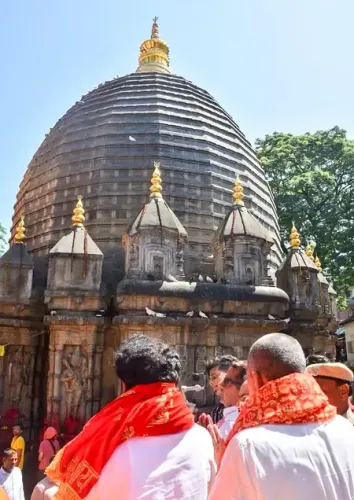
The Kamakhya Temple on Nilachal Hill, Guwahati is one of India's foremost Shakti Peethas, attracting millions of pilgrims annually.
The PRASAD scheme , launched in 2014-15 , already identifies Kamakhya as a site for pilgrimage infrastructure upgrades.
Corridor-style temple infrastructure projects have become a national pattern, benefiting pilgrims, local traders, and the broader tourism economy.
Stakeholders are watching for formal budget allocations, central ministry approvals, or foundation-stone events to follow the government's signalling.
The Chief Minister's Office of Assam drew a pointed connection on Friday, 17 July 2026, between the global reach of the FIFA World Cup and the state's ambitions for the Kamakhya Corridor in Guwahati, signalling the government's intent to position the ancient pilgrimage site alongside world-class infrastructure benchmarks.
Context
The post — captioned in Assamese as 'ফিফা বিশ্বকাপৰ পৰা কামাখ্যা কৰিডৰলৈ...' ('From the FIFA World Cup to the Kamakhya Corridor...') — juxtaposes two seemingly disparate reference points to make a statement about scale and aspiration. By invoking the world's most-watched sporting tournament alongside a temple corridor project, the CMO is framing the Kamakhya development as an initiative of comparable ambition and visibility.
The Kamakhya Temple, perched atop Nilachal Hill in Guwahati, is one of India's foremost Shakti Peethas and draws millions of devotees annually, particularly during the Ambubachi Mela. Improving access, amenities, and the overall pilgrim experience at the site has been a stated priority of the Assam government.
Policy Backdrop
The idea of a dedicated corridor around the Kamakhya Temple fits within a broader national pattern of corridor-style infrastructure projects at major religious sites. The Government of India launched the PRASAD scheme in 2014-15 specifically to upgrade pilgrimage and heritage tourism infrastructure at identified sites, with Kamakhya among those included.
State governments across India have increasingly paired the promotion of major religious sites with large-scale infrastructure upgrades — widened approach roads, improved amenities, crowd-management systems, and commercial zones — to boost both the pilgrim experience and local economies. Assam's move follows a template visible in projects at other prominent temples in recent years.
Stakeholders and Impact
The primary beneficiaries of a Kamakhya Corridor would be the millions of pilgrims who visit the temple each year, many of whom currently navigate congested approach routes and limited facilities. Assam's tourism sector, local traders, and hospitality businesses in Guwahati stand to gain significantly from increased and better-managed footfall.
The FIFA World Cup reference also carries a soft-power dimension: by anchoring the corridor's aspirations to a globally recognised event, the CMO is signalling that Assam's development narrative is being pitched not just to domestic audiences but to an international frame of reference. This kind of positioning is increasingly common among state governments competing for tourism investment and central government attention.
What's Next
Observers will watch for concrete follow-through in the form of state budget allocations, approvals from the Union Ministry of Tourism, or foundation-stone events tied to Kamakhya Corridor components in the coming assembly session. The post's tone suggests the government is building public and political momentum ahead of a formal announcement or milestone. Whether the FIFA World Cup reference signals a specific timeline or funding trigger remains to be seen from official statements.
Point of View
Making it harder to dismiss as routine. This fits a well-established playbook where Indian state governments use high-visibility cultural or sporting references to build momentum for religious-tourism projects ahead of formal announcements. For Assam, which has invested heavily in positioning itself as a destination state, the Kamakhya Corridor is a flagship narrative asset. The real test will be whether the rhetorical ambition translates into budgetary commitment and central government partnership in the sessions ahead.
NationPress
15 Oct 2026
Frequently Asked Questions
What is the Kamakhya Corridor project in Assam?
The Kamakhya Corridor is a proposed infrastructure development project around the Kamakhya Temple in Guwahati , aimed at improving access, amenities, and the overall experience for the millions of pilgrims who visit the Shakti Peetha each year.
Why did Assam's CMO mention the FIFA World Cup with the Kamakhya Corridor?
The Chief Minister's Office of Assam used the FIFA World Cup as a reference point to signal the scale and global ambition of the Kamakhya Corridor project, framing it as an initiative of comparable visibility and aspiration.
What is the PRASAD scheme and does it cover Kamakhya Temple?
The PRASAD scheme (Pilgrimage Rejuvenation and Spiritual, Heritage Augmentation Drive) was launched by the Government of India in 2014-15 to upgrade infrastructure at major pilgrimage sites, and Kamakhya Temple is among the identified sites.
How many pilgrims visit Kamakhya Temple every year?
Kamakhya Temple on Nilachal Hill, Guwahati draws millions of devotees annually, with the footfall surging especially during the Ambubachi Mela , one of India's largest religious gatherings.
What should we watch for next on the Kamakhya Corridor?
Key developments to follow include state budget allocations , approvals from the Union Ministry of Tourism , and any foundation-stone events or formal announcements in the coming Assam assembly session.