Assam Eidgah Committees Back CM Himanta's Cow Qurbani Appeal

Synopsis
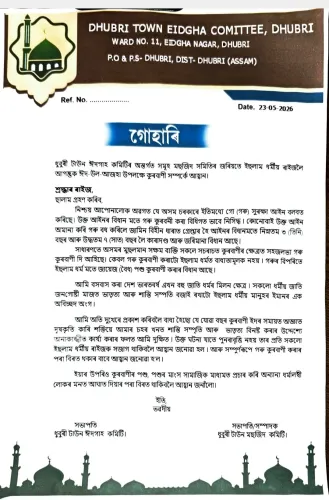
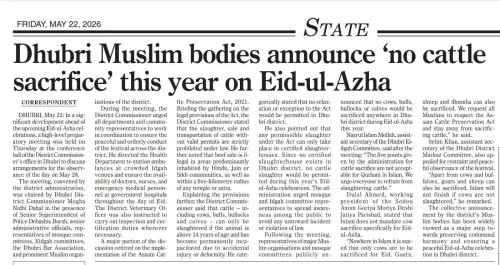
Eidgah committees across Assam have backed Chief Minister Himanta Biswa Sarma's appeal to refrain from cow slaughter and comply with the Assam Cattle Preservation Act during Eid-ul-Adha. The CM commended the community's response as a reflection of peace and harmony in the state.
Key Takeaways
Eidgah committees across Assam publicly supported CM Himanta Biswa Sarma 's appeal ahead of Eid-ul-Adha 2026 .
The appeal urged Muslims to refrain from cow qurbani and comply with the Assam Cattle Preservation Act .
The Assam Cattle Preservation Act was enacted in 1950 and restricts slaughter of milch and draught cattle without official certification.
CM Sarma appreciated the response and described it as reflecting 'peace and harmony' across the state.
The development is seen as community-led voluntary compliance rather than enforcement-driven action.
The Chief Minister's Office of Assam announced on Saturday, 23 May 2026 that Eidgah committees across the state have extended their support to Chief Minister Dr. Himanta Biswa Sarma's appeal urging Muslims to refrain from cow slaughter during Eid-ul-Adha and to comply with the Assam Cattle Preservation Act.
Context
The CMO's post states that 'various Eidgah committees across Assam have extended support' to the Chief Minister's appeal, which called on communities to 'refrain from cow qurbani and to follow the Assam Cattle Preservation Act.' Dr. Sarma acknowledged the response and 'commended the spirit of peace and harmony reflected across the State.'
The appeal comes ahead of Eid-ul-Adha, when animal sacrifice — known as qurbani — is a central religious observance for Muslims. In Assam, this practice intersects with longstanding state legislation that restricts cattle slaughter.
Policy Backdrop
The Assam Cattle Preservation Act was originally enacted in 1950 and prohibits the slaughter of certain cattle — primarily milch and draught animals — without a certificate from a competent authority. The legislation has remained a reference point in periodic government communications ahead of major Islamic festivals in the state.
Several Indian states maintain comparable cattle preservation statutes, and Assam's periodic appeals for voluntary compliance ahead of Eid represent a recurring pattern of state-level outreach aimed at reducing communal friction over animal sacrifice norms.
Stakeholders and Impact
Eidgah committees, which oversee congregational Eid prayers and associated community activities, carry considerable social authority within Muslim communities. Their public endorsement of the appeal signals a degree of community-level buy-in that goes beyond a top-down government directive.
Chief Minister Himanta Biswa Sarma, who has helmed Assam since 2021, has made law enforcement and cultural policy a consistent feature of his administration. The CMO's framing of the Eidgah committees' response as reflecting 'peace and harmony' positions this as a cooperative, rather than coercive, outcome.
Muslim communities in Assam represent a significant share of the state's population, and the manner in which Eid-ul-Adha observances unfold in the state is closely watched as a gauge of inter-community relations.
What's Next
Attention will now turn to on-ground compliance during the Eid-ul-Adha observance period and whether the state home department issues any follow-up statements on enforcement or voluntary adherence. The response from Eidgah committees could set a precedent for how similar appeals are received in future festival cycles.
If compliance is broadly observed, the episode may be cited by the state government as a model of community-led adherence to cattle preservation norms — with implications for how Assam navigates the intersection of religious practice and state law in the years ahead.
Point of View
Effectively shifting the compliance dynamic from enforcement to social consensus. For CM Himanta Biswa Sarma, whose administration has consistently positioned itself as a firm custodian of law-and-order on cultural matters, a cooperative outcome is politically valuable — it demonstrates governance without confrontation. The episode also fits a broader national pattern in which state governments use pre-festival outreach to test the elasticity of religious community leadership on sensitive legislative compliance. How durably this goodwill holds — and whether it translates into measurable on-ground compliance — will determine whether it becomes a replicable model or a one-cycle headline.
NationPress
7 Oct 2026
Frequently Asked Questions
What is the Assam Cattle Preservation Act?
The Assam Cattle Preservation Act is a 1950 state law that prohibits the slaughter of certain cattle — particularly milch and draught animals — without a certificate from a competent authority. It has been periodically invoked by the Assam government ahead of festivals involving animal sacrifice.
Why did CM Himanta Biswa Sarma appeal against cow qurbani during Eid?
CM Himanta Biswa Sarma appealed to Muslim communities to refrain from cow slaughter during Eid-ul-Adha in line with the Assam Cattle Preservation Act , which restricts such slaughter in the state. The appeal was aimed at ensuring legal compliance while maintaining communal harmony.
Did Eidgah committees in Assam agree to stop cow slaughter during Eid?
According to the Chief Minister's Office of Assam , various Eidgah committees across the state extended support to CM Sarma's appeal and urged people to follow the Assam Cattle Preservation Act during Eid-ul-Adha 2026 .
What is qurbani and why is it significant during Eid-ul-Adha?
Qurbani refers to the ritual animal sacrifice performed by Muslims during Eid-ul-Adha as an act of religious observance. In states like Assam, the practice intersects with cattle preservation laws that restrict the slaughter of certain animals.
Is cow slaughter banned in Assam?
Assam does not have a blanket ban on cow slaughter, but the Assam Cattle Preservation Act of 1950 restricts the slaughter of milch and draught cattle without official certification. The state government periodically invokes this law ahead of religious festivals.