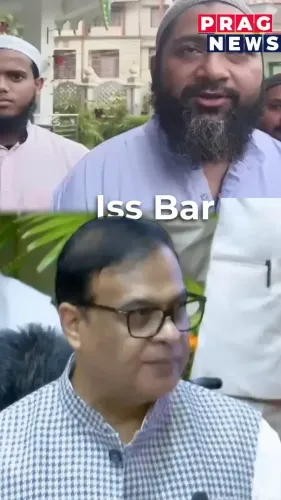
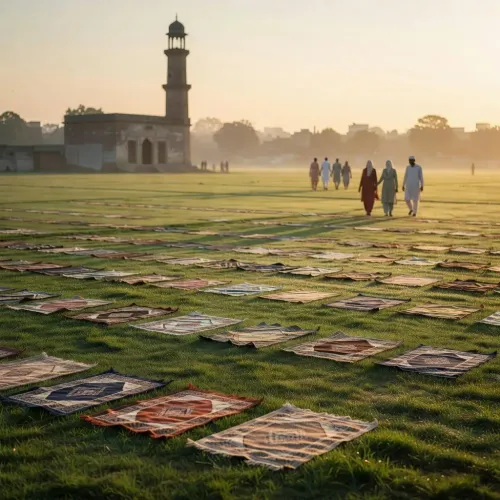
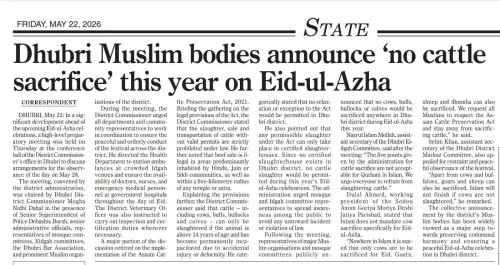
Assam Eidgah Committees Forgo Cow Qurbani After CM Himanta's Appeal
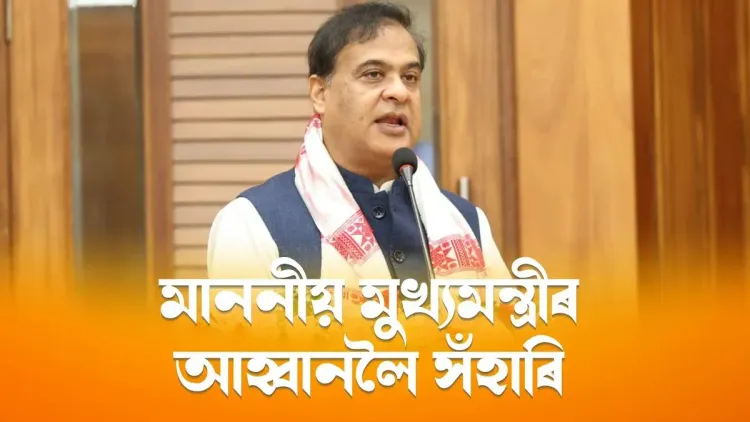
Synopsis
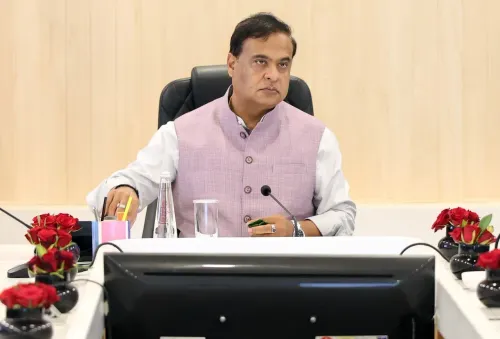
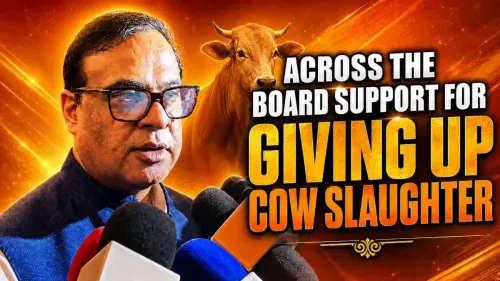
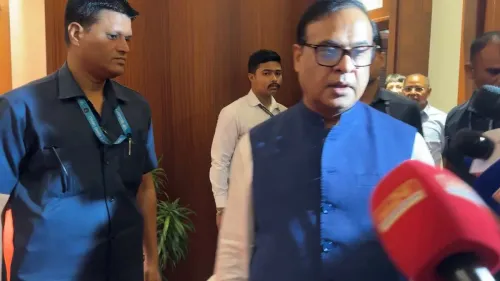
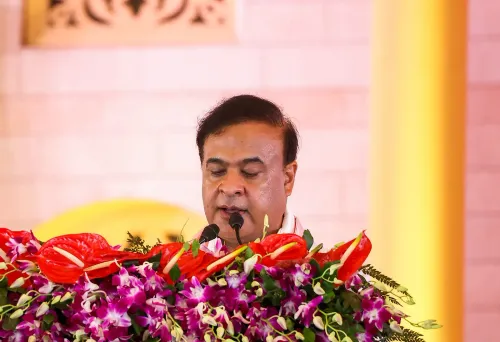
Several Eidgah committees in Assam voluntarily refrained from cow qurbani during Eid-ul-Zuha, responding to an appeal by Chief Minister Dr. Himanta Biswa Sarma. The Chief Minister's Office described the move as a gesture of peace, harmony, and mutual respect that also received wide media attention.
Key Takeaways
The Chief Minister's Office of Assam announced on 29 May 2026 that multiple Eidgah committees voluntarily skipped cow qurbani during Eid-ul-Zuha .
The committees acted in response to a personal appeal by Chief Minister Dr.
Himanta Biswa Sarma .
The CMO described the gesture as a message of 'peace, harmony and mutual respect.' The development reportedly received widespread coverage across regional and national media platforms.
The move aligns with the Assam BJP government's broader strategy of combining strict cattle-trade enforcement with appeals for voluntary inter-religious accommodation since 2021 .
The Chief Minister's Office of Assam announced on Friday, 29 May 2026 that several Eidgah committees across the state voluntarily refrained from cow qurbani during Eid-ul-Zuha, responding to an appeal made by Chief Minister Dr. Himanta Biswa Sarma. The development was described as a gesture of peace, harmony, and mutual respect.
Context
The CMO's post stated that the voluntary restraint came in direct response to an appeal by HCM Dr. Himanta Biswa Sarma, and that the gesture 'drew widespread coverage across regional and national media platforms.' Eidgah committees are local bodies that oversee Eid prayer arrangements and broader community decisions in Muslim localities. Their decision to forgo cow qurbani — an act that has historically triggered communal sensitivities in parts of Assam and the wider Northeast — was framed by the government as a positive signal ahead of and during the festival.
Policy Backdrop
Since taking office in May 2021, Chief Minister Sarma has pursued a dual approach: strict enforcement against illegal cattle trade alongside public appeals for voluntary inter-religious accommodation during sensitive festivals. This strategy has been a recurring feature of the Assam BJP government's governance posture, seeking to reduce festival-related friction while projecting administrative control. The voluntary restraint by Eidgah committees fits within this broader pattern of the state government encouraging community-level gestures to lower communal tensions.
Stakeholders and Impact
Assam has a substantial Muslim population alongside a Hindu majority, and cow slaughter around festivals has periodically been a flashpoint in the state. The decision by multiple Eidgah committees — representing organised Muslim community bodies — to respond to the Chief Minister's appeal carries symbolic weight beyond any single locality. For Hindu communities in the state, the gesture signals a willingness for mutual accommodation; for Muslim communities, it reflects a public alignment with the state government's calls for harmony, even as some within those communities may hold differing views on religious practice.
What's Next
The government's communication of this development — including its note on media amplification — suggests that such gestures are being positioned as a replicable model ahead of future festivals. Observers will watch whether the Assam Assembly advances any legislative measures on cattle preservation, and whether similar appeals and responses become a formalised part of the state's pre-festival outreach. The pattern of Chief Minister Sarma making public appeals to community bodies, and those bodies responding visibly, is likely to continue as a governance and communication strategy in the run-up to the next Eid-ul-Zuha.
Point of View
Voluntary gestures from Muslim community bodies and then amplifying them as proof of social harmony under BJP rule in Assam. By routing the announcement through the official CMO account and noting media coverage, the government signals that the gesture is not incidental but curated. For critics, the pattern raises questions about the nature of 'voluntary' restraint when it follows a Chief Minister's public appeal in a politically charged environment. For the government, it offers a counter-narrative to perceptions of communal polarisation — one that is likely to feature prominently ahead of future festivals and elections.
NationPress
24 Oct 2026
Frequently Asked Questions
Why did Eidgah committees in Assam skip cow qurbani during Eid-ul-Zuha 2026?
Several Eidgah committees across Assam voluntarily refrained from cow qurbani during Eid-ul-Zuha in response to an appeal made by Chief Minister Dr. Himanta Biswa Sarma, according to the Chief Minister's Office.
What is cow qurbani and why is it sensitive in Assam?
Qurbani refers to the ritual sacrifice of animals during Eid-ul-Zuha (Bakrid). In Assam, cow slaughter is a communally sensitive issue given the state's Hindu majority and periodic tensions around the practice during festivals.
Who are Eidgah committees?
Eidgah committees are local community bodies in Muslim localities that oversee Eid prayer arrangements and broader community decisions, including practices observed during festivals like Eid-ul-Zuha.
What is Himanta Biswa Sarma's policy on communal harmony in Assam?
Since becoming Chief Minister in May 2021, Dr. Himanta Biswa Sarma has combined strict enforcement against illegal cattle trade with public appeals for voluntary inter-religious accommodation during sensitive festivals, aiming to reduce communal friction.
Is cow slaughter banned in Assam?
Assam has legislation restricting cattle slaughter, and the Sarma government has actively enforced anti-cow-smuggling measures since 2021. The Eidgah committees' decision was described as voluntary restraint beyond any legal requirement.