CM Himanta Hails Eidgah Committees for Cow Qurbani Restraint

Synopsis
On Eid Al Adha 2026, Assam CM Himanta Biswa Sarma acknowledged that several Eidgah committees voluntarily accepted a government appeal to refrain from cow sacrifice, calling it a powerful message of communal harmony and mutual respect across communities.
Key Takeaways
The Chief Minister's Office of Assam shared CM Himanta Biswa Sarma's statement on Eid Al Adha, May 26, 2026 .
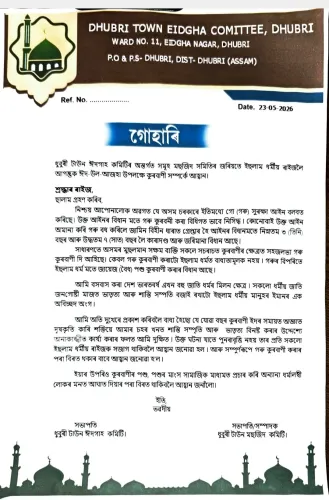
Several Eidgah committees voluntarily accepted an appeal to refrain from cow qurbani during the festival.
The decision was taken in consideration of the sentiments of all communities , not under any legal mandate.
CM Himanta described the gesture as reflecting 'communal harmony, mutual respect and unity in society.' Assam has a diverse population of Hindu and Muslim communities with a history of government-led communal outreach efforts.
The development may set a precedent for similar voluntary arrangements during future religious festivals in the state.
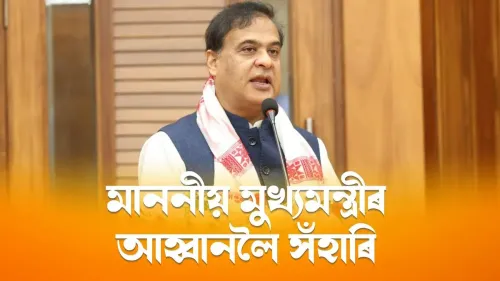
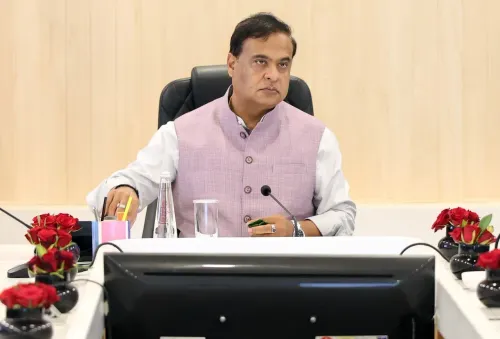
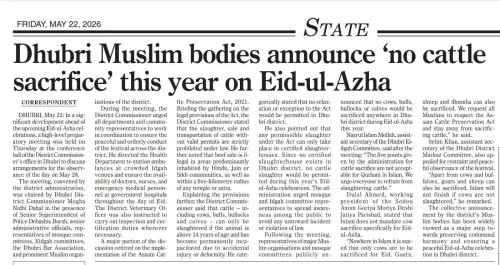
The Chief Minister's Office of Assam on Tuesday, May 26, 2026, shared a statement from Chief Minister Dr. Himanta Biswa Sarma on the occasion of Eid Al Adha, acknowledging that several Eidgah committees had voluntarily accepted an appeal to refrain from cow sacrifice out of respect for the sentiments of other communities.
Context
In his statement, CM Himanta Biswa Sarma said: 'On the occasion of Eid Al Adha, several Eidgah committees graciously accepted our appeal to refrain from cow qurbani in consideration of the sentiments of all communities. This reflects a powerful message of communal harmony, mutual respect and unity in society.' The statement was shared through the official CMOfficeAssam handle on Eid Al Adha 2026, one of Islam's most significant festivals, during which ritual animal sacrifice is a central religious practice.
Cow sacrifice is a particularly sensitive matter in India, where the cow holds religious significance for Hindu communities. Assam, a northeastern state with a diverse population of both Hindu and Muslim communities, has historically navigated this intersection of religious practices with varying degrees of tension and cooperation.
Policy Backdrop
Indian state governments have periodically issued appeals for voluntary restraint during religious festivals to manage cross-community sensitivities, particularly around cow sacrifice. These efforts are distinct from legal prohibition and instead rely on dialogue with religious bodies and community leaders to arrive at voluntary agreements.
Assam under the BJP-led government of CM Himanta Biswa Sarma, who took office in May 2021, has engaged religious leaders on matters of communal coexistence as part of broader governance priorities that include development, security, and social cohesion. Such outreach aligns with constitutional principles of secularism and fraternity, which call on citizens and institutions to promote harmony across religious communities.
Stakeholders and Impact
The Eidgah committees that accepted the appeal represent organised Muslim congregations, typically responsible for managing large open-air prayer grounds used especially during Eid festivals. Their voluntary decision to forego cow sacrifice signals a willingness among religious bodies to accommodate inter-community concerns without state compulsion.
For Hindu communities in Assam, the gesture carries symbolic weight, as it directly addresses a longstanding source of communal friction. The Chief Minister's public acknowledgement of the committees' decision serves both to validate their choice and to frame it as a model of civic behaviour rooted in mutual respect.
What's Next
The success of this appeal is likely to influence how the Assam government approaches similar outreach during other major festivals such as Eid-ul-Fitr and Durga Puja, where inter-community sensitivities also come into play. Observers will watch whether this voluntary restraint becomes a recurring pattern or prompts broader state-level conversations about formalising such arrangements.
If replicated consistently, this model of government-facilitated, community-led accommodation could serve as a reference point for other multi-religious states in India seeking to balance religious freedom with communal peace.
Point of View
Lending it greater moral authority. The move fits a broader pattern of BJP-led state governments seeking to manage communal flashpoints through dialogue and optics rather than legislation alone. By spotlighting Muslim religious bodies as willing partners in communal harmony, the statement also serves to project Assam as a model of managed pluralism under the current administration. Whether this translates into durable inter-community goodwill or remains a symbolic moment will depend on the consistency of such outreach across the electoral and festival calendar.
NationPress
10 Oct 2026
Frequently Asked Questions
Why did Eidgah committees in Assam refrain from cow sacrifice on Eid Al Adha 2026?
Several Eidgah committees in Assam voluntarily accepted an appeal from the state government to refrain from cow qurbani on Eid Al Adha 2026 out of respect for the sentiments of other communities, particularly Hindus for whom the cow holds religious significance.
What did CM Himanta Biswa Sarma say about Eid Al Adha 2026?
CM Himanta Biswa Sarma said the Eidgah committees' decision to refrain from cow qurbani reflects 'a powerful message of communal harmony, mutual respect and unity in society.'
Is cow sacrifice banned in Assam?
The Eidgah committees' restraint in 2026 was a voluntary decision in response to a government appeal, not a legal prohibition. Assam has various laws related to cattle but this particular gesture was not mandated by law.
What is Eid Al Adha and why is cow sacrifice sensitive in India?
Eid Al Adha is an important Islamic festival involving ritual animal sacrifice. In India, cow sacrifice is particularly sensitive because the cow is considered sacred by Hindu communities, making it a recurring point of inter-community tension during the festival.
How has the Assam government approached communal harmony under CM Himanta?
Since taking office in May 2021, CM Himanta Biswa Sarma's government has engaged religious leaders and community bodies on issues of coexistence, including appeals for voluntary restraint during religious festivals, as part of broader social cohesion efforts.