Assam CM Office Celebrates World Food Day 2026
Synopsis
On World Food Day 2026, the Chief Minister's Office of Assam called for celebrating and preserving the state's diverse indigenous cuisines and sharing them with the world, spotlighting a rich culinary tradition rooted in tribal communities and the Brahmaputra valley.
Key Takeaways
The Chief Minister's Office of Assam marked World Food Day, 16 October 2026 with a public call to celebrate indigenous cuisines.
World Food Day is an annual FAO -established observance focused on food security and agricultural heritage.
Assam's culinary traditions are shaped by dozens of ethnic communities including the Bodo, Mising, Karbi, and Dimasa peoples.
Products like Assam tea and indigenous rice varieties such as joha have attracted Geographical Indication interest.
The state's food heritage intersects with growing food tourism potential tied to wildlife and Bihu festival circuits.
The post signals a broader cultural-diplomacy ambition to take Assam's distinctive flavours to a global audience.
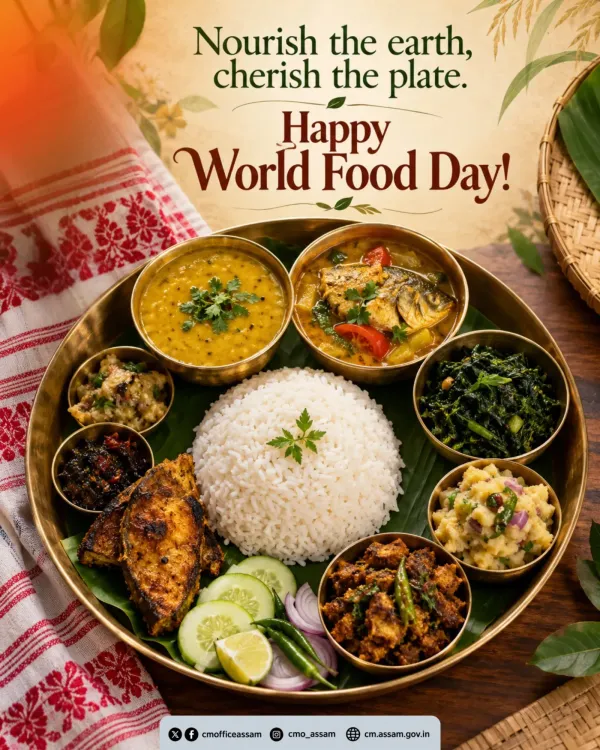
On the global stage of food security and heritage, Assam is staking a claim for its ancient plates. The Chief Minister's Office of Assam on Friday, 16 October 2026 — World Food Day — called on people to celebrate the state's diverse indigenous cuisines, preserve its culinary traditions for future generations, and carry the unique flavours of the land to a global audience.
The post read: 'This #WorldFoodDay, let us celebrate the diverse indigenous cuisines of Assam, preserve our rich culinary traditions for future generations and share the unique flavours of our land with the world.'
Why Assam's food map is unlike any other
Assam sits at the crossroads of South and Southeast Asia, its cuisine shaped by the Brahmaputra river valley, dense forests, and dozens of tribal and ethnic communities — from the Bodo and Mising peoples to the Karbi and Dimasa. The result is a culinary tradition that leans on freshwater fish, fermented bamboo shoots, indigenous herbs, and hand-pounded rice in ways that have no precise equivalent elsewhere in India. It is a living food culture, not a museum exhibit. World Food Day, observed annually on 16 October, was established by the Food and Agriculture Organisation (FAO) of the United Nations to draw attention to food security and agricultural heritage. For Indian states, the occasion has become a regular moment to spotlight regional identity — but Assam's culinary depth gives the gesture genuine weight.GI tags, teas, and the politics of culinary identity
Assam has already moved beyond symbolism in parts of its food-heritage agenda. The state's teas — synonymous with the global breakfast cup — and distinctive rice varieties like joha (a short-grain aromatic rice) have attracted Geographical Indication interest, tying local produce to legal protection and premium markets. That framework, if extended deliberately to other indigenous ingredients and dishes, could give Assam's food culture both economic muscle and international recognition. The tourism sector stands to gain too. Food tourism is among the fastest-growing travel segments globally, and Assam — already drawing visitors for its wildlife corridors and Bihu festivals — has an underexploited culinary story waiting for a larger stage. The call to 'share the unique flavours of our land with the world' is not just ceremonial. It is a quiet signal toward a fuller cultural-diplomacy strategy — one where a bowl of masor tenga (a tangy fish curry) or a smoked pork preparation from the hills can carry a state's identity as powerfully as any official delegation. Assam's kitchens have held these flavours for centuries. The next move is deciding who helps carry them forward.Point of View
But Assam's post lands with more substance than most: the state genuinely possesses a layered, underdocumented food heritage tied to ethnic diversity and riverine geography. The framing — preserve for future generations, share with the world — tracks a pattern of soft cultural diplomacy that complements harder economic tools like GI tagging. Whether this translates into structured policy, food-festival programming, or culinary tourism infrastructure will determine whether the sentiment moves beyond social media. The signal is consistent with Assam's broader push under recent administrations to convert cultural distinctiveness into tangible branding.
NationPress
16 Oct 2026
Frequently Asked Questions
What is World Food Day and why does India observe it?
World Food Day is observed every year on 16 October, established by the United Nations Food and Agriculture Organisation (FAO) to raise awareness about food security and agricultural heritage. Indian states and the central government use the occasion to spotlight regional food cultures and policy priorities.
What makes Assam's cuisine unique?
Assam's cuisine is shaped by the Brahmaputra river valley and dozens of tribal communities including the Bodo, Mising, Karbi, and Dimasa peoples. It features freshwater fish, fermented bamboo shoots, indigenous herbs, and aromatic rice varieties like joha — flavours with no precise equivalent elsewhere in India.
What Assam food products have GI tags or GI interest?
Assam's world-famous teas hold strong geographical identity, and indigenous rice varieties such as joha aromatic rice have attracted Geographical Indication interest, which links local produce to legal protection and premium market access.
How does food heritage connect to tourism in Assam?
Assam already draws visitors for its wildlife corridors and Bihu festivals. Food tourism is a fast-growing global travel segment, and the state's distinctive culinary traditions represent an underexploited attraction that could complement existing tourism circuits.
What did the Assam Chief Minister's Office say on World Food Day 2026?
The Chief Minister's Office of Assam posted on 16 October 2026 urging people to celebrate the state's diverse indigenous cuisines, preserve rich culinary traditions for future generations, and share Assam's unique flavours with the world.