Assam CM Office Highlights District Mustard Mission Push
Synopsis
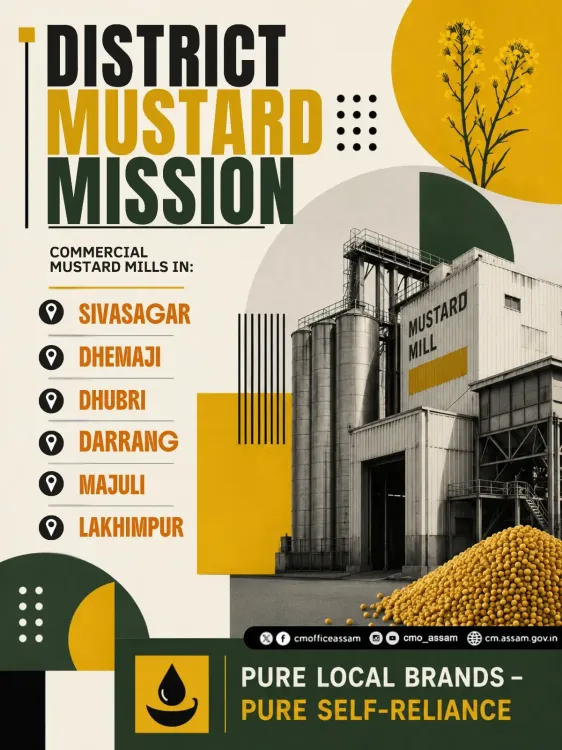
Assam's Chief Minister's Office announced on June 14, 2026, that commercial mustard mills are being established across multiple districts under the District Mustard Mission, aiming to strengthen the mustard value chain and boost farmer incomes under CM Dr. Himanta Biswa Sarma's leadership.
Key Takeaways
The Chief Minister's Office of Assam announced the District Mustard Mission on June 14, 2026 , targeting a stronger mustard value chain.
Commercial mustard mills are being established across multiple districts of Assam to enhance local processing capacity.
The initiative is led by Chief Minister Dr.
Himanta Biswa Sarma , who has overseen multiple agricultural value-addition programmes since May 2021 .
Assam has been part of the central National Food Security Mission-Oilseeds since 2007-08 , providing a policy foundation for the current effort.
The mission aligns with India's post-2021 push for atmanirbhar (self-reliant) edible-oil production, mirroring similar district-level oilseed initiatives in Madhya Pradesh , Rajasthan , and Uttar Pradesh .
Key beneficiaries include mustard farmers and local oil millers across Assam's districts.
The Chief Minister's Office of Assam on Sunday, June 14, 2026, spotlighted the state's District Mustard Mission, announcing that commercial mustard mills are being established across multiple districts to build a stronger mustard value chain under the leadership of Chief Minister Dr. Himanta Biswa Sarma.
Context
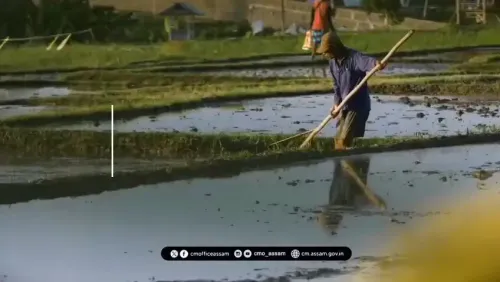
The CMO's post declared: 'Every bottle of mustard oil begins with the hard work of our farmers.' The statement frames the mission not merely as an industrial initiative but as a recognition of the agricultural labour underpinning Assam's edible-oil economy. The District Mustard Mission is a state-level programme aimed at expanding mustard cultivation, processing infrastructure, and commercial milling capacity across Assam's districts.
Mustard oil occupies a central place in the culinary and cultural identity of Assam and the broader northeastern region. By investing in local processing infrastructure, the state government seeks to capture more value within the supply chain rather than allowing raw oilseeds to be processed elsewhere.
Policy Backdrop
Assam's push sits within a longer national policy arc. The state has participated in the central National Food Security Mission-Oilseeds since 2007-08, which was designed to raise rapeseed-mustard output across producing states. The post-2021 national emphasis on atmanirbhar (self-reliant) edible-oil production has given fresh urgency to such state-level efforts, as India continues to depend heavily on edible-oil imports.
Several Indian states — including Madhya Pradesh, Rajasthan, and Uttar Pradesh — have pursued comparable district-level oilseed value chains, combining production support with new commercial milling capacity. Assam's District Mustard Mission mirrors this broader pattern, tailored to the state's agro-climatic conditions and farmer base.
Stakeholders and Impact
The primary beneficiaries of the mission are mustard farmers across Assam's districts, who stand to gain from better procurement linkages, reduced post-harvest losses, and potentially higher farm-gate prices once local processing capacity is in place. Local oil millers and agri-entrepreneurs represent a second layer of stakeholders who could see new business opportunities as commercial mills come online.
For consumers, a more robust local supply chain could translate into greater availability of Assam-origin mustard oil, reducing dependence on supplies processed outside the state. The initiative also carries employment implications for rural districts where the new mills are being established.
What's Next
Observers will watch for the rollout timelines and capacity utilisation rates of the new mustard mills as the mission scales across districts. State budget allocations and any production or procurement targets announced for 2026-27 will be key indicators of how aggressively the government intends to push the programme forward.
If the District Mustard Mission delivers on its stated goals, it could position Assam as a model for other northeastern states seeking to build oilseed value chains — and provide CM Dr. Himanta Biswa Sarma with a concrete rural-economy achievement ahead of the next electoral cycle.
Point of View
The CMO is simultaneously signalling policy intent and building rural goodwill. The initiative fits a broader pattern of BJP-governed states using district-level missions to demonstrate granular governance rather than top-down schemes. Whether the commercial mills translate into measurable income gains for farmers will ultimately determine the mission's political and economic legacy.
NationPress
13 Sept 2026
Frequently Asked Questions
What is the District Mustard Mission in Assam?
The District Mustard Mission is a state-level programme in Assam designed to expand mustard cultivation, build processing infrastructure, and establish commercial mustard mills across multiple districts to create a stronger oilseed value chain.
Who is leading the District Mustard Mission in Assam?
The mission is being led under the leadership of Chief Minister Dr. Himanta Biswa Sarma, who has been in office since May 2021 and has overseen multiple agricultural and rural economy initiatives.
How does Assam's mustard mission connect to national oilseed policy?
Assam has participated in the central National Food Security Mission-Oilseeds since 2007-08. The current initiative also aligns with India's post-2021 emphasis on self-reliant edible-oil production to reduce import dependence.
Who benefits from the commercial mustard mills being set up in Assam?
Mustard farmers across Assam's districts are the primary beneficiaries, gaining better processing linkages and potentially higher farm-gate prices. Local oil millers and rural workers in districts where mills are established also stand to benefit.
Which other Indian states have similar oilseed value chain programmes?
Madhya Pradesh, Rajasthan, and Uttar Pradesh have pursued comparable district-level oilseed value chain initiatives, combining production support with commercial milling capacity — a model Assam is now replicating.