CM Himanta: Assam's 624 PACS to bring agri services to farmers' doors
Synopsis
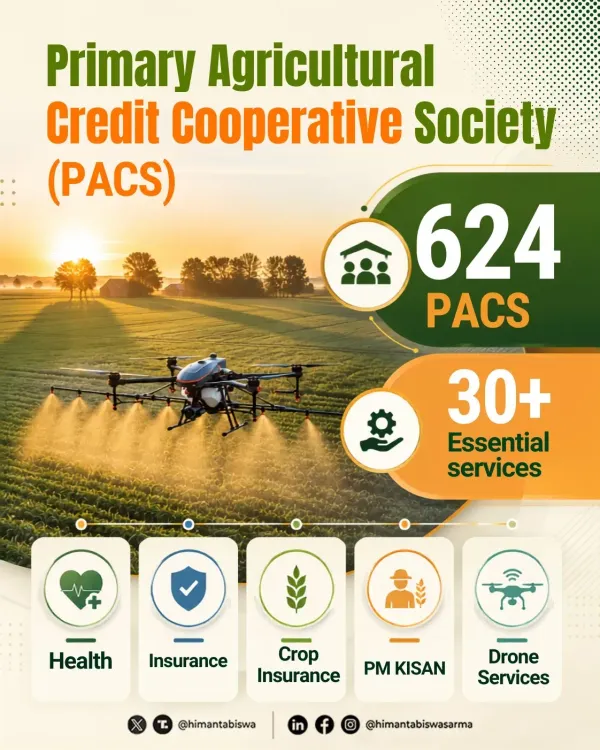
Assam Chief Minister Himanta Biswa Sarma announced on 30 June 2026 that 624 Primary Agricultural Credit Cooperative Societies will serve as one-stop centres delivering finance, crop insurance, agri-tech, advisory support, and welfare schemes to farmers at their doorstep.
Key Takeaways
624 PACS across Assam are being activated as multi-service delivery points for farmers.
Services to be channelled through PACS include finance, crop insurance, agri-tech, advisory support, and welfare schemes .
The stated goal is to minimise travel for farmers to access government and financial services.
The initiative aligns with the Union Government's national PACS computerisation and multipurpose expansion drive .
The move is particularly significant for Assam's smallholder farmers in flood-prone and geographically remote areas.
CM Himanta Biswa Sarma framed the PACS network as central to the state's agricultural outreach strategy.
Assam Chief Minister Himanta Biswa Sarma on Tuesday, 30 June 2026 outlined the state government's push to decentralise agricultural services, stating that 624 Primary Agricultural Credit Cooperative Societies (PACS) are being activated to deliver finance, crop insurance, agri-tech, advisory support, and welfare schemes directly to farmers with minimal travel burden.
Context
In his post, CM Sarma stated: 'Our aim is to ensure that farmers need to undertake minimal travel to access services. With 624 Primary Agricultural Credit Cooperative Societies (PACS), we are bringing finance, crop insurance, agri-tech, advisory support and welfare schemes closer to their doorstep.' The statement signals a deliberate policy direction to use the cooperative network as a last-mile delivery channel for a bundled suite of agricultural services in Assam.
PACS are village-level cooperative credit institutions that form the base tier of India's short-term rural cooperative credit structure. Historically, their primary mandate has been providing crop loans and accepting deposits, but successive national and state-level reforms have sought to expand their functional scope to include storage, processing, retail, and now integrated agri-services.
Policy Backdrop
The expansion of PACS beyond credit has been a stated priority of the Union Government as well, with a national-level computerisation drive launched to digitise over 63,000 PACS across India to make them multipurpose service centres. Assam's articulation of a 624-PACS network delivering bundled services fits within this broader federal policy architecture, adapting it to state-specific agricultural conditions.
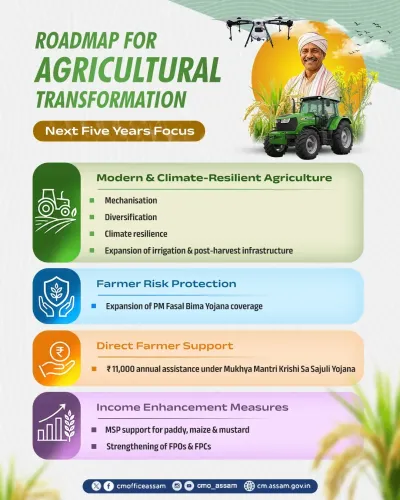
Assam's agrarian economy is characterised by smallholder farmers, flood-prone cultivation zones, and significant dependence on paddy, jute, and tea. Access to formal credit and insurance has historically been constrained by geography and infrastructure gaps. Channelling crop insurance — including schemes such as the Pradhan Mantri Fasal Bima Yojana (PMFBY) — through PACS could reduce the documentation and travel burden that has deterred enrolment among marginal farmers.
The inclusion of agri-tech and advisory support in the PACS mandate is notable. It suggests an intent to make these societies function as one-stop centres where farmers can access soil health data, market price information, and extension services alongside financial products — a model that several state governments have piloted with varying degrees of success.
Stakeholders and Impact
The primary beneficiaries of this initiative are Assam's smallholder and marginal farming households, who constitute the bulk of the state's agricultural workforce. Reducing travel requirements is particularly significant in Assam, where riverine geography and seasonal flooding can make district-level government offices inaccessible for extended periods.
Cooperative sector staff, agri-input suppliers, and insurance company correspondents operating through PACS branches stand to see increased transactional volume if the multi-service model is operationalised effectively. State-level agricultural departments and financial institutions will also be key implementation partners in ensuring that the expanded mandate translates into on-ground service delivery.
What's Next
The government's stated aim now raises questions of implementation: whether the 624 PACS have the trained personnel, digital infrastructure, and financial linkages to deliver the full suite of services described. Operational guidelines, budgetary allocations, and timelines for the expanded PACS mandate will be closely watched by farming communities and cooperative sector observers alike.
If successfully executed, the model could position Assam as a reference case for other northeastern states seeking to strengthen last-mile agricultural service delivery through existing cooperative infrastructure, with implications for how NEDA-aligned governments approach rural economic policy across the region.
Point of View
Bundling financial inclusion with agri-tech to project a modernising image. The move dovetails with the BJP's broader national narrative of cooperative-led rural development, giving Assam a visible role in a federally-backed policy direction. However, the credibility of the announcement will hinge on whether the state can staff, digitise, and financially link all 624 societies — a logistical challenge that has stalled similar initiatives in other states. For the NEDA bloc, a successful Assam model could become a template that strengthens the alliance's rural governance pitch across the northeast.
NationPress
29 Sept 2026
Frequently Asked Questions
What are PACS and how do they help farmers in Assam?
Primary Agricultural Credit Cooperative Societies (PACS) are village-level cooperative institutions that provide short-term crop loans and financial services to farmers. In Assam, the government is expanding their role to also cover crop insurance, agri-tech support, and welfare scheme enrolment, reducing the need for farmers to travel to distant offices.
How many PACS are active in Assam?
According to Chief Minister Himanta Biswa Sarma's statement on 30 June 2026, Assam has 624 Primary Agricultural Credit Cooperative Societies being used to deliver bundled agricultural and financial services to farmers.
What services will Assam PACS provide to farmers?
Under the initiative announced by CM Sarma, PACS in Assam are set to provide finance (crop loans), crop insurance, agri-tech tools and information, agricultural advisory support, and government welfare scheme access — all at or near the village level.
How does this relate to the national PACS expansion policy?
The Union Government has been running a national programme to computerise and convert over 63,000 PACS into multipurpose service centres. Assam's 624-PACS initiative is consistent with this federal direction, adapting the model to the state's specific agricultural and geographic challenges.
Which farmers in Assam will benefit most from the PACS doorstep service initiative?
Smallholder and marginal farmers in Assam — especially those in flood-prone riverine areas and remote districts where travel to government offices is difficult — are expected to be the primary beneficiaries of the expanded PACS service delivery model.