BTC's Kachugaon Forest Division launches human-elephant conflict drive near Raimona
Synopsis
For forest fringe communities living alongside the Chirang-Ripu Elephant Reserve, crop raids and property damage by wild elephants are a recurring reality. The BTC's Kachugaon Forest Division has now launched Assam's first structured awareness drive near Raimona National Park — bringing together forest officials, the army, scientists, and villagers to move from reactive crisis management to proactive coexistence.
Key Takeaways
The Kachugaon Forest Division under the Bodoland Territorial Council (BTC) launched its first human-elephant conflict awareness programme on 11 July 2025 .
The inaugural session was held at Thaisoguri FRA village under the Sanfan Range , near Raimona National Park .
The programme was inaugurated by Additional PCCF Sonali Ghosh , who stressed community cooperation as essential to ecological balance.
Key strategies discussed include early warning systems, protection of elephant corridors, and immediate reporting of elephant sightings to the Forest Department .
The region falls within the Chirang-Ripu Elephant Reserve ; the BTR covers Kokrajhar , Chirang , Baksa , and Udalguri districts.
Similar awareness programmes are planned for other forest fringe villages across the Bodoland Territorial Region .
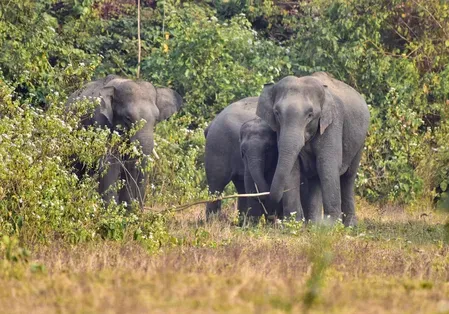
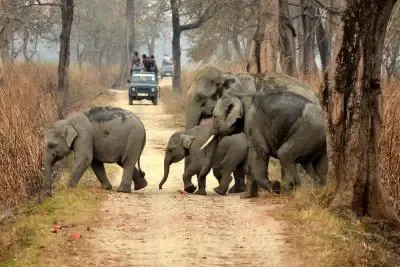
The Kachugaon Forest Division under the Bodoland Territorial Council (BTC) launched its first formal awareness programme on human-elephant conflict on 11 July 2025, targeting forest fringe communities near Raimona National Park in Assam. The initiative aims to foster safer coexistence between local residents and wild elephants in one of India's most conflict-prone wildlife corridors.
How the Programme Was Launched
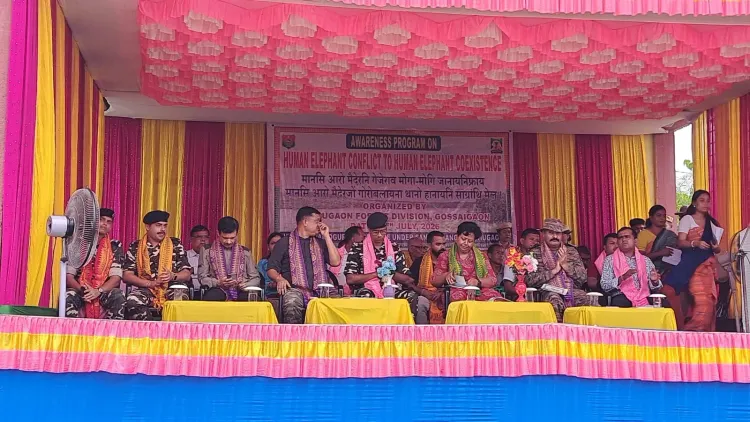
The inaugural session was held at Thaisoguri, a Forest Rights Act (FRA) village under the Sanfan Range, and was inaugurated by Additional Principal Chief Conservator of Forests (Additional PCCF) and BTC Council Head of Department Sonali Ghosh. The event brought together forest officials, wildlife experts, security agencies including the Sashastra Seema Bal (SSB) and Territorial Army, community leaders, and residents from villages bordering the national park.
Attendees included Kameswar Das, Chief Scientist at Assam Agricultural University's Zonal Research Station in Gossaigaon; Porna Sharma, Senior Head Scientist of Krishi Vigyan Kendra (KVK) at Gossaigaon; Major Pratap Singh Rathore of the 135 Ecological Task Force at Bishmuri; Mustafa Ali Ahmed, Divisional Forest Officer; and Shree Jeet Singh, Second-in-Command of SSB 31 Battalion at Telipara.
What Experts and Officials Said
In her address, Sonali Ghosh underscored the indispensable role of local communities in wildlife conservation, urging villagers to adopt practices that reduce direct encounters with elephants. The senior Indian Forest Service (IFS) officer noted that elephants are integral to the region's forest ecosystem and that maintaining ecological balance demands close cooperation between the Forest Department and residents.
Ghosh also acknowledged the sustained support of neighbouring communities in preserving the biodiversity of Raimona National Park. Other experts stressed that effective coordination among government agencies, local organisations, and village communities is essential for ensuring the safety of both people and elephants.
Key Strategies Discussed
Experts at the session outlined several practical measures to reduce conflict, including strengthening early warning systems, protecting agricultural fields from elephant incursions, safeguarding traditional elephant corridors from encroachment, and expanding public awareness campaigns in forest fringe villages. Residents were specifically advised to alert the Forest Department immediately whenever elephant movement is detected near human settlements.
Villagers from Thaisoguri and neighbouring communities actively participated, sharing first-hand accounts of crop damage and property loss caused by elephants and seeking durable, long-term solutions to the recurring problem.
Why This Region Is Especially Vulnerable
The area falls within the Chirang-Ripu Elephant Reserve, one of Assam's designated elephant habitats. The BTC is an autonomous administrative body constituted under the Sixth Schedule of the Constitution to govern the Bodoland Territorial Region (BTR) in western Assam. The BTR — comprising the four districts of Kokrajhar, Chirang, Baksa, and Udalguri — shares international borders with Bhutan and a state border with West Bengal, making it ecologically sensitive and a critical transit zone for elephant movement.
This is the first such structured awareness drive under the Kachugaon Forest Division, and officials indicated that similar programmes are planned for other forest fringe villages across the BTR. The initiative reflects a broader shift in wildlife management — from reactive conflict response to proactive community engagement.
Point of View
Rooted in shrinking corridors and expanding agricultural settlements. The BTC's awareness drive is a welcome step, but awareness alone does not rebuild degraded corridors or compensate families who lose harvests season after season. The real measure of this initiative will be whether it leads to enforceable corridor protection and a faster, more transparent crop-damage compensation mechanism. Without those, the goodwill generated at Thaisoguri risks evaporating the next time a herd moves through a paddy field at night.
NationPress
11 Jul 2026
Frequently Asked Questions
What is the human-elephant conflict awareness programme launched by the BTC?
It is a community outreach initiative by the Kachugaon Forest Division under the Bodoland Territorial Council, launched on 11 July 2025 at Thaisoguri village near Raimona National Park in Assam. The programme sensitises forest fringe residents on early warning systems, corridor protection, and safe practices to reduce direct encounters with wild elephants.
Where was the first awareness session held and who inaugurated it?
The first session was held at Thaisoguri, a Forest Rights Act village under the Sanfan Range, and was inaugurated by Additional PCCF and BTC Council Head of Department Sonali Ghosh. Forest officials, wildlife experts, security agencies, and local residents all participated.
Why is the Chirang-Ripu Elephant Reserve area particularly prone to human-elephant conflict?
The Chirang-Ripu Elephant Reserve is a critical elephant habitat in western Assam, and the Bodoland Territorial Region's four districts border both Bhutan and West Bengal, making them key transit zones for elephant movement. Dense forest fringe settlements and agricultural expansion near these corridors increase the frequency of conflict.
What practical measures were recommended to reduce elephant conflict?
Experts recommended strengthening early warning systems, protecting agricultural fields, preventing encroachment on traditional elephant corridors, and ensuring residents immediately alert the Forest Department when elephants are spotted near settlements. Coordination among government agencies, local organisations, and village communities was also emphasised.
What is the Bodoland Territorial Council and which districts does it cover?
The BTC is an autonomous administrative body established under the Sixth Schedule of the Indian Constitution to govern the Bodoland Territorial Region in western Assam. It covers four districts — Kokrajhar, Chirang, Baksa, and Udalguri — and shares borders with Bhutan and West Bengal.