Assam's Chot Tingrai Estate Becomes India's First Commercial Matcha Producer
Synopsis
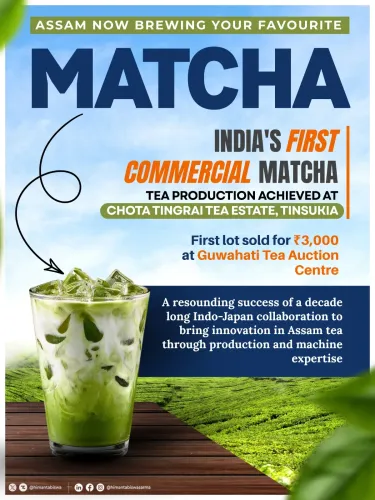
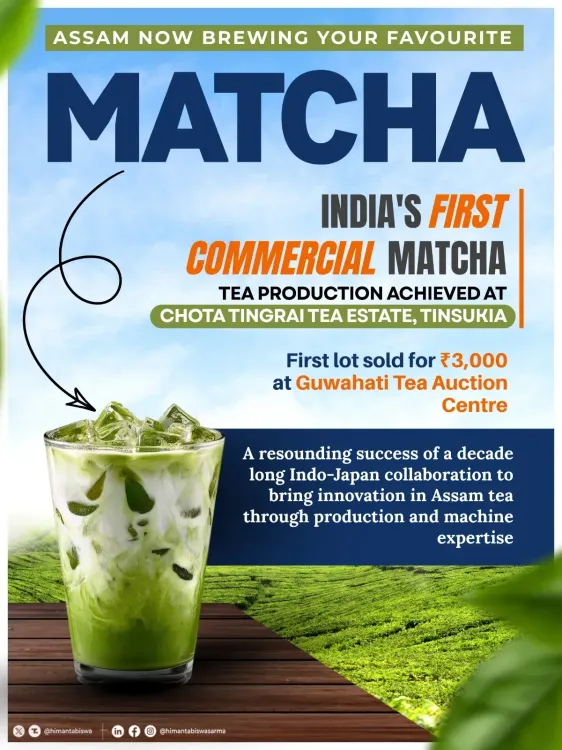
Chot Tingrai Tea Estate in Tinsukia, Assam has made history as India's first commercial Matcha tea producer. The debut lot fetched ₹3,000 at the Guwahati Tea Auction Centre, marking a significant diversification milestone for Assam's tea industry and opening a potential new export avenue.
Key Takeaways
Chot Tingrai Tea Estate in Tinsukia, Assam is the first tea estate in India to commercially produce Matcha tea .
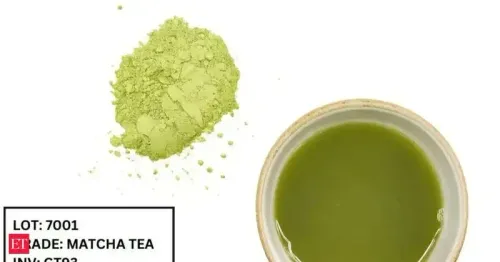
The inaugural Matcha lot was auctioned at the Guwahati Tea Auction Centre , fetching ₹3,000 .
Matcha is a finely ground green tea powder historically produced in Japan ; India has until now been a consumer, not a producer.
Assam produces over half of India's tea, predominantly CTC and orthodox black varieties ; Matcha represents a major value-added diversification.
The Tea Board of India , established in 1953 , has long promoted specialty and value-added tea to improve farmgate realisations.
Successful scaling of the Matcha model could open new premium export markets in Europe, North America, and East Asia for Indian producers.
The Chief Minister's Office of Assam announced on Thursday, 9 July 2026, that Chot Tingrai Tea Estate in Tinsukia has become the first tea estate in India to commercially produce Matcha tea, with the inaugural lot fetching ₹3,000 at the Guwahati Tea Auction Centre.
Context
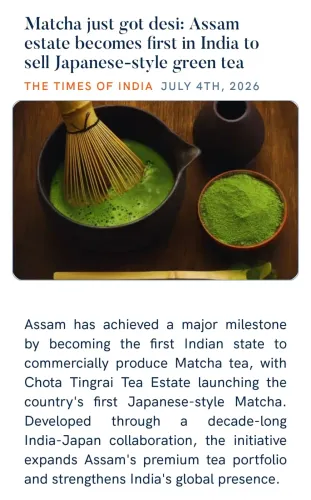
Chot Tingrai Tea Estate, located in the Tinsukia district of upper Assam, achieved a milestone that has so far eluded every other tea garden in the country. Matcha — a finely ground powder of specially shade-grown green tea leaves — has historically been associated with Japan, where it forms the backbone of the traditional tea ceremony and a rapidly growing global food and beverage market. India has until now remained a consumer and importer of the product, not a producer.
The first commercial lot from Chot Tingrai was put up for trade at the Guwahati Tea Auction Centre, the region's primary price-discovery platform operating under the framework of the Tea Board of India. The opening price of ₹3,000 per lot signals early market interest in domestically produced Matcha.
Policy Backdrop
The Tea Board of India, constituted in 1953 under the Tea Act, has over the decades encouraged diversification beyond the bulk black tea that dominates Assam's output. Assam accounts for more than half of India's total tea production, the vast majority of which is CTC (crush-tear-curl) and orthodox black varieties sold at relatively low per-kilogram realisations.
Successive Tea Board schemes and national agricultural export policy have pushed estates toward value-added and specialty products — including orthodox, white, and green teas — to improve farmgate prices and compete in premium international markets. Commercial Matcha production represents the furthest point along that diversification curve attempted by any Indian estate.
Stakeholders and Impact
Tea growers across Assam's roughly 800 large estates and thousands of small-holder gardens stand to benefit if the Matcha experiment at Chot Tingrai proves replicable and commercially viable at scale. Specialty teas command significantly higher per-kilogram prices than commodity CTC grades, offering a route to better incomes for garden workers and smallholders alike.
Tea exporters are also watching closely: global Matcha demand — driven by health-conscious consumers in Europe, North America, and East Asia — has grown sharply over the past decade, and an Indian supply source could diversify the global market currently dominated by Japanese and, increasingly, Chinese producers. The Guwahati Tea Auction Centre will serve as the initial barometer of buyer appetite and price discovery for this new category.
What's Next
Industry observers will track subsequent auction results at Guwahati to see whether the debut price of ₹3,000 holds, rises, or attracts competitive bidding from specialty buyers and exporters. Any formal recognition or incentive from the Tea Board of India or the Government of Assam for Matcha processing units could accelerate adoption across other estates in Tinsukia and neighbouring districts.
If Chot Tingrai's model scales, Assam could position itself as a credible alternative origin for global Matcha buyers — adding a high-value chapter to a tea industry that has defined the state's economy for nearly two centuries.
Point of View
The state's tea economy has been squeezed by low CTC prices and stagnant export realisations; a viable domestic Matcha supply chain could fundamentally alter that calculus. The CMO Assam's decision to amplify the news signals that the state government sees specialty tea as a political and economic priority, potentially inviting Tea Board support and private investment. Whether the ₹3,000 debut price sustains competitive bidding in subsequent auctions will be the real test of whether this milestone translates into a durable industry shift.
NationPress
9 Jul 2026
Frequently Asked Questions
Which tea estate became India's first commercial Matcha producer?
Chot Tingrai Tea Estate in Tinsukia, Assam became the first tea estate in India to commercially produce Matcha tea, as announced by the Chief Minister's Office of Assam on 9 July 2026.
What price did India's first commercial Matcha tea lot fetch?
The first commercial Matcha lot from Chot Tingrai Tea Estate fetched ₹3,000 at the Guwahati Tea Auction Centre .
What is Matcha tea and why is it significant?
Matcha is a finely ground powder made from shade-grown green tea leaves, traditionally produced in Japan. It commands premium global prices and is used in beverages, confectionery, and health products. India producing it commercially for the first time opens a new high-value export category.
Where is Chot Tingrai Tea Estate located?
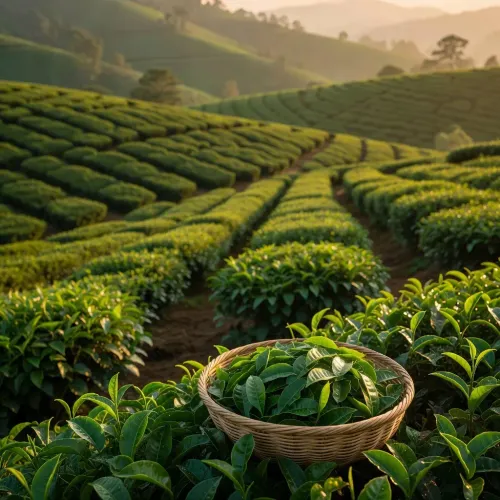
Chot Tingrai Tea Estate is located in the Tinsukia district of upper Assam, a region in northeastern India known for its large-scale tea cultivation in the Brahmaputra valley.
How does this development fit into Assam's tea industry policy?
The Tea Board of India and successive state governments have encouraged diversification beyond commodity CTC black tea to improve farmgate realisations. Commercial Matcha production represents the most advanced step yet in that value-addition strategy for Assam's tea sector.