Will Assam’s R-Day Tableau Showcase Asharikandi’s Terracotta Heritage and Riverine Culture?
Synopsis
This year, Assam's Republic Day tableau will illuminate the terracotta heritage of Asharikandi, showcasing its rich riverine culture and self-reliance. Discover how this vibrant craft village is portrayed on a national stage, reflecting the deep-rooted traditions and entrepreneurial spirit of its artisans. Join us in celebrating Assam's cultural legacy!
Key Takeaways
Asharikandi is a significant terracotta craft village in Dhubri district.
The tableau highlights traditional Assamese crafts and riverine culture.
Artisans use locally sourced hiramati clay for their creations.
The village has a rich history, tracing back over a century.
The terracotta crafts of Dhubri received a Geographical Indication (GI) tag in March 2024.
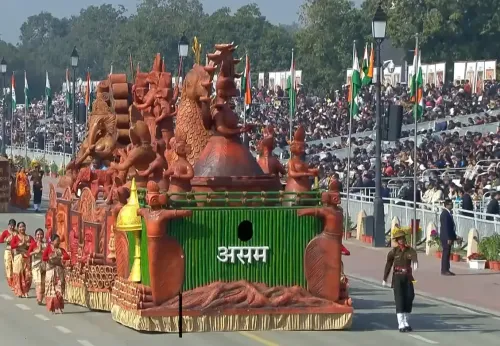
New Delhi, Jan 22 (NationPress) This year, Assam’s Republic Day tableau aims to spotlight Asharikandi, a distinguished terracotta craft village located in Dhubri district, which exemplifies the state’s rich riverine culture and the essence of self-reliance deeply embedded in traditional livelihoods.
The tableau was previewed for media representatives on Thursday at the Rashtriya Rangshala Camp in the national capital, attended by Nodal Officer Bikram Newar along with officials from the Cultural Affairs Department of the Government of Assam.
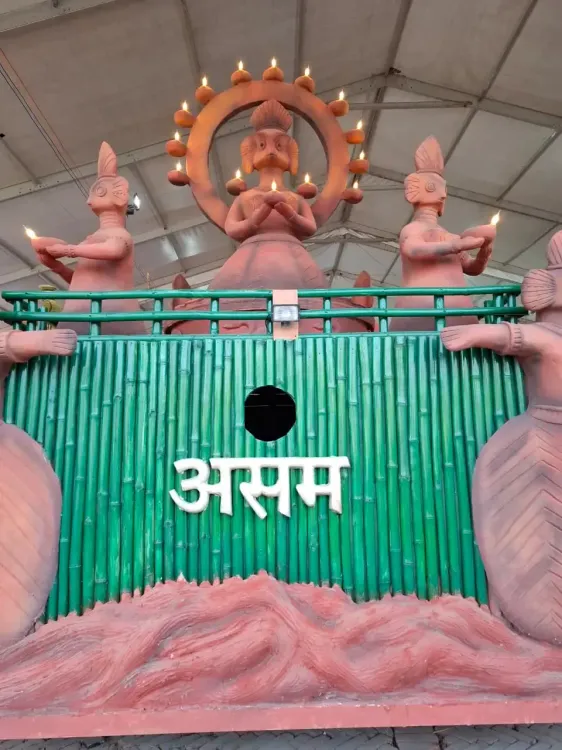
At the heart of the tableau is an impressive terracotta installation featuring a towering figure holding earthen lamps arranged in a circular pattern, symbolizing continuity, light, and the lasting legacy of Assam’s indigenous crafts.
The tractor-mounted display is accompanied by earthen sarai positioned along bamboo fencing, highlighting the significance of bamboo as a sustainable resource and its role in the socio-economic landscape of the state. The trailer part resembles a traditional Mayurpangkhi boat, reflecting Assam’s profound connection with its rivers.
Artisans can be seen actively molding hiramati (local clay) into deities' idols such as Ganesh, Kartik, Durga, Lakshmi, and Saraswati, offering a vivid representation of the terracotta-making process.
A traditional sail canvas at the back enhances the authenticity of the riverine theme. Conceptualized around the theme of Atmanirbhar Bharat, the tableau showcases Asharikandi as a model of cultural entrepreneurship, where generations of artisans have maintained their livelihoods through time-honored skills adapted for modern markets.
The village symbolizes self-reliance achieved through the preservation and promotion of traditional knowledge systems.
Situated in western Assam’s Dhubri district, Asharikandi is recognized as the largest terracotta and pottery craft hub in the state. Its artisans are celebrated for producing puttola—terracotta toys and idols—including the famous Hatima doll.
The craft tradition has a history of over a century, tracing back to pottery communities that migrated from erstwhile East Bengal in the early 19th century.
The village gained national acclaim through the late Sarala Bala Devi, who won the National Award for Terracotta Craft in 1982.
In March 2024, the terracotta crafts of Dhubri district were awarded the Geographical Indication (GI) tag, further solidifying Asharikandi’s reputation as a center of excellence.
Through its Republic Day tableau, Assam presents a living craft tradition to Kartavya Path, celebrating heritage, resilience, and self-reliance, according to an official release.
Point of View
It is essential to recognize the significance of Assamese culture represented through Asharikandi’s terracotta crafts at the Republic Day tableau. This event not only showcases the resilience and creativity of local artisans but also highlights the importance of preserving traditional skills in a rapidly modernizing world.
NationPress
4 Oct 2026
Frequently Asked Questions
What is the significance of Asharikandi in Assam?
Asharikandi is renowned for its terracotta crafts, representing a unique blend of traditional skills and modern entrepreneurship, making it a vital part of Assam's cultural heritage.
What does the tableau feature?
The tableau features a striking terracotta installation with artisans at work, showcasing the terracotta-making process and symbolizing the region's riverine culture.
Who conceptualized the tableau?
The tableau is conceptualized around the theme of Atmanirbhar Bharat, showcasing Asharikandi as a model of cultural entrepreneurship.