BARC scientists visit Andaman Islands to scout Small Modular Reactor sites

Synopsis
India's nuclear establishment has moved from discussion to ground-level action on Small Modular Reactors for the Andaman and Nicobar Islands. A BARC team is now physically scouting sites — a first step that, if it succeeds, could make these islands India's inaugural SMR territory and solve a power crisis that decades of diesel dependence and failed LNG plans never could.
Key Takeaways
A BARC team arrived in Sri Vijaya Puram on 4 September 2026 to identify sites for Small Modular Reactors (SMRs) in the Andaman and Nicobar Islands .
The team will spend four days surveying all three districts of the island chain.
The islands currently rely entirely on diesel generator sets fuelled by mainland-shipped oil — conventional power plants cannot be built there.
The Great Nicobar Project — encompassing a deep-sea port, container transhipment terminal, and airport — is expected to sharply increase electricity demand.
Lieutenant Governor Admiral D K Joshi (Retd) has strongly backed SMR deployment and pledged full administrative support to the BARC team.
Alternative power plans — offshore LNG and geothermal energy — have stalled, making SMRs the most viable near-term solution.
A team of scientists from the Bhabha Atomic Research Centre (BARC), under the Department of Atomic Energy, is currently in Sri Vijaya Puram (formerly Port Blair) to identify potential sites for Small Modular Reactors (SMRs) in the Andaman and Nicobar Islands. The Centre is actively exploring SMRs as the most feasible solution to the archipelago's chronic power deficit, which is set to deepen with the ambitious Great Nicobar Project underway.
What the BARC Team Is Doing
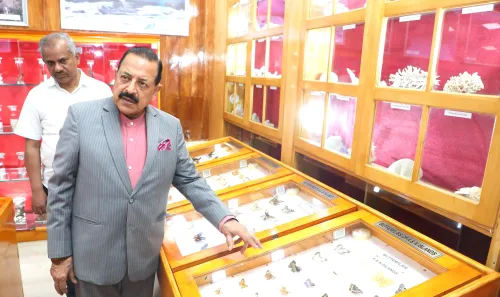
On Friday, 4 September 2026, the first day of the site-selection visit, the BARC delegation called on Admiral D K Joshi (Retd), Lieutenant Governor of the Andaman and Nicobar Islands, and delivered a detailed presentation on prospective sites and the technical parameters of the proposed SMR plan. Over the following four days, the team is scheduled to travel across the archipelago's three districts to conduct on-ground assessments of the shortlisted locations.
Why the Islands Need a New Power Source
The Andaman and Nicobar Islands currently have no conventional power plants — geography and environmental constraints make them impractical to build. The entire electricity supply is generated by diesel generator sets fuelled by oil shipped from the Indian mainland, a system that is both expensive and heavily polluting. As the Great Nicobar Project — which envisages a deep-sea port, an international container transhipment terminal, and an airport — gathers pace, electricity demand is expected to rise sharply beyond what diesel generation can sustain.
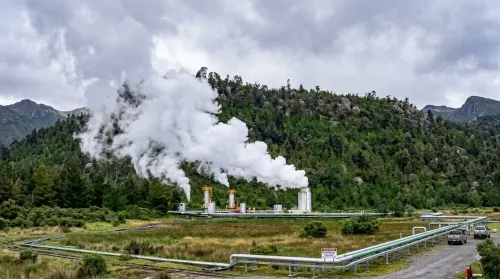
The government has explored alternatives over the years. Plans for an offshore LNG re-gasification plant have not materialised, and a proposal to harness geothermal energy is still in preliminary study stages, with feasibility assessments reportedly years away from completion. SMRs have emerged as the most immediately workable option.
Strategic and Military Significance
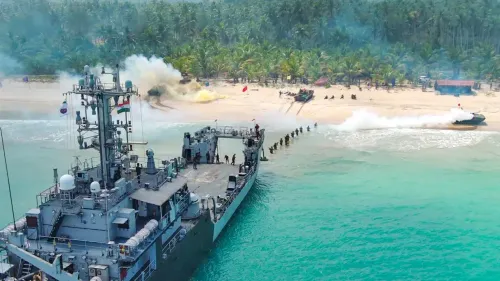
The push for energy self-sufficiency on the islands carries clear strategic weight. The Great Nicobar Project is designed to give the Indian Navy and the Indian Air Force expanded access to the Six Degree Channel, a critical maritime corridor leading to the Strait of Malacca — the vital choke point linking the Indian Ocean to the South China Sea. Reliable, indigenous power is a prerequisite for sustained military and commercial operations at that scale.
Lieutenant Governor's Backing
Admiral Joshi (Retd), who also serves as Vice-Chairman of the Islands Development Agency, has been a vocal advocate for SMR adoption. At the Power Ministers' Roundtable during the Bharat Electricity Summit 2026 held earlier this year, he made a strong case for deploying SMRs at select locations across the island chain. Drawing on his experience as a former Chief of the Indian Navy, he highlighted that several countries situated in Seismic Zone-V — a high-risk earthquake category — are already operating comparable nuclear power systems, including offshore barge-mounted floating plants. He also pointed to SMRs' advantages of rapid scalability and the potential for freshwater generation through associated cooling systems. According to sources, the Lieutenant Governor showed keen interest in the BARC team's presentation and pledged full administrative support.
Why SMRs Are a Fit for Island Geographies
Unlike full-scale nuclear plants, SMRs can be custom-engineered to match the specific power requirements of remote or island territories. They occupy a significantly smaller physical footprint, are modular by design — meaning capacity can be scaled up incrementally — and are operationally simpler to manage with a smaller on-site workforce. These characteristics make them well suited to geographically isolated locations like the Andaman and Nicobar Islands, where logistics and space are constrained.
If the site-selection exercise yields viable locations, the Andaman and Nicobar Islands could become the first Indian territory to host an SMR installation — a development that would mark a significant milestone in India's civilian nuclear programme.
Point of View
The Centre has quietly pivoted to nuclear as the pragmatic answer for the Andaman and Nicobar Islands. The strategic subtext is hard to miss — the Great Nicobar Project is fundamentally a military-access play on the Strait of Malacca, and you cannot sustain that kind of infrastructure on diesel shipped from the mainland. The real question is timeline: SMR projects globally have faced construction delays and cost overruns, and India has yet to build one. If the site selection moves quickly but regulatory and procurement processes lag, the islands' power crisis will outlast the project's optimistic framing.
NationPress
20 Oct 2026
Frequently Asked Questions
What are Small Modular Reactors and why are they suitable for the Andaman and Nicobar Islands?
Small Modular Reactors (SMRs) are compact, factory-built nuclear reactors that can be custom-sized for specific power needs and require far less physical space than conventional nuclear plants. They are considered ideal for the Andaman and Nicobar Islands because the archipelago cannot accommodate full-scale power plants, and SMRs can be scaled up incrementally as demand grows.
Why is the Andaman and Nicobar Islands' current power supply inadequate?
The islands have no conventional power plants and rely entirely on diesel generator sets fuelled by oil shipped from the Indian mainland — a costly and polluting arrangement. The upcoming Great Nicobar Project, which includes a deep-sea port, container transhipment terminal, and airport, is expected to drive electricity demand well beyond what the existing diesel-based system can handle.
What is the BARC team doing in Sri Vijaya Puram?
Scientists from the Bhabha Atomic Research Centre (BARC) arrived in Sri Vijaya Puram on 4 September 2026 to assess potential sites where SMRs could be installed. Over five days, the team will survey all three districts of the island chain and has already briefed Lieutenant Governor Admiral D K Joshi (Retd) on the proposed plan.
What other power alternatives have been considered for the islands?
The government has previously explored an offshore LNG re-gasification plant, which has not progressed, and a geothermal energy proposal that is still in early feasibility stages — reportedly years away from yielding actionable results. SMRs have emerged as the most immediately viable alternative to diesel generation.
What is the strategic significance of the Great Nicobar Project?
The Great Nicobar Project is designed to give the Indian Navy and Indian Air Force greater operational access to the Six Degree Channel, which connects the Indian Ocean to the South China Sea via the Strait of Malacca — one of the world's most critical maritime chokepoints. Reliable indigenous power is essential to sustaining the scale of military and commercial activity the project envisions.