Andaman geothermal energy: SECI invites EoIs for 5–20 MW plant
Synopsis
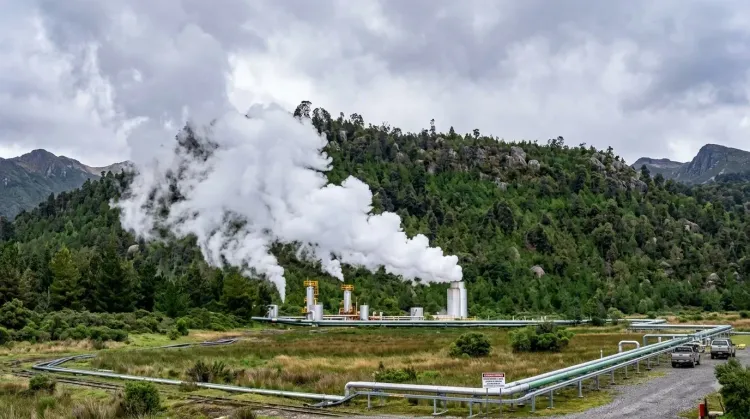
India is moving to harness volcanic geology in the Andaman and Nicobar Islands for geothermal power — a first for any Indian island region. SECI's EoI for a 5–20 MW plant, backed by a ₹15/kWh tariff ceiling and a 20–25-year PPA, could end the archipelago's costly diesel dependence and set a replicable model for other remote Indian territories.
Key Takeaways
SECI has invited Expressions of Interest for geothermal resource assessment and potential power plant development in the Andaman and Nicobar Islands .
The indicative project capacity is between 5 MW and 20 MW , with a proposed tariff ceiling of ₹15 per kWh and a PPA tenure of 20–25 years .
The initiative is part of the National Policy on Geothermal Energy notified by MNRE in September 2025 .
The Geological Survey of India has identified the islands as a major geothermal province; the region hosts South Asia's only active volcano on Barren Island.
Resource assessment is expected to take 18 months ; power plant development a further 24 months after validation.
A pre-submission meeting is scheduled for 17 August 2026 ; both Indian and international entities can participate.
The Solar Energy Corporation of India (SECI) has invited Expressions of Interest (EoIs) from domestic and international agencies to assess, explore, and potentially develop a geothermal power plant in the Andaman and Nicobar Islands, marking a significant step toward energy self-reliance for the ecologically sensitive archipelago. The move, reported on 13 August 2026, is part of India's National Policy on Geothermal Energy, notified by the Ministry of New and Renewable Energy (MNRE) in September 2025.
Why the Andamans Are a Natural Candidate
The island chain sits directly on an active tectonic boundary where the Indian Plate continues to subduct beneath the smaller Burma Plate, generating persistent seismic activity and sub-surface heat. The Geological Survey of India has formally identified the Andaman and Nicobar Islands as one of the country's major geothermal provinces. Reinforcing this geology, Barren Island in the Andamans hosts South Asia's only active volcano — a visible marker of the tectonic energy beneath.
The islands currently depend heavily on diesel imports from the mainland to power generators, a costly and carbon-intensive arrangement. Conventional thermal power plants are ruled out given the region's eco-sensitive classification, making renewable alternatives not just preferable but necessary.
What SECI Is Proposing
The proposed programme will unfold in stages: geological, geophysical, and geochemical investigations first, followed by exploratory drilling, resource validation, and — contingent on successful confirmation — construction of a geothermal power plant. The indicative project capacity is set between 5 MW and 20 MW.
SECI has indicated that the resource assessment and feasibility phase may take approximately 18 months, with power plant development requiring a further 24 months after resource validation. A tariff ceiling of ₹15 per kWh has been proposed, with a Power Purchase Agreement (PPA) tenure of 20–25 years for future competitive bidding. The Electricity Department of the Andaman and Nicobar Administration will procure the electricity generated.
Who Can Participate
Both Indian and international entities are eligible, either individually or through consortiums. SECI is specifically seeking organisations with experience in geothermal exploration, deep drilling — preferably to depths of 1,000 metres or more — renewable energy project development, or integrated infrastructure development. International geothermal technology providers and specialist consultants may also participate independently or in partnership with Indian firms.
A pre-submission meeting is scheduled for 17 August 2026.
India's Broader Geothermal Landscape
India's theoretical geothermal resource potential is estimated at around 10,600 MW, according to available data. The country has 381 documented hot springs, with 42 geothermal manifestations identified as promising sites for future exploration. Despite this potential, commercially operational geothermal power remains largely untapped in India. If the Andaman project clears its feasibility hurdles, it could become one of India's first geothermal power plants in an island region — a template potentially replicable in Lakshadweep and other remote territories.
SECI has underscored that geothermal energy, being weather-independent and available round the clock, offers baseload renewable power — a quality that solar and wind alone cannot provide, making it especially valuable for island grids with limited interconnection to the national network.
Point of View
Yet India has let this resource sit idle while importing diesel at significant cost and ecological risk. The ₹15/kWh tariff ceiling will be the real test: geothermal exploration is capital-intensive and uncertain, and developers will need confidence that the ceiling leaves room for a viable return even if drilling yields fall short. If SECI can attract credible international operators — Iceland, Kenya, and New Zealand have deep expertise — this could finally convert India's 10,600 MW theoretical potential into something bankable. The bigger question is whether a successful Andaman pilot accelerates geothermal policy for the mainland's 42 identified sites, or remains a one-off island experiment.
NationPress
28 Sept 2026
Frequently Asked Questions
What is the SECI geothermal project in the Andaman and Nicobar Islands?
SECI has invited Expressions of Interest to assess, explore, and potentially develop a geothermal power plant in the Andaman and Nicobar Islands, with an indicative capacity of 5 MW to 20 MW. The project is part of India's National Policy on Geothermal Energy notified in September 2025 and aims to reduce the islands' dependence on diesel-generated electricity.
Why are the Andaman and Nicobar Islands suitable for geothermal energy?
The islands sit on an active tectonic boundary where the Indian Plate subducts beneath the Burma Plate, generating sub-surface heat. The Geological Survey of India has classified the archipelago as a major geothermal province, and Barren Island hosts South Asia's only active volcano — clear indicators of exploitable geothermal resources.
What is the proposed tariff and contract structure for the project?
SECI has proposed a tariff ceiling of ₹15 per kWh, with a Power Purchase Agreement tenure of 20–25 years for future competitive bidding. The Electricity Department of the Andaman and Nicobar Administration will be the procuring entity.
How long will the project take to complete?
The resource assessment and feasibility stage is expected to take approximately 18 months. If the resource is confirmed viable, power plant development is projected to require a further 24 months, putting the earliest possible commissioning several years away.
Who is eligible to participate in the SECI EoI?
Both Indian and international entities can apply, individually or through consortiums. SECI is looking for organisations with experience in geothermal exploration, deep drilling to 1,000 metres or more, renewable energy development, or integrated infrastructure projects. A pre-submission meeting is scheduled for 17 August 2026.