Giriraj Singh: Ex-Naxal Zones in Bastar Now Host Mann ki Baat
Synopsis
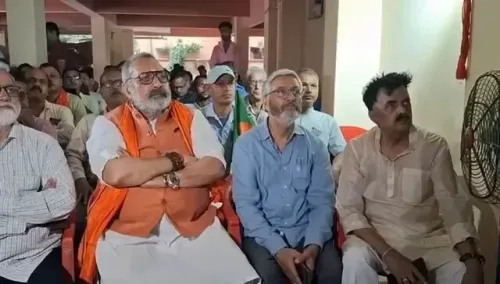
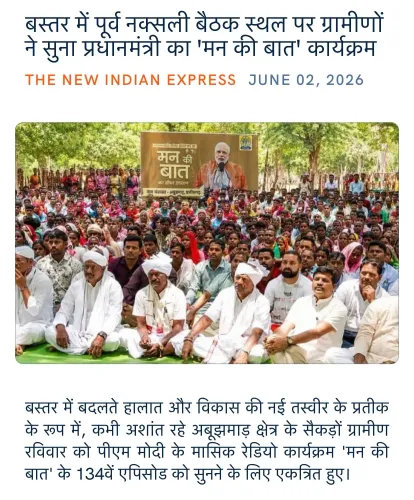
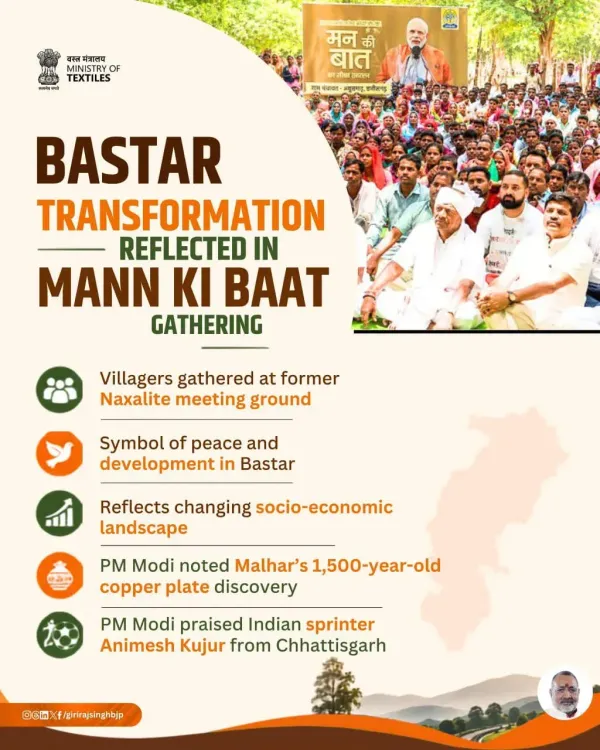
Union Textiles Minister Giriraj Singh on 8 June 2026 posted an image of Bastar villagers listening to PM Modi's Mann ki Baat in areas once used for Naxalite meetings, framing the scene as evidence of Bastar's shift toward peace and development under the New India agenda.
Key Takeaways
Giriraj Singh posted on 8 June 2026 about villagers in Bastar, Chhattisgarh listening to Mann ki Baat in former Naxal gathering spots.
Mann ki Baat was launched by PM Narendra Modi in October 2014 as a monthly radio address to citizens.
The Aspirational Districts Programme launched in 2018 specifically targeted Bastar and other LWE-affected districts for development investment.
The central government has pursued a dual-track policy of security operations and welfare schemes in LWE districts of Chhattisgarh , Jharkhand , and Odisha since 2014.
Singh's post uses the #NewIndia and #नया_बस्तर hashtags, placing the image within the BJP's broader governance narrative.
Union Textiles Minister Giriraj Singh on Monday, 8 June 2026 shared an image from Bastar, Chhattisgarh, highlighting that villagers in areas once used for Naxalite gatherings are now collectively listening to Prime Minister Narendra Modi's monthly radio address, Mann ki Baat. The minister described the scene as proof of Bastar's rapid transition toward peace, development, and socio-economic change.
Context
In his post, Singh wrote: 'Kabhi jahaan Naxali baithkein hoti theen, aaj wahaan Bastar ke graameen ekjut hokar Pradhan Mantri Shri Narendra Modi ji ke Mann ki Baat sun rahe hain' — 'Where Naxal meetings once took place, today Bastar's villagers are united, listening to Prime Minister Narendra Modi's Mann ki Baat.' He added that this transformation 'tells the powerful story of New India's resolve and Bastar's bright future.'
The post carried hashtags #बदलाव (change), #NewIndia, #नया_बस्तर (New Bastar), and #Chhattisgarh, situating the imagery within the ruling party's broader 'New India' political narrative.
Policy Backdrop
Prime Minister Modi launched Mann ki Baat in October 2014 as a monthly radio programme to communicate directly with citizens on governance themes. The programme has since been broadcast across community radio stations, public spaces, and government offices, including in remote and conflict-affected regions.
In 2018, the central government rolled out the Aspirational Districts Programme, which covered Bastar and other Left-Wing Extremism (LWE)-affected districts, channelling targeted investment in health, education, and infrastructure. Since 2014, the government has pursued a dual-track approach — intensified security operations alongside expanded welfare schemes — in LWE-affected districts of Chhattisgarh, Jharkhand, and Odisha.
Official statements over successive years have pointed to declining violence and increased state outreach in former Naxal strongholds, with Bastar frequently cited as a focal point of this transition.
Stakeholders and Impact
Tribal villagers and residents of LWE-affected districts in Bastar are the primary stakeholders in this narrative. For these communities, the shift from insurgency-era restrictions to open participation in national civic programmes like Mann ki Baat represents a change in both security conditions and access to government communication.
Singh's post amplifies the symbolic weight of the image: a public gathering in a space previously inaccessible or unsafe for state-sponsored activities. The framing is consistent with the BJP's long-standing effort to present Bastar as a success story of governance outreach in conflict zones.
What's Next
Attention will now turn to on-the-ground implementation updates for centrally sponsored schemes operating in Bastar, and whether the upcoming monsoon session of Parliament will see any discussion on LWE-related funding allocations. The government's ability to translate symbolic milestones — such as community Mann ki Baat gatherings — into measurable development outcomes will determine how enduring the 'New Bastar' narrative proves to be.
Point of View
Suggesting a coordinated effort to showcase governance dividends ahead of any electoral cycle. Whether the symbolism translates into verifiable development metrics in Bastar remains the critical question for analysts and opposition parties alike.
NationPress
19 Sept 2026
Frequently Asked Questions
What did Giriraj Singh say about Bastar and Mann ki Baat?
Giriraj Singh posted that villagers in Bastar are now listening to PM Modi's Mann ki Baat in areas that were once used for Naxalite meetings, calling it evidence of the region's shift toward peace and development.
What is Mann ki Baat and when did it start?
Mann ki Baat is a monthly radio programme launched by Prime Minister Narendra Modi in October 2014 to communicate directly with citizens on governance and social themes.
What is the Aspirational Districts Programme and does it cover Bastar?
The Aspirational Districts Programme was launched in 2018 by the central government to accelerate development in underdeveloped districts, including Bastar and other Left-Wing Extremism-affected areas in Chhattisgarh, Jharkhand, and Odisha.
Is Bastar still affected by Naxalism?
Bastar has historically been one of the most Naxal-affected districts in India. The government has reported declining violence in the region following sustained security operations and development outreach, though ground conditions continue to be monitored.
Why is Giriraj Singh, a Textiles Minister, posting about Bastar?
As a senior BJP leader and Lok Sabha MP, Giriraj Singh regularly posts on governance and political themes beyond his ministerial portfolio, often amplifying the party's broader narrative on security, development, and national progress.