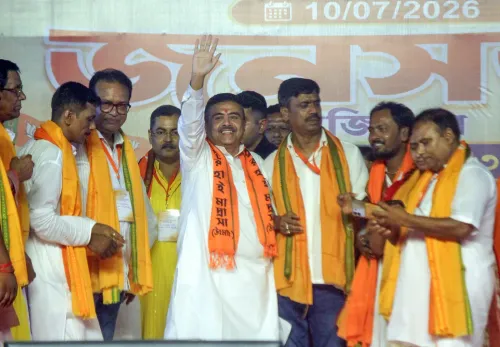
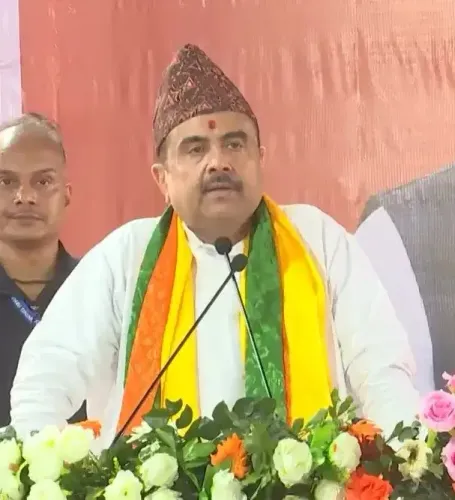
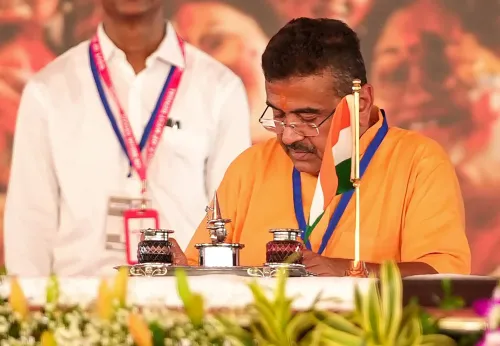
Bengal CM Suvendu Adhikari orders loudspeaker curbs at religious places
Synopsis
West Bengal CM Suvendu Adhikari has put police on notice: loudspeakers at religious places must stay within the NGT's 55-decibel cap, or face legal action. The directive — issued at Nabanna — signals a sharp enforcement pivot after years of widespread non-compliance that regularly disturbed elderly residents and patients.
Key Takeaways
Chief Minister Suvendu Adhikari issued strict loudspeaker curb orders at a police meeting at Nabanna on 14 May .
Public address systems at religious places must not exceed 55 decibels in residential areas, per NGT rules.
During special festivals and events, the permissible limit rises to 65 decibels .
Police have been directed to initiate legal action against any violations without exception.
Past enforcement was inconsistent — loudspeakers were often used beyond both decibel and time limits, disturbing elderly residents and patients.
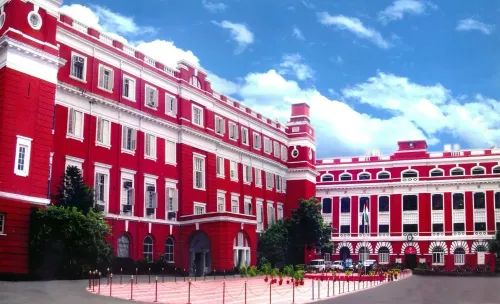
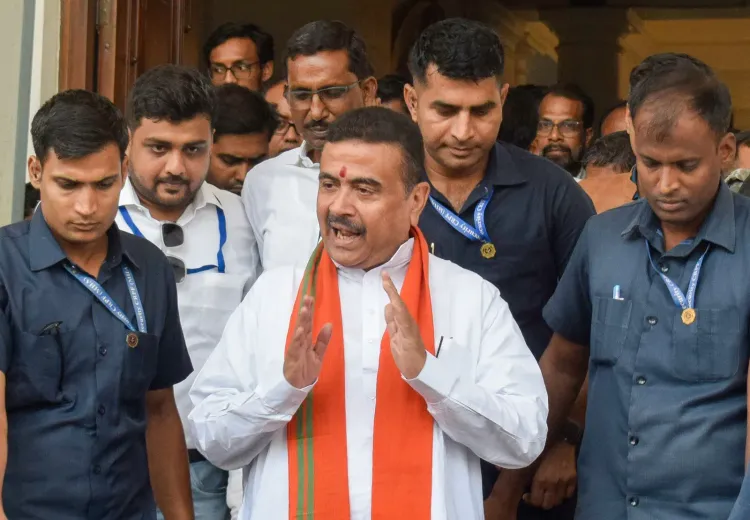
West Bengal Chief Minister Suvendu Adhikari on Thursday, 14 May directed police officers to strictly enforce permissible noise limits on public address systems at religious places and events across the state. The instructions were issued during a high-level police administration meeting held at the state secretariat, Nabanna, in Kolkata.
What the Chief Minister Ordered
Addressing senior police officers in a stern tone, Adhikari made clear that loudspeakers must not be operated beyond legally permitted decibel levels at any religious venue. He emphasised that violations would invite strict legal action, and reportedly repeated the directive more than once to underscore its seriousness.
According to government officials present at the meeting, the Chief Minister stated that if public address systems are used beyond the specified level, the police will take appropriate legal action without exception.
The Noise Rules in Force
Under National Green Tribunal (NGT) guidelines, loudspeakers in residential areas — where most religious places are situated — are capped at 55 decibels. The limit is somewhat higher in industrial and commercial zones. During special festivals and events, the permissible ceiling rises to 65 decibels, according to the same framework.
Notably, enforcement of these norms had been inconsistent in the past. Reports indicate that public address systems were frequently operated beyond both the decibel limit and the permitted time window at religious sites during festivals, causing significant inconvenience to elderly residents and patients in surrounding areas.
Broader Administrative Push
Thursday's directive is part of a wider administrative overhaul that Adhikari has been driving since assuming charge of the state. The new government has signalled its intent to enforce existing rules more rigorously across multiple departments, with the loudspeaker order being the latest in a series of compliance-focused instructions issued to law enforcement.
This comes amid a changed political landscape in West Bengal, where the administration is keen to distinguish itself through visible rule enforcement — including on issues that touch on everyday civic life.
Impact on Citizens and What Comes Next
The directive is expected to affect religious gatherings, festivals, and community events across the state, particularly in densely populated urban and semi-urban areas. Police are now tasked with monitoring decibel levels at religious venues and initiating legal proceedings against violators.
Whether enforcement translates consistently on the ground — especially during large religious festivals — will be the real measure of the directive's impact in the weeks ahead.
Point of View
Where noise norms at religious places have long been a flashpoint. Adhikari's government is signalling enforcement evenhandedness — but the credibility of that signal depends entirely on whether police act uniformly across all religious communities and not selectively. Past administrations across India have issued similar orders that quietly lapsed after initial publicity. The NGT framework is clear; the gap has always been implementation. If Bengal's police administration enforces the 55-decibel cap consistently through festival season, it will be a genuine departure from the norm — if not, this risks being another headline directive without teeth.
NationPress
16 Sept 2026
Frequently Asked Questions
What did Bengal CM Suvendu Adhikari order regarding loudspeakers?
Chief Minister Suvendu Adhikari directed police to strictly enforce permissible decibel limits on public address systems at religious places and events across West Bengal. He warned that violations would result in strict legal action, and issued the order at a police administration meeting at Nabanna on 14 May.
What is the permissible loudspeaker limit at religious places in India?
Under National Green Tribunal (NGT) guidelines, loudspeakers in residential areas — where most religious places are located — are capped at 55 decibels. During special festivals and events, the limit is raised to 65 decibels.
Why has this order been issued now?
The directive comes after frequent reports of public address systems being used beyond both decibel limits and permitted time windows at religious sites, causing inconvenience to elderly people and patients. The new West Bengal government has signalled a broader push to enforce existing rules across departments.
Who will be responsible for enforcement?
State police officers have been tasked with monitoring loudspeaker usage at religious venues and initiating appropriate legal proceedings against those who exceed the prescribed limits, as per the Chief Minister's instructions.
How does this fit into Adhikari's broader governance approach?
The loudspeaker order is part of a wider administrative overhaul that Adhikari has been implementing since taking charge. The government has been issuing compliance-focused directives across multiple departments as part of an effort to revamp state administration.