Bengal Elections: Anticipated Surge in Voter Engagement

Synopsis
The record voter turnout in the recent Assembly polls has set a precedent, prompting expectations for a similar surge in the upcoming elections in Tamil Nadu and West Bengal. Discover the dynamics behind these trends and what they mean for the political landscape.
Key Takeaways
Record turnout in recent Assembly polls highlights increased political engagement.
Tamil Nadu elections are set for April 23 , while West Bengal will vote in two phases.
Historical patterns show West Bengal has had high voter turnout over the decades.
The electorate size in West Bengal is currently about 6.77 crore .
Results of the elections across four states will be revealed on May 4 .
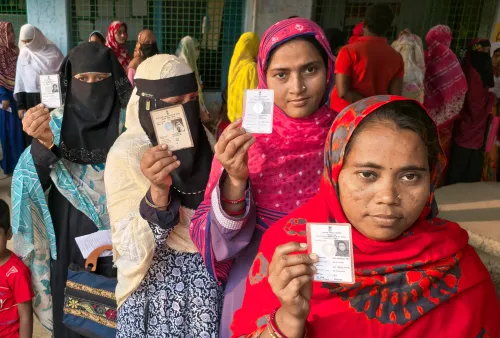
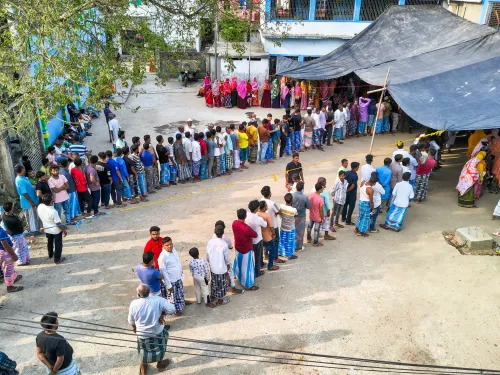
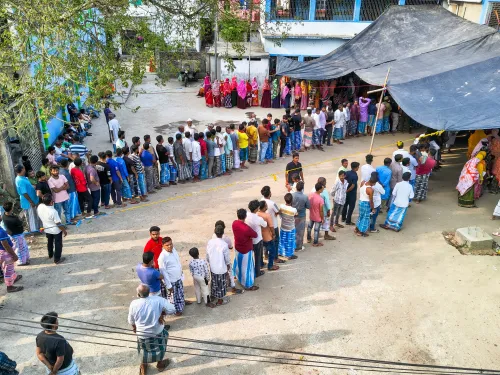
New Delhi, April 11 (NationPress) The unprecedented turnout observed in the Assembly elections on April 9 is attributed to various factors, and a similar trend is expected in both Tamil Nadu and West Bengal as they approach their polling dates.
The elections in Tamil Nadu are scheduled for April 23, while West Bengal will participate in two phases on April 23 and April 29. The latter is likely to experience a significant increase in voter turnout, given the state's historical patterns of high participation over the past three decades, as demonstrated by previous polling statistics.
High voter engagement has been particularly noted during periods of intense political rivalry. This stands in stark contrast to the turnout recorded by the Election Commission of India back in 1977, when West Bengal first elected the Left Front, which governed the state uninterrupted until 2011.
In 1977, the turnout was only 56.15 percent, but this figure surged to 84.33 percent in 2011 when the Trinamool Congress ascended to power.
Mamata Banerjee spearheaded the Trinamool's victory, securing 184 seats, while their former ally Congress captured 42 seats, leaving the Communist Party of India (Marxist) with around 40 seats and other Left Front partners managing an additional 22 seats.
However, this turnout did not surpass the 2006 elections when a record 84.52 percent turnout was noted, even as the Trinamool attempted to unseat the communists but ultimately fell short. The Left Front fortified its stronghold, with the CPI (M) winning 176 seats and its allies another 57. It was reported that Left cadres mobilized effectively to maintain their dominance.
Interestingly, as voter participation declined from 82.94 percent in 1996 to 75.29 percent in 2001, the Left Front's Assembly seats also decreased by four. For the first time, the CPI (M) lost its absolute majority, securing only 143 seats.
Since the Trinamool took over in 2011, voter turnout has been on a gradual decline, dropping from 84.33 percent in 2016 to 83.02 percent in 2021, and further to 82.32 percent in 2021. Despite this, the ruling party has managed to strengthen its position in the last two Assembly elections, increasing its seat count from 184 to 211, and subsequently to 215.
Meanwhile, during the recent elections, Assam and Jammu & Kashmir achieved their highest recorded voter turnouts, with 85.91 percent and 89.87 percent respectively. Previously, Assam's highest turnout was 84.67 percent during the 2016 Assembly elections, while J&K recorded 86.19 percent in the 2011 state poll.
In Kerala, the turnout was noted at 78.27 percent, falling short of the highest ever recorded during the 1960 Assembly election at 85.77 percent. The state has seen voter participation exceeding 80 percent on two other occasions: during the 1957 Lok Sabha elections (80.51 percent) and the 1987 Assembly elections (80.54 percent). Nevertheless, this year marked the highest turnout since the 1989 Lok Sabha poll, which recorded 79.30 percent.
In West Bengal, the heightened polarization along religious lines and the Election Commission’s Special Intensive Revision of electoral rolls are poised to further amplify voter turnout.
Theoretically, a decrease in the total number of electors, known as the denominator, can lead to an increase in voter turnout, represented as the numerator. For instance, if 100 out of a constituency's 1,000 total electors cast their votes, the numerator is 100, and the denominator is 1,000. This ratio indicates voter turnout.
The electorate in West Bengal currently stands at approximately 6.77 crore, representing a decrease of about 90 lakh from the number of voters on the rolls before the Special Intensive Revision exercise commenced in October 2025.
This figure is also lower than the 7.34 crore voters registered in the preceding Assembly election in 2021.
The results of the April elections across all four states and J&K will be announced on May 4.
Point of View
The current political climate in West Bengal and Tamil Nadu is witnessing a remarkable shift in voter engagement. Both states are poised for significant electoral participation, shaped by historical patterns and contemporary dynamics, reflecting a robust democratic process.
NationPress
8 Oct 2026
Frequently Asked Questions
When are the upcoming elections in Tamil Nadu and West Bengal?
The elections in Tamil Nadu are scheduled for April 23, while West Bengal will vote in two phases on April 23 and April 29.
What was the voter turnout in West Bengal during the 2011 elections?
The voter turnout in West Bengal during the 2011 elections reached 84.33 percent.
How does the current electorate size compare to previous elections?
Currently, West Bengal's electorate stands at approximately 6.77 crore, which is about 90 lakh lower than before the Special Intensive Revision started in October 2025.
What factors are contributing to increased voter turnout?
Factors such as heightened political competition, religious polarization, and the Special Intensive Revision of electoral rolls are contributing to increased voter turnout.
When will the results of the April elections be announced?
The results of the April elections across all states, including J&K, will be announced on May 4.