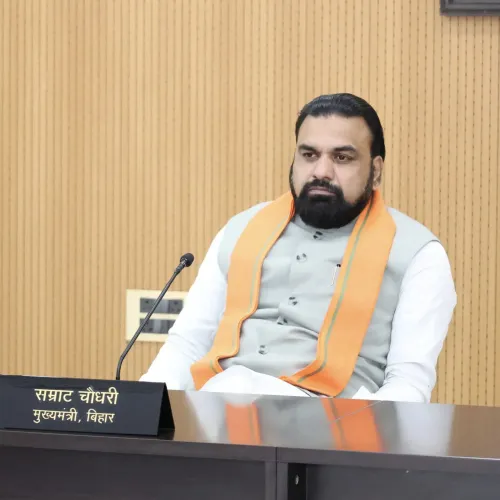
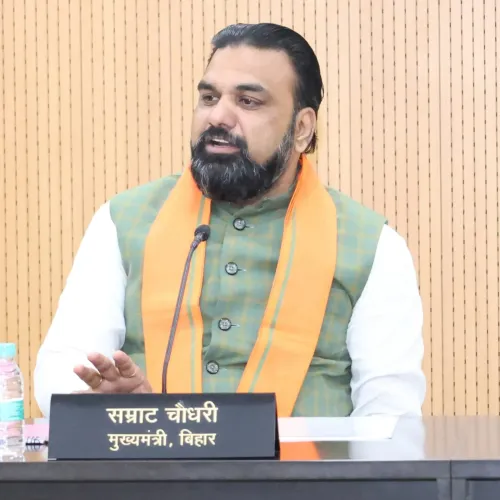
Bihar school infrastructure crisis: CM Samrat Choudhary vows fix in 6 months

Synopsis
An RJD MLA's claim that nearly 40 per cent of Bihar's government school buildings are dilapidated or collapsed — and that students are studying under trees — forced Chief Minister Samrat Choudhary to commit to a six-month fix on the floor of the Assembly. The land acquisition bottleneck blocking 600–700 schools is now a political deadline.
Key Takeaways
RJD MLA Kumar Sarvjeet alleged that nearly 40 per cent of Bihar's government school buildings are dilapidated or have collapsed.
Around 600–700 schools lack permanent campuses due to unresolved land acquisition issues, according to Chief Minister Samrat Choudhary .
CM Choudhary assured the Bihar Legislative Assembly that land for affected schools will be secured within six months .
Students in Classes 3 to 6 are reportedly unable to read the basic English alphabet, with overcrowding cited as a key factor.
The school expansion drive was originally launched under former CM Nitish Kumar with the goal of a high school in every panchayat.
The crumbling state of Bihar's government school infrastructure took centre stage on 21 July during the second day of the Monsoon Session of the Bihar Legislative Assembly in Patna, as Opposition legislators accused the NDA government of systemic neglect of basic educational facilities. Chief Minister Samrat Choudhary responded with a six-month assurance to resolve pending land-related issues blocking school construction across the state.
Opposition's Allegations
Rashtriya Janata Dal (RJD) MLA Kumar Sarvjeet alleged that nearly 40 per cent of government school buildings in Bihar are either dilapidated or have collapsed entirely. He said many schools are being forced to operate from neighbouring villages or in severely inadequate facilities, with students in some cases compelled to study under trees despite land being available nearby.
Sarvjeet questioned whether the Education Department had conducted any comprehensive survey to identify schools with collapsed buildings, panchayats lacking functional school structures, and institutions where students study outdoors despite land availability. He urged the government to prioritise reconstruction of damaged schools and overhaul educational infrastructure statewide.
The RJD legislator also raised concerns about learning outcomes, claiming that many students in Classes 3 to 6 are unable to read even the basic English alphabet. He argued the problem goes beyond teacher training. 'If a school with only two classrooms has to accommodate nearly a thousand students, quality education is impossible,' he said. Sarvjeet proposed convening a meeting of all MLAs in the Central Hall of the Assembly to discuss practical solutions, particularly for children from economically weaker families.
What the Government Said
Chief Minister Choudhary acknowledged the concerns raised by the Opposition and provided context: the expansion of school infrastructure had originally been initiated under former Chief Minister Nitish Kumar, who aimed to establish a high school in every panchayat across the state. During implementation, however, land could not be arranged for approximately 600–700 schools, prompting the government to begin classes wherever at least two rooms were available so that students would not be deprived of education entirely.
Choudhary assured the House that the government will conduct a fresh review of the situation. He stated that land-related issues affecting schools without permanent campuses will be resolved, and that the necessary land will be made available within six months, after which construction and other required works will be initiated promptly.
The Deeper Infrastructure Crisis
The debate reflects a long-standing structural challenge in Bihar's public education system. The state has one of the country's highest enrolment rates under the Right to Education Act, yet physical infrastructure has struggled to keep pace with demand. Overcrowding — with thousands of students sharing a handful of classrooms — directly undermines learning outcomes, critics argue, and no amount of teacher training can compensate for the absence of functional school buildings.
Notably, this is not the first time the issue has surfaced in the Bihar Assembly. Successive governments have flagged the land acquisition bottleneck as a persistent obstacle, yet the gap between enrolment and infrastructure has widened over the years.
What Happens Next
The Chief Minister's six-month timeline sets a measurable political benchmark. If land is not secured and construction orders issued by early 2026, the Opposition is likely to return to the issue during the next Assembly session. Education department officials are expected to begin a fresh survey of affected schools, the findings of which will determine the scale of the remedial programme.
Point of View
If accurate, is an indictment of successive governments — not just the current one. Bihar's school expansion was announced years ago under Nitish Kumar, yet land acquisition for 600–700 schools remains unresolved, which points to an administrative failure that outlasted multiple political cycles. Choudhary's six-month promise is now a hostage to fortune: it is specific enough to be tracked and cited against him. What is missing from the Assembly debate is any discussion of accountability — who audits the fresh survey, who verifies land transfer, and what happens if the deadline slips. Without those guardrails, a floor assurance risks becoming another entry in Bihar's long ledger of education pledges that did not translate into classrooms.
NationPress
21 Jul 2026
Frequently Asked Questions
What was the key issue raised in the Bihar Assembly on 21 July 2025?
The deteriorating state of government school infrastructure in Bihar dominated the second day of the Monsoon Session, with RJD MLA Kumar Sarvjeet alleging that nearly 40 per cent of school buildings in the state are dilapidated or have collapsed. Chief Minister Samrat Choudhary responded with a six-month assurance to resolve land-related issues blocking school construction.
What did RJD MLA Kumar Sarvjeet allege about Bihar's schools?
Sarvjeet alleged that around 40 per cent of Bihar's government school buildings are either dilapidated or have collapsed, forcing schools to operate from neighbouring villages or under trees. He also claimed that many students in Classes 3 to 6 cannot read the basic English alphabet, linking poor learning outcomes to severe overcrowding.
What assurance did CM Samrat Choudhary give in the Bihar Assembly?
Chief Minister Choudhary assured the House that the government will conduct a fresh review of school infrastructure and resolve pending land-related issues for schools without permanent campuses within six months. He said construction and other required works will begin promptly once land is secured.
Why do 600–700 schools in Bihar lack permanent buildings?
According to Chief Minister Choudhary, land could not be arranged for approximately 600–700 schools during the state's school expansion drive initiated under former Chief Minister Nitish Kumar. The government began classes in whatever minimal space was available to avoid depriving students of education entirely.
Who is affected by Bihar's school infrastructure crisis?
Students across Bihar — particularly those from economically weaker families in rural panchayats — are most affected. Schools operating without permanent buildings, adequate classrooms, or basic facilities disproportionately impact children in lower primary grades, where foundational literacy is built.