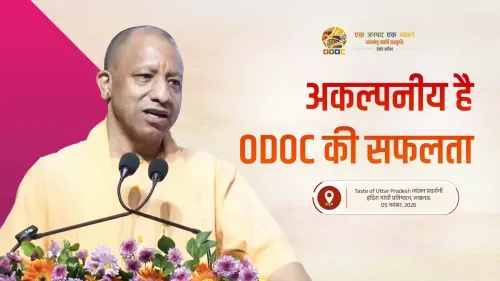
Bihar CM Nitish Kumar Pushes ODOP to Put Local Goods on Global Map
Synopsis
Bihar CM Nitish Kumar has announced that quality improvement, attractive packaging, and strong marketing will drive the state's export push, with the One District-One Product policy serving as the core framework to give Bihar's local goods a global presence.
Key Takeaways
CM Nitish Kumar announced special emphasis on better products, attractive packaging, and effective marketing to boost Bihar's exports.
The One District-One Product (ODOP) policy will be used to give each district's signature product a global identity.
Uttar Pradesh first launched a comparable ODOP framework in 2018 , which Bihar is now adapting for its own districts.
Key stakeholders include local artisans, district-level exporters, and MSME units currently outside formal supply chains.
Packaging and marketing — not just quality — are explicitly named as the bottlenecks Bihar intends to fix for export competitiveness.
Specific product-district assignments and subsequent export data releases will be the concrete benchmarks to track going forward.
Bihar is setting its sights on global markets. Chief Minister Nitish Kumar has declared that the state will channel focused energy into better product quality, attractive packaging, and impactful marketing to drive exports — with the 'One District-One Product' (ODOP) policy positioned as the engine of that push.
Addressing the ambition, the Chief Minister's Office posted on Thursday, 19 November 2026, quoting the CM directly: 'Niryan ko badhawa dene ke liye behtar utpad, aakarshak packaging aur prabhavshali marketing par vishesh jor diya jayega' — ('Special emphasis will be placed on better products, attractive packaging, and effective marketing to promote exports'). The ODOP framework, the CM stressed, will be the vehicle to give Bihar's local products a global identity.
What ODOP Actually Means for Bihar's Districts
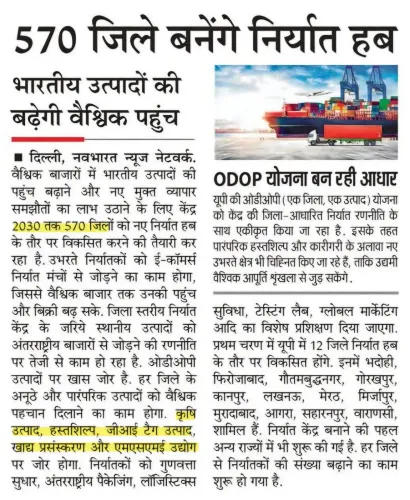
The One District-One Product concept maps one signature product to each district — a craft, an agricultural produce, a manufactured good — and then concentrates branding, infrastructure, and market-linkage support around it. The idea is deceptively simple: rather than spreading thin, go deep on what a district already does best and build a recognisable identity around it.
Uttar Pradesh pioneered the model at scale when it launched its ODOP scheme in 2018, using it to link district artisans and MSME units with national and export buyers. Bihar's adoption of the framework signals it wants a seat at the same table — tapping local artisans, district-level exporters, and small manufacturers who have long remained outside formal supply chains.
Bihar's Export Play in a Larger National Pattern
The move fits a well-established pattern across Indian states: decentralised product promotion as a route into global supply chains. Post-2014, the central government's push for export diversification beyond traditional sectors gave states both the political cover and the policy vocabulary to launch district-level frameworks. Bihar — historically associated with agriculture and labour migration rather than manufacturing exports — is now explicitly framing itself as a production and export node.
The practical levers the CM flagged — packaging and marketing alongside quality — matter because they target the exact bottlenecks that have kept Indian artisanal and small-manufacturer goods off premium global shelves. A good product that ships in poor packaging at an unknown brand loses every time against an average product with a sharp retail story. Fixing that equation is the bet Bihar is making.
What to Watch Next
The critical next steps will be in the specifics: which products get assigned to which districts, whether dedicated buyer-seller meets are scheduled, and whether state export data begins to reflect movement in MSME-category goods. Announcements without product-level rollout plans have been a recurring gap in similar state schemes elsewhere — Bihar's execution will be the real story.
For now, the signal from Patna is unambiguous: Nitish Kumar wants Bihar's local identity stamped on global shelves, one district at a time.
Point of View
However, will hinge on whether district-level product selection is merit-based or politically driven, and whether the state can create credible buyer linkages rather than repeat the pattern of well-announced schemes that fade without measurable export uptick.
NationPress
19 Nov 2026
Frequently Asked Questions
What is the One District-One Product scheme in Bihar?
The One District-One Product (ODOP) scheme identifies one signature local product per district — such as a craft, agricultural produce, or manufactured good — and concentrates branding, infrastructure, and market-linkage support around it to boost exports and economic growth.
What did Bihar CM Nitish Kumar say about exports?
CM Nitish Kumar said that special emphasis will be placed on better products, attractive packaging, and effective marketing to promote exports, and that the ODOP policy will be used to give Bihar's local products a global identity.
Which state first launched the One District-One Product scheme in India?
Uttar Pradesh launched the ODOP scheme in 2018 to promote district-specific products for economic growth and exports, and it has since been adopted in various forms by other states including Bihar.
Who benefits from Bihar's ODOP export push?
The primary beneficiaries are local artisans, district-level exporters, and MSME units in Bihar who currently operate outside formal global supply chains and stand to gain from improved branding, packaging support, and buyer-seller linkages.
What should we watch for after Bihar's ODOP export announcement?
The key markers will be the selection of specific products for each Bihar district, the scheduling of buyer-seller meets, and any subsequent state export data showing movement in MSME-category goods.