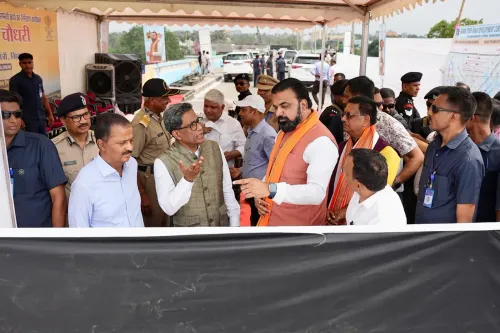
Bihar CM Orders Ganga Ghat Safety Ahead of Rising Water Levels
Synopsis
Bihar's Chief Minister has directed strong barricading, firm security, cleanliness measures, and continuous public address announcements at Ganga ghats, keeping river water levels and currents in view — a standing state protocol activated to protect pilgrims during fluctuating river conditions.
Key Takeaways
Bihar's Chief Minister's Office issued the directive on 5 November 2026 , ordering immediate action at Ganga ghats.
Authorities are mandated to erect strong barricading calibrated to the Ganga's current water level and flow.
Security deployments, cleanliness , and smooth traffic management are the three accompanying operational mandates.
Continuous miking (public address announcements) must be used to relay necessary information to pilgrims in real time.
The directive is part of Bihar's established district-level disaster and crowd-management protocol for Ganga riverine sites.
District administrations and state irrigation or disaster management departments are responsible for on-ground execution and monitoring.
With the Ganga's water levels and currents demanding attention, Bihar's Chief Minister's Office has directed district authorities to tighten safety arrangements at river ghats — ordering strong barricading, robust security deployments, cleanliness drives, and smooth traffic management, while ensuring pilgrims are kept continuously informed through public address systems. The directive, issued on Thursday, 5 November 2026, signals the state's intent to get ahead of any crowd-management crisis before it reaches the water's edge.
The Chief Minister's Office posted the directive on X, stating: 'मा. मुख्यमंत्री जी ने निर्देश दिया कि गंगा नदी के जलस्तर एवं प्रवाह को ध्यान में रखते हुए घाटों पर मजबूत बैरिकेडिंग, सुरक्षा के पुख्ता इंतजाम, स्वच्छता एवं सुगम यातायात व्यवस्था सुनिश्चित की जाए।' — meaning the Honourable Chief Minister has directed that, keeping the Ganga's water level and flow in view, strong barricading, firm security arrangements, cleanliness, and smooth traffic management must be ensured at the ghats. Additionally, pilgrims are to be provided with continuous necessary information through miking (public address systems).
Four pillars: barricading, security, cleanliness, and live announcements
The directive bundles four distinct administrative responsibilities into a single order. Strong barricading at ghats is the front line — physical barriers calibrated to the river's current water level to prevent pilgrims from inadvertently entering fast-flowing or deeper zones. Alongside this, security deployments are to be made robust enough to manage crowd pressure during peak bathing hours.
The third pillar — cleanliness — reflects a persistent challenge at heavily visited riverine sites, where the volume of devotees can rapidly overwhelm waste management. The fourth, continuous miking, is arguably the most operationally nimble: real-time public announcements allow authorities to redirect crowds, warn of water fluctuations, and issue safety advisories without physical intervention.
A routine directive with a non-routine river
Bihar administrations have issued comparable ghat-safety protocols across multiple years whenever the Ganga's water level shifts — a practice embedded in the state's standard district-level disaster and crowd-management playbook. What makes each iteration consequential is the river itself: the Ganga through Bihar is among India's most dynamic river corridors, its flow capable of surging sharply with upstream releases or rainfall patterns, transforming a familiar bathing ghat into a hazard zone within hours.
Pilgrims, many travelling long distances for devotional bathing, often have little visibility into real-time water conditions. The miking instruction directly addresses that information gap — turning public address infrastructure into a live safety channel rather than a ceremonial backdrop.
District execution now in focus
The directive sets the what; district administrations now own the how. Officials from state irrigation and disaster management departments will be expected to monitor water levels and report on barricade placement ahead of any significant bathing dates on the religious calendar. The Chief Minister's Office's public communication of the order — via X — also creates a layer of accountability: the instructions are on the record, and execution will be visible.
At Bihar's Ganga ghats, the difference between a safe congregation and a tragedy has often come down to preparation speed. The state has now drawn the starting line.
Point of View
Making anticipatory crowd-management orders a political as much as administrative necessity. The emphasis on continuous miking is a low-cost, high-reach intervention that acknowledges information asymmetry as a core risk factor at pilgrimage sites. Consistent issuance of such protocols ahead of bathing events is increasingly a marker of administrative preparedness that state governments are keen to put on the record.
NationPress
5 Nov 2026
Frequently Asked Questions
Why has Bihar CM ordered barricading at Ganga ghats?
The Bihar Chief Minister has directed strong barricading at Ganga ghats because the river's water level and current flow require precautionary safety measures to protect pilgrims from entering hazardous zones.
What arrangements has Bihar ordered at Ganga ghats?
Bihar has ordered four key arrangements: strong barricading aligned with water levels, robust security deployments, cleanliness management, and smooth traffic flow, along with continuous public address (miking) announcements for pilgrims.
What is miking at Ganga ghats and why is it important?
Miking refers to continuous public address announcements at ghats, used to relay safety information, water-level warnings, and crowd-management advisories to pilgrims in real time — directly addressing the information gap many visitors face.
Is this a new policy or a routine directive from the Bihar government?
This is part of Bihar's established district-level disaster and crowd-management practice. State administrations have routinely issued similar ghat-safety protocols whenever Ganga water levels fluctuate, particularly around major bathing dates.
Who is responsible for implementing the Ganga ghat safety order in Bihar?
District administrations, along with state irrigation and disaster management departments, are responsible for on-ground implementation — including barricade placement, security deployment, and water-level monitoring.