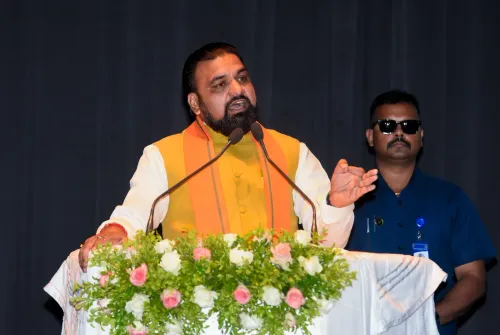
Bihar CM's Office: State to Strengthen Fast Track Courts
Synopsis
The Chief Minister's Office of Bihar announced on 4 July 2026 that the state government will provide all necessary resources to strengthen fast track courts and speedy trial mechanisms, reaffirming Bihar's commitment to time-bound justice delivery.
Key Takeaways
The Chief Minister's Office of Bihar posted on 4 July 2026 that the state will provide all necessary resources for fast track courts.
The commitment covers speedy trials , fast track courts , and a time-bound justice system .
The statement was made as a clarification, attributed to a senior government figure, most likely Chief Minister Nitish Kumar .
Fast track courts were first introduced nationally in 2000 to address criminal case backlogs.
Key watch points include resource allocations in the next Bihar budget session and any formal expansion of fast track benches.
Primary beneficiaries include crime victims and court litigants facing prolonged trial delays in Bihar.
The Chief Minister's Office of Bihar stated on Saturday, 4 July 2026, that the state government will provide all necessary resources to further strengthen speedy trial mechanisms, fast track courts, and a time-bound justice system in Bihar. The announcement came via a reply post on X, signalling the government's intent to back judicial infrastructure with active state support.
The post, in Hindi, stated: 'unhonne spasht kiya ki speedy trial, fast track court tatha samayabaddh nyay vyavastha ko aur adhik sashakt banane ke liye rajya sarkar har aavashyak sansadhan uplabdh karaegi' — ('He clarified that the state government will provide every necessary resource to further strengthen speedy trials, fast track courts, and a time-bound justice system.')
Context
The statement is framed as a clarification, indicating it was made in response to a query or discussion. The reply was addressed to @samrat4bjp on X, suggesting the exchange took place in the context of a conversation around law, order, or judicial reform in Bihar. While the specific occasion of the original remark being referenced could not be independently verified, the language used — 'he clarified' — implies a senior government figure, most likely Chief Minister Nitish Kumar, made the commitment in a public or official setting.
Policy Backdrop
Fast track courts were introduced under a Government of India scheme in 2000 to address the mounting backlog of criminal cases across states. Over the years, Bihar has periodically announced support for additional judicial infrastructure, including dedicated benches for serious offences, as part of broader law-and-order reforms.
Case pendency in Indian courts runs into the crores nationally, with state-level fast track courts seen as a critical pressure valve. Bihar's commitment to resource allocation for these courts aligns with a wider national push for court modernisation and improved disposal rates.
Stakeholders and Impact
The primary beneficiaries of an expanded fast track court system are crime victims and litigants caught in prolonged trial processes. For victims of serious offences — particularly those involving violence — time-bound justice mechanisms can be the difference between meaningful redress and prolonged uncertainty.
Legal aid organisations and district court administrators in Bihar would also be directly affected, as increased resources could mean additional benches, more judicial officers, and better infrastructure at the district level.
What's Next
The immediate watch point is the next Bihar budget session, where specific allocations for fast track court expansion and judicial infrastructure are expected to reflect this commitment. Any state-level notifications formally expanding the number of fast track benches or designating new special courts would be the concrete follow-through to this announcement.
Broader judicial reform advocates will be watching whether Bihar issues formal guidelines or memoranda of understanding with the state judiciary to operationalise the promised resources within a defined timeline.
Point of View
Whose political identity has long been tied to 'Sushasan' (good governance), such announcements carry both administrative and electoral weight. The real test, however, lies in budgetary follow-through — past commitments to fast track infrastructure in Bihar and other states have not always translated into proportionate resource deployment. Observers will be watching whether this statement precedes concrete allocations or remains a rhetorical marker.
NationPress
3 Oct 2026
Frequently Asked Questions
What did the Bihar government announce about fast track courts?
The Chief Minister's Office of Bihar announced on 4 July 2026 that the state government will provide all necessary resources to strengthen speedy trials, fast track courts, and a time-bound justice system in the state.
What are fast track courts in India?
Fast track courts are specialised courts set up under a Government of India scheme introduced in 2000 to expedite the disposal of pending criminal cases, particularly serious offences, and reduce the overall backlog in the judicial system.
Who is the Chief Minister of Bihar?
Nitish Kumar is the Chief Minister of Bihar, known for multiple terms in office with a focus on governance reforms, law and order, and judicial infrastructure development.
How does Bihar plan to strengthen its judiciary?
According to the Chief Minister's Office, the Bihar state government has committed to providing every necessary resource — including infrastructure and personnel — to make speedy trial mechanisms and fast track courts more effective.
When will Bihar's fast track court expansion details be known?
Specific details on resource allocation are expected to emerge during the next Bihar budget session, with any formal state notifications on new or expanded fast track benches serving as the concrete follow-through to this commitment.