Is Banning Customers with Hijabs and Masks Legal in Bihar?

Synopsis
Maulana Khalid Rasheed Farangi Mahli challenges the legality of Bihar's jewellery shop policy banning customers with covered faces. He highlights the importance of religious rights and cultural practices, emphasizing the need for dialogue amidst recent tensions over demolition drives in Delhi.
Key Takeaways
Maulana Khalid Rasheed opposes the ban on customers with covered faces in Bihar.
The hijab is a recognized religious practice for Muslim women.
Prohibiting entry based on covered faces is viewed as a violation of constitutional rights.
There is a need for dialogue amidst rising tensions over cultural practices.
Recent events in Delhi highlight the complexities of community relations.
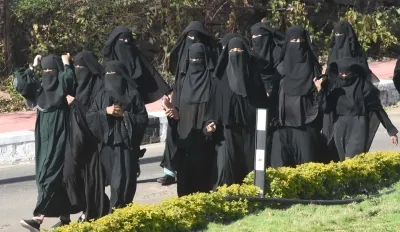
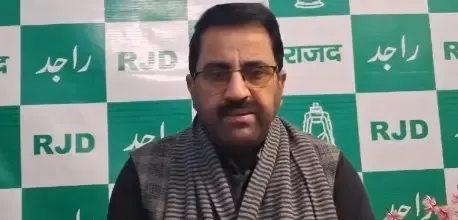
Lucknow, Jan 8 (NationPress) The Chairman of the Islamic Centre of India, Maulana Khalid Rasheed Farangi Mahli, expressed his concerns on Thursday regarding the decision made by jewellery shop owners in Bihar to restrict entry to customers whose faces are covered, which includes those wearing hijabs and masks. He argued that such a decision is against the law of the country.
This marks the first instance of such a policy being enacted in Bihar.
In an interview with IANS, Maulana Khalid Rasheed emphasized that the hijab is a form of religious attire for Muslim women. He stated, "It is widely recognized that the hijab is a religious practice for Muslim women. Adhering to one’s faith is a constitutional and fundamental right for every citizen in our nation, and no one has the jurisdiction to impose a ban on it."
The cleric also noted that the practice of covering the head or face is not limited to Muslim women alone. He remarked, "Even today, numerous non-Muslim women observe similar traditions, such as wearing a ghoonghat in rural areas. These customs are integral to our country's heritage and culture. If something is deeply rooted in culture, no authority should impose a ban on it, not even by law," he added.
Regarding the use of masks, Maulana Khalid Rasheed pointed out that many individuals wear masks for health safety. He stated, "With the increasing levels of pollution, many people utilize masks to safeguard their health. Therefore, prohibiting entry based on this reason is unjust. In my opinion, such decisions violate the law of the land."
This past Tuesday, the All India Jewellers and Gold Federation (AIGJF) declared that customers with faces covered by hijabs, burqas, scarves, helmets, or similar items would not be permitted entry into jewellery showrooms unless their faces were visible. According to the new guideline, buyers can only enter after proper facial identification. The federation announced on Wednesday that Bihar is the first state in India to implement such a sweeping decision.
Maulana Khalid Rasheed also commented on the recent demolition actions near the Faiz-e-Elahi Masjid in the Turkman Gate area of Delhi. He asserted, "We unequivocally condemn the incident that transpired near Turkman Gate. We also denounce the hardships faced by the local residents, particularly during such frigid weather, and urge everyone to be empathetic toward those affected."
He further stressed the importance of dialogue and a peaceful resolution. "In this context, considering the High Court’s directives and their implementation, it would be prudent for all involved parties to convene and address the matter amicably," he conveyed to IANS.
Recently, Delhi Police have apprehended six additional individuals connected to the unrest that occurred during the municipal corporation’s demolition operation near the mosque in the Turkman Gate area. With these arrests, the cumulative number of individuals detained in this case has risen to 11.
Point of View
The situation highlights a critical intersection of law, culture, and religious rights in India. The concerns raised by Maulana Khalid Rasheed underscore the importance of protecting individual freedoms while navigating community norms. This is a pivotal moment that necessitates thoughtful discussion and understanding among various stakeholders in society.
NationPress
29 Sept 2026
Frequently Asked Questions
What was the decision made by Bihar jewellery shop owners?
Bihar jewellery shop owners decided to ban customers with covered faces, including those wearing hijabs and masks, requiring facial identification for entry.
Who objected to this decision?
Maulana Khalid Rasheed Farangi Mahli, the Chairman of the Islamic Centre of India, objected to this decision, stating it is against the law.
What are the implications of this ruling?
The ruling raises concerns about religious freedoms and cultural practices in India, as it affects not only Muslim women but also non-Muslim women who observe similar customs.
What is the broader context of this issue?
This issue takes place within a broader context of societal tensions and recent demolition drives in Delhi, highlighting the need for dialogue and peaceful resolutions.
How has the community responded?
The community has expressed strong objections to the ruling, emphasizing the importance of cultural identity and the right to practice one's religion freely.