Why Did RJD Condemn the Bihar Jewellery Shop Owners' Decision to Restrict Customers in Hijabs and Niqabs?
Synopsis
The decision by a jewellery shop owners' association in Bihar to limit entry to customers with covered faces, including hijabs and niqabs, has led to significant political backlash. RJD's Ejaz Ahmed calls it unconstitutional, sparking a debate on security versus religious freedom.
Key Takeaways
Political controversy arises from security measures targeting religious attire.
RJD condemns the decision as unconstitutional.
Shop owners cite security concerns amid rising theft incidents.
Debate over religious freedom versus safety continues in Bihar.
Equal application of the rule to all customers is emphasized.
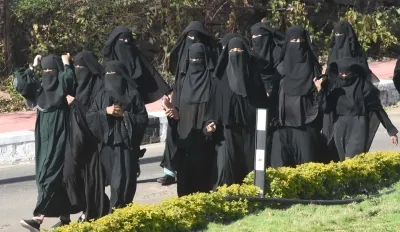
Patna, Jan 7 (NationPress) A recent ruling by a collective of jewellery shop owners in Bihar aimed at limiting the access of customers with obscured faces, such as women adorned in hijabs or niqabs, has ignited a political uproar in the region.
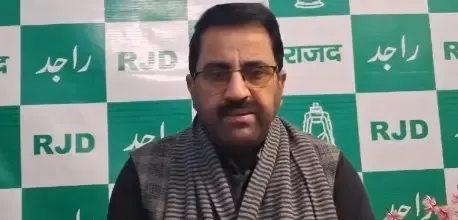
RJD state spokesperson Ejaz Ahmed expressed strong disapproval, labeling the initiative as unconstitutional and in direct conflict with India's foundational constitutional principles.
“This targeting of hijabs and niqabs under the pretext of security infringes upon religious sentiments and is an encroachment on the fundamental right to religious freedom enshrined in the Constitution,” Ahmed asserted.
He further alleged that individuals associated with the BJP and RSS are orchestrating this agenda, urging the jewellery shop owners to retract their decision immediately or risk undermining India's constitutional and secular framework.
In a counter-response, the All India Jewellers and Gold Federation (AIGJF) announced that the ruling dictates that customers whose faces are obscured by hijabs, burqas, scarves, helmets, or similar items will be barred from entering jewellery showrooms unless their faces are visible.
According to the federation, purchases of jewellery will only take place after adequate facial identification.
Ashok Kumar Verma, the State President of the AIGJF, informed IANS that Bihar is the inaugural state to implement such a regulation on a statewide basis.
He clarified that the decision is strictly a security measure and is not aimed at targeting any specific community.
“Currently, the price for 10 grams of gold is roughly Rs 1.40 lakh, while a kilogram of silver is around Rs 2.5 lakh. Numerous robbery incidents have transpired where individuals enter shops in groups with their faces completely concealed. They don helmets or veils and carry out thefts. This ruling is intended to avert such criminal acts,” Verma explained.
Verma emphasized that the federation is not prohibiting the burqa or hijab, but simply requesting customers to momentarily reveal their faces while shopping.
He reiterated that this regulation applies equally to men who cover their faces with scarves or helmets.
“Our aim is not discrimination. Establishing a face-to-face connection between customer and shopkeeper fosters trust,” he stated, adding that this guideline is universal and not directed at any particular community.
Verma also mentioned that he had consulted with the Patna City Central Superintendent of Police, who raised no objections.
He claimed that similar precautionary actions are already observed in certain districts of other states.
Addressing potential protest concerns, Verma stated that there would be no grounds for controversy.
“No staff member will forcibly remove anyone’s hijab or burqa. We will only extend a courteous request. There will be no confrontations,” he assured.
This situation has ignited a wider discussion in Bihar regarding the equilibrium between security protocols and religious freedoms, as political responses continue to emerge.
Point of View
We recognize that the balance between security measures and religious freedoms is a delicate matter. This incident highlights ongoing tensions and underscores the need for dialogue to foster understanding while ensuring safety in public spaces.
NationPress
2 Oct 2026
Frequently Asked Questions
What is the reason behind the jewellery shop owners' decision?
The jewellery shop owners claim that the decision is motivated by security concerns, aimed at preventing thefts where individuals enter shops with their faces covered.
How has the RJD responded to this decision?
The RJD has condemned the decision, calling it unconstitutional and an infringement on the fundamental right to religious freedom.
Is this rule applicable to all customers?
Yes, the rule applies equally to all customers, regardless of gender, who cover their faces with items like scarves or helmets.
What are the potential implications of this ruling?
The ruling has sparked a broader debate regarding the balance between security measures and the protection of religious freedoms in Bihar.
Are there other states implementing similar measures?
Yes, similar precautionary measures are reportedly in place in some districts of other states.