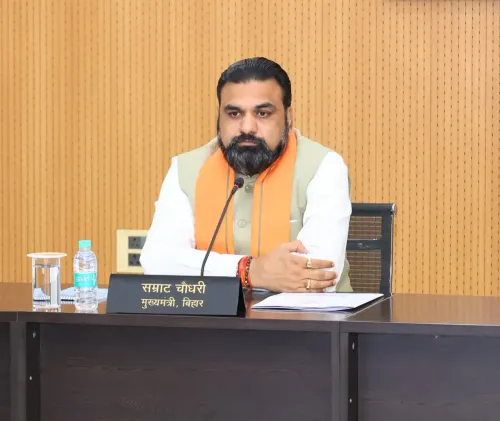
CM Samrat Choudhary Felicitates BIPARD on Third ISO 9001:2015 Certification

Synopsis
Bihar Chief Minister Samrat Choudhary on 6 July 2026 felicitated BIPARD, Patna for its third ISO 9001:2015 certification at Lok Sevak Avas and directed expansion of training facilities at Patna and Gaya campuses, reinforcing Bihar's year-round administrative capacity-building push.
Key Takeaways
BIPARD, Patna received its third ISO 9001:2015 certification, recognising quality management in administrative training.
The felicitation ceremony was held at the Sankalp Sabhagar, Lok Sevak Avas, Patna on 6 July 2026 .
CM Samrat Choudhary directed expansion of training capacity at both BIPARD Patna and BIPARD Gaya campuses.
BIPARD offers training programmes for 365 days a year, serving Bihar government officers and employees continuously.
The certification aligns with national frameworks including Mission Karmayogi (2020) and the National Training Policy 2012 .
The initiative supports Bihar's contribution to the Viksit Bharat 2047 vision through institutional governance strengthening.
Bihar Chief Minister Samrat Choudhary on Monday, 6 July 2026, presided over a felicitation ceremony at the Sankalp Sabhagar of Lok Sevak Avas in Patna, honouring the Bihar Institute of Public Administration and Rural Development (BIPARD) on receiving its third ISO 9001:2015 certification — a quality-management standard that recognises consistent, process-driven delivery of services.
Context
Posting on X, Chief Minister Choudhary described the achievement as 'guṇavattāpūrṇa prashikṣaṇ, sushāsan evaṃ prashāsanik kṣamatā sudṛḍhīkaraṇ kī diśā meṃ ek mahatvapūrṇ kadam' — 'an important step toward quality training, good governance, and strengthening administrative capacity.' He also directed officials to further expand the training capacity of BIPARD's campuses in Patna and Gaya to equip government officers and employees with modern skills.
The post noted that BIPARD runs regular training programmes throughout the year, with training facilities available for 365 days. The institute serves as Bihar's primary hub for training civil servants across district and state administration.
Policy Backdrop
BIPARD's ISO recertification aligns with two significant national frameworks. The National Training Policy 2012 directed states to upgrade administrative training institutes to improve governance capacity. A decade later, Mission Karmayogi, launched in 2020, established a national framework for civil service capacity building that explicitly includes state-level institutions such as BIPARD.
Across India, state governments have increasingly pursued ISO 9001 certifications for public training bodies to standardise processes and demonstrate accountability. Bihar's third consecutive certification signals sustained institutional commitment rather than a one-time compliance exercise. The push also dovetails with the central government's Viksit Bharat 2047 vision, which treats administrative capacity as a foundation for long-term development.
Stakeholders and Impact
The most direct beneficiaries are Bihar government officers and employees who undergo training at BIPARD's Patna and Gaya campuses. Year-round availability of structured programmes means district-level administrators can access skill upgradation without long waiting periods, potentially improving service delivery at the grassroots.
The Gaya campus expansion is particularly significant for south Bihar, a region that has historically lagged in administrative infrastructure. Directing capacity expansion at both campuses simultaneously suggests the state is prioritising geographic reach alongside quality standardisation.
What's Next
Chief Minister Choudhary's directive to expand training capacity at both BIPARD campuses will be closely watched for timelines and resource allocation. The rollout of new or upgraded training modules — especially those aligned with Mission Karmayogi's competency framework — will determine whether the ISO certification translates into measurable improvements in governance outcomes.
If Bihar sustains this trajectory, it could position BIPARD as a model for other state-level administrative training institutes seeking to benchmark quality under national capacity-building programmes. Further quality certifications for Bihar's administrative institutions remain a possibility worth monitoring.
Point of View
Directing simultaneous capacity expansion at both Patna and Gaya campuses reflects a deliberate effort to extend administrative reform beyond the state capital into regions that historically lacked training infrastructure. This move fits neatly into the BJP-led government's broader narrative of governance-as-development, where measurable institutional benchmarks substitute for slower-to-show economic indicators. The alignment with Mission Karmayogi also gives Bihar a credible hook to access central resources and visibility in the national civil-service reform conversation.
NationPress
6 Oct 2026
Frequently Asked Questions
What is BIPARD Bihar and what does it do?
BIPARD stands for the Bihar Institute of Public Administration and Rural Development. It is Bihar's primary state-level institute for training government officers and employees in public administration, rural development, and modern governance skills, with campuses in Patna and Gaya offering year-round programmes.
What is the ISO 9001:2015 certification BIPARD received?
ISO 9001:2015 is an internationally recognised quality management standard that certifies an organisation consistently delivers services through well-defined, process-driven systems. BIPARD, Patna has now received this certification for the third time, indicating sustained quality in its training operations.
Why did CM Samrat Choudhary direct expansion of BIPARD Gaya?
CM Choudhary directed capacity expansion at both the Patna and Gaya BIPARD campuses to extend modern training access to government employees across Bihar, including in south Bihar where the Gaya campus serves as a key facility.
How does BIPARD relate to Mission Karmayogi?
Mission Karmayogi, launched by the central government in 2020, established a national framework for civil service capacity building that includes state-level training institutions like BIPARD. Bihar's investment in BIPARD aligns with this framework's goal of competency-based training for public servants.
How often does BIPARD conduct training programmes?
BIPARD runs regular training programmes throughout the year with facilities available for all 365 days , ensuring continuous access to skill upgradation for Bihar government officers and employees without long gaps between batches.