BJP's Trivedi defends exam anti-cheating bill in Rajya Sabha, cites Modi's grassroots rise
Synopsis
BJP MP Sudhanshu Trivedi's Rajya Sabha speech was as much a political biography of PM Modi as it was a defence of an exam-integrity bill — arguing that only those who have competed on merit can judge a leader who rose the same way. The Bill's centrepiece: penalties for paper leaks jump tenfold to ₹10 crore, with up to 10 years in prison and fast-track courts.
Key Takeaways
BJP MP Sudhanshu Trivedi defended the Public Examinations (Prevention of Unfair Means) Amendment Bill in the Rajya Sabha on 30 July .
Penalties for paper leaks raised from ₹1 crore to ₹10 crore ; imprisonment extended to up to 10 years .
Fast-track courts can be set up on the recommendation of the Chief Justice of the High Court ; appeals must be resolved within three months .
Government cited 10,000 new medical seats, ₹50,000 crore Research Foundation investment in 2023 , and access to 13,000 international journals.
Trivedi argued that NEET saw meaningful progress only after 2014 , contrasting current action with what he described as Congress-era inaction on paper leaks.
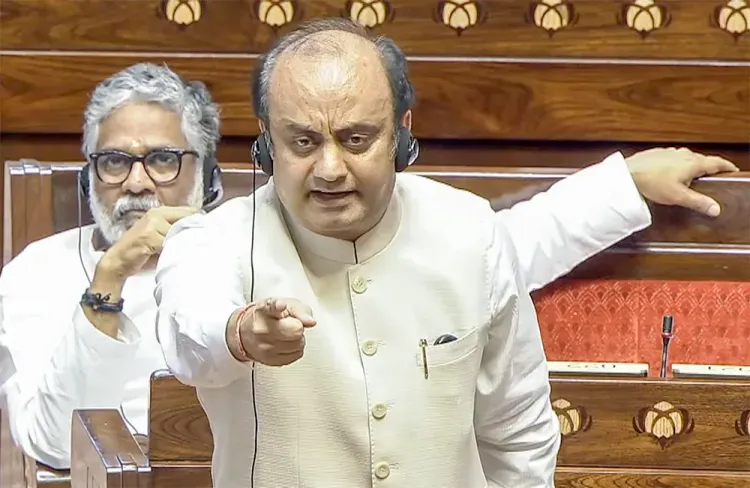
Bharatiya Janata Party (BJP) MP Sudhanshu Trivedi on Thursday, 30 July mounted a vigorous defence of the Public Examinations (Prevention of Unfair Means) Amendment Bill in the Rajya Sabha, arguing that politicians who never competed in open examinations or employment cannot appreciate Prime Minister Narendra Modi's journey from the grassroots. Trivedi, speaking as both a legislator and a former engineering student and teacher, framed the Bill as the government's most decisive strike yet against the paper-leak mafia.
Key Arguments in the Rajya Sabha
Trivedi grounded his speech in personal experience, saying he understood student anxiety when examination integrity is compromised. He credited PM Modi with securing reservations for SC, ST, and OBC communities, describing it as their rightful entitlement rather than a political concession. He argued that leaders who bypassed competitive processes — in education or employment — are ill-placed to judge a prime minister whose rise, he said, was built on clearing every challenge in sequence.
He invoked the 1952 fast-unto-death of Potti Sriramulu to contrast historical political sacrifice with the present government's response to student sentiment, pointing to Education Minister Dharmendra Pradhan's decision to step down as an act of institutional sensitivity — a move that drew criticism from some members of the House.
What the Amendment Bill Proposes
Trivedi outlined three governing principles of the Bill: sensitivity towards students, facilitation of a smooth examination ecosystem, and stringent legal deterrents against paper leaks. Under the amended provisions, financial penalties have been raised from ₹1 crore to ₹10 crore, and imprisonment can extend to 10 years. Fast-track courts may be constituted on the recommendation of the Chief Justice of the High Court, and appeals must be disposed of within three months.
Education Achievements Cited
The BJP MP cited a series of education-sector milestones under the current government, including the addition of new medical colleges, 10,000 new medical seats, a ₹50,000 crore investment in the Research Foundation in 2023, and free access to 13,000 international journals. He also highlighted the establishment of an IIT Delhi campus in Abu Dhabi and an IIT Ahmedabad campus in Dubai, noting that several other institutions have received requests for overseas campuses.
NEET and the Congress Record
On the contentious NEET examination, Trivedi said the concept was first mooted in 1992 but meaningful progress came only after 2014. He contrasted what he described as decisive action under the current dispensation with earlier inaction, citing paper-leak incidents he attributed to the Congress years and the unfulfilled padyatra of Congress leader Sachin Pilot in Rajasthan. He cited examples of students from economically disadvantaged backgrounds who had cleared NEET to underscore the examination's democratising potential.
Warning Against Politicisation
Trivedi cautioned against what he described as the politicisation of student concerns, referencing a warning attributed to Sonam Wangchuk about anti-social elements infiltrating student protests. He urged philosophical reflection on youth pursuits and conveyed what he described as a message from PM Modi: that while some irregularities may have occurred, the government's resolve to protect every aspiring student remains firm.
Point of View
But their effectiveness depends entirely on enforcement infrastructure that the Bill does not address. The NEET crisis exposed not just criminal networks but systemic gaps in examination administration; tougher sentencing alone does not close those gaps. Framing opposition criticism as the complaint of those who never competed risks shutting down legitimate scrutiny of a Bill that still needs implementation detail.
NationPress
14 Sept 2026
Frequently Asked Questions
What is the Public Examinations (Prevention of Unfair Means) Amendment Bill?
It is a legislative amendment aimed at curbing paper leaks and cheating in public examinations. The Bill raises financial penalties for offenders from ₹1 crore to ₹10 crore and extends maximum imprisonment to 10 years, while also providing for fast-track courts to expedite trials.
What are the new penalties under the amended Bill?
Under the amended provisions, those found guilty of paper leaks or unfair means in public examinations face fines of up to ₹10 crore — ten times the earlier ceiling of ₹1 crore — and imprisonment of up to 10 years. Appeals through fast-track courts must be disposed of within three months.
Why did Education Minister Dharmendra Pradhan step down, according to Trivedi?
BJP MP Sudhanshu Trivedi stated that Education Minister Dharmendra Pradhan stepped down out of deference to student sentiment over examination integrity concerns. Trivedi described the move as an act of institutional sensitivity, though some Rajya Sabha members criticised it.
What did Trivedi say about NEET and the Congress party?
Trivedi argued that while the NEET concept was first proposed in 1992, meaningful implementation occurred only after 2014. He cited paper-leak incidents he attributed to the Congress era and referenced Sachin Pilot's unfulfilled padyatra in Rajasthan as examples of earlier inaction on examination integrity.
What education investments did the government highlight during the debate?
BJP MP Trivedi cited the addition of new medical colleges and 10,000 medical seats, a ₹50,000 crore investment in the Research Foundation in 2023, free access to 13,000 international journals, and the establishment of IIT Delhi and IIT Ahmedabad campuses in Abu Dhabi and Dubai respectively.