BJP's Future in West Bengal: Key Constituencies at Stake
Synopsis
The BJP's consolidation in West Bengal hinges on crucial elections in April, especially in North and West Bengal, where its support has historically been stronger. The party faces challenges from the ruling TMC and aims to solidify its gains from past elections.
Key Takeaways
BJP's consolidation depends on results from key districts.
Strong performance in North and West Bengal is crucial.
TMC maintains dominance in the South.
The Left Front faces challenges in returning to the Assembly.
Matua community's votes may influence outcomes.
Kolkata, March 16 (NationPress) The future of the Bharatiya Janata Party (BJP), the leading Opposition group in West Bengal, is closely tied to the outcomes in the 152 constituencies across 16 districts scheduled to vote on April 23 during the first phase of the two-phase elections.
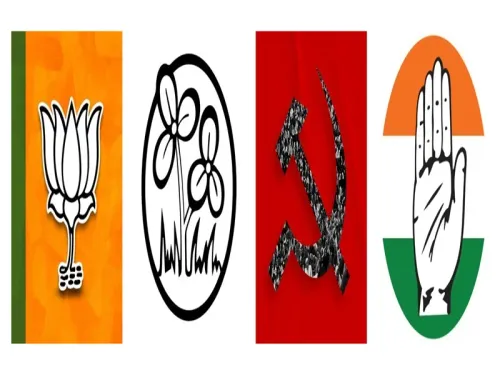
Historically, the BJP has garnered substantial backing in North Bengal and the western regions of the state. In contrast to the southern parts, the party has seen greater success in the northern districts such as Alipurduar, Jalpaiguri, Cooch Behar, Darjeeling, and Uttar Dinajpur, as well as in the western areas like Purulia, Bankura, Jhargram, and sections of Burdwan.
On the other hand, the ruling Trinamool Congress (TMC) has solidified its dominance in the South, where 142 seats are up for election during the second phase on April 29. This includes key districts such as Kolkata, Howrah, Hooghly, and South 24 Parganas.
The Communist Party of India (Marxist)-led Left Front faces a challenging path to re-enter the Assembly. This election cycle, they are collaborating with the Indian Secular Front (ISF), while their previous ally, the Indian National Congress, is campaigning independently.
The Congress is primarily targeting its traditional strongholds in Malda and Murshidabad, areas often referred to as the "Ma-Mu" belt—'Ma' representing Malda, where the return of Mausam Noor is anticipated to boost prospects, and 'Mu' for Murshidabad, where the party aims to secure several seats.
For the BJP, the majority of constituencies in the North and West have historically shown greater backing, particularly noted during the 2019 Lok Sabha elections. Despite failing to replicate that success in the 2024 Parliamentary elections or the 2021 Assembly elections, they remain hopeful.
In districts where the ruling party holds sway, such as Birbhum, the BJP will focus on internal conflicts among local TMC leaders. In Nadia and North 24 Parganas, the voting behavior of the sizeable Matua community will be crucial. The Matuas, primarily Namasudras from a Hindu reform movement that emerged in present-day Bangladesh, have largely migrated to India during and post-Independence due to allegations of oppression.
The community's support is split between the ruling party and the BJP, with the TMC attempting to sway them by criticizing the Election Commission's Special Intensive Revision (SIR) process. Meanwhile, the BJP is advocating for their citizenship through the recently amended Citizenship Amendment Act (CAA).
Across West Bengal, Prime Minister Narendra Modi continues to maintain significant popularity, which bolstered the BJP's performance in the 2019 Lok Sabha elections, where they garnered approximately 41% of the vote against the TMC's 44%. However, in 2024, the BJP's vote share dipped below 40%, while the TMC strengthened its position to around 46%. Although the BJP reached its zenith in the 2019 parliamentary elections, much of its electoral prowess in the 2021 Assembly polls remained focused on North and West Bengal.
Historically, the TMC has made inroads into several BJP strongholds, whereas the BJP has struggled to penetrate the TMC's bastions. Nevertheless, the BJP's ascent in the state is noteworthy, evolving from zero seats in the 2011 Assembly elections to becoming the primary Opposition with 77 seats in 2021. However, these gains were predominantly in constituencies voting in the first phase.
During the 2011 West Bengal Legislative Assembly election, the TMC ended the Left Front's long-standing rule, securing nearly 39% of the vote share while the BJP only achieved about 4%.
In the 2016 elections, the BJP's share improved slightly to three seats, with a vote share of around 10%, while the TMC won 211 seats with almost 45% of the votes.
In the 2021 Assembly elections, the BJP saw a significant rise, winning 77 seats with close to 38% of the vote, particularly excelling in North Bengal and western districts—regions where the party aims to further solidify its support while also seeking to expand into urban areas dominated by the ruling party.
Point of View
It's evident that the BJP's strategy in West Bengal is critical for its political aspirations. The party's historical strongholds in the North and West may provide an advantage, but the TMC's entrenched presence in the South poses significant challenges. The evolution of voter sentiment will be a key factor in shaping the election outcomes.
NationPress
7 Oct 2026
Frequently Asked Questions
What are the key constituencies for the BJP in West Bengal?
The BJP is focusing on constituencies in North Bengal and the western districts, where it has historically received more support.
When will the elections take place?
The elections are scheduled in two phases, with the first phase on April 23 and the second phase on April 29.
Who are the main opponents of the BJP in West Bengal?
The BJP's primary opponents are the ruling Trinamool Congress (TMC) and the Left Front, which is allied with the Indian Secular Front.
What is the significance of the Matua community in the elections?
The Matua community's voting behavior is crucial, as their support is divided between the BJP and the TMC.
How did the BJP perform in previous elections in West Bengal?
In the 2019 Lok Sabha elections, the BJP secured approximately 41% of the vote share, while in the 2021 Assembly elections, it won 77 seats.