Is Brotherhood Prevailing in Ayodhya After the Temple's Construction?

Synopsis
Iqbal Ansari, a key figure in the Babri Masjid case, declares Ayodhya a beacon of peace and brotherhood after the temple's construction. With significant developments post-verdict, he emphasizes the city's growth and communal harmony. This article explores the transformation and current state of Ayodhya amidst heightened security measures.
Key Takeaways
Peace and communal harmony are now central to Ayodhya's identity.
The city has experienced considerable development and infrastructure improvements .
Heightened security measures are in place to maintain tranquility .
The Supreme Court ruling in 2019 marked a significant turning point.
Brothers and sisters from all faiths are embracing unity for national progress.
New Delhi, Dec 6 (NationPress) Iqbal Ansari, a former litigant in the Babri Masjid case, stated on Saturday that peace and communal harmony have become the hallmark of Ayodhya, nearly three decades post the demolition of the Babri Masjid.
In an interview with IANS, he declared, “A temple has been constructed, and brotherhood thrives in Ayodhya,” emphasizing the city’s progress and the spirit of coexistence.
Reflecting on the Supreme Court's 2019 ruling, Ansari remarked, “Muslims nationwide respected the judgement. Currently, Ayodhya enjoys tranquility. There are no tensions between Hindus and Muslims, no protests, and no unrest. Ayodhya is a sacred place filled with brotherhood. The temple is built, and all Muslims accepted this decision harmoniously. Our aspiration is for our nation to advance, where work is revered, and peace prevails.”
Ansari also noted the city’s evolution since the verdict. “Ayodhya now boasts an airport, a railway station, a bus terminal, improved roads, ponds, and parks. Employment opportunities have surged, and the city has seen remarkable progress,” he stated.
On the anniversary of the Babri Masjid's demolition in 1992, security measures were substantially increased across Uttar Pradesh.
Ayodhya and Mathura, two of the state's most sensitive areas, remain on high alert. Law enforcement agencies are exercising strict vigilance with extensive security protocols, including barricades, CCTV surveillance, and drone monitoring.
In Mathura, the Shri Krishna Janmabhoomi complex and Shahi Eidgah Mosque are under intense security, organized into zones and super zones for systematic oversight. Similarly, Vrindavan’s Banke Bihari Temple, Prem Mandir, and other notable temples are under strict watch, with undercover personnel and units from the Provincial Armed Constabulary (PAC) and Rapid Action Force (RAF) on standby.
December 6 is a sensitive date on India’s communal calendar, marked as 'Shaurya Diwas' by some Hindu factions and as 'Black Day' by various Muslim organizations. Authorities have heightened preventive measures to maintain peace and unity.
The Babri Masjid-Ram Mandir conflict reached a pivotal moment on November 9, 2019, when the Supreme Court ruled in favor of Ram Lalla Virajman, directing that five acres be allocated to the Sunni Waqf Board.
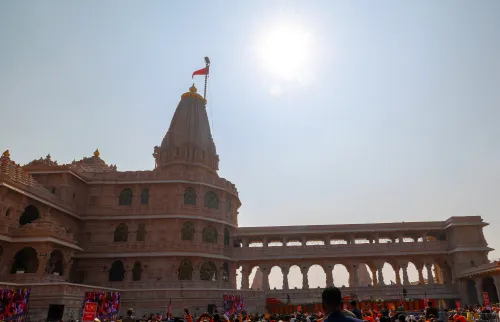
The foundation stone for the Ram temple was laid on August 5, 2020, and as of November 25, 2025, the temple has been fully constructed, with the saffron Dharma Dhwaj hoisted atop its spire by Prime Minister Narendra Modi.
Point of View
It's essential to recognize the significance of Iqbal Ansari's statements regarding communal harmony in Ayodhya. This narrative underscores the importance of dialogue and coexistence in a nation often challenged by division. The developments in Ayodhya serve as a reminder that progress can emerge from conflict, and that unity is crucial for national growth.
NationPress
1 Oct 2026
Frequently Asked Questions
What did Iqbal Ansari say about Ayodhya's current state?
Iqbal Ansari emphasized that Ayodhya now embodies peace and communal harmony, highlighting the city's transformation since the Babri Masjid demolition.
What security measures are in place in Ayodhya?
Authorities have implemented extensive security protocols, including barricades, CCTV monitoring, and drone surveillance, particularly in sensitive areas like Ayodhya and Mathura.
How has Ayodhya changed since the Supreme Court verdict?
Since the Supreme Court ruling in 2019, Ayodhya has seen significant development, including improved infrastructure and increased employment opportunities.