Cabinet Sanctions ₹6,969 Crore for UP's Barabanki-Bahraich 4-Lane Highway Project
Synopsis
The Indian Cabinet has approved a transformative ₹6,969 crore project for a 4-lane highway in Uttar Pradesh, enhancing connectivity and promoting economic growth. Discover how this development will reshape regional logistics and cross-border trade!
Key Takeaways
Investment: ₹6,969 crore for the project.
Distance: The highway spans 101.515 km.
Travel Time: Expected reduction to about one hour.
Economic Boost: Enhances regional growth and connectivity.
Cross-Border Trade: Facilitates trade with Nepal.
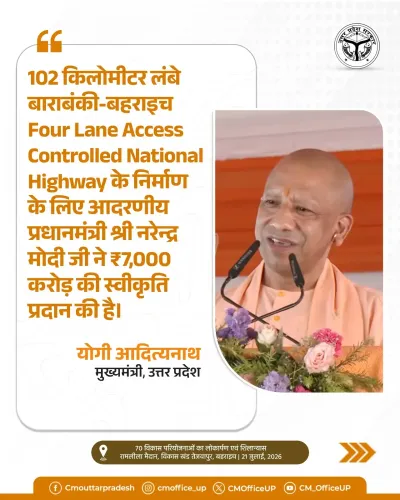
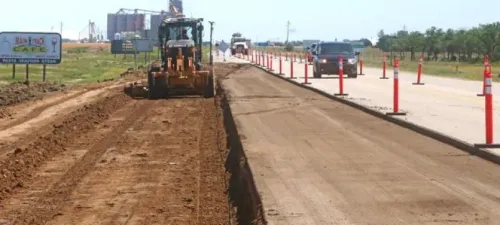
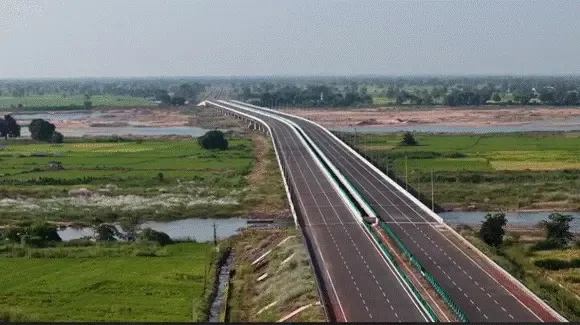
New Delhi, March 18 (NationPress) The Cabinet Committee on Economic Affairs, led by Prime Minister Narendra Modi, has officially given the green light for the development of the 4-lane access-controlled National Highway 927 connecting Barabanki to Bahraich. This significant project covers a distance of 101.515 km in Uttar Pradesh and entails an investment of Rs 6969.04 crore under the hybrid annuity mode (HAM).
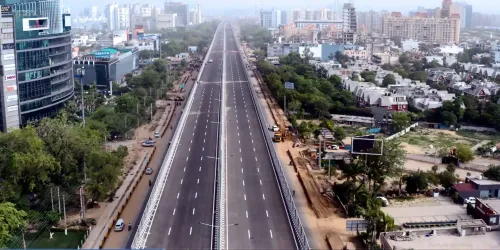
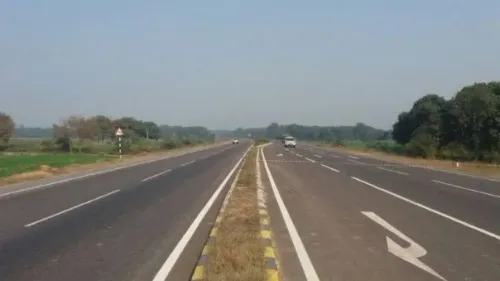
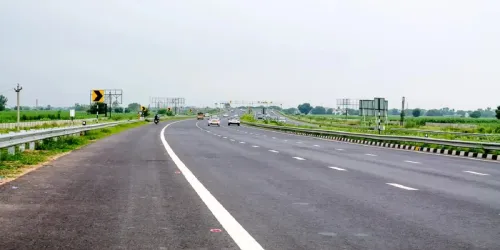
The enhancement of the Barabanki–Bahraich segment of NH-927 aims to rectify critical geometric flaws, including sharp curves and congestion in densely populated areas of both Barabanki and Bahraich districts. The newly designed access-controlled 4-lane highway will feature continuous service roads, effectively bypassing major settlements, which will lead to increased average travel speeds, a reduction in travel time to approximately one hour, and improvements in overall road safety, fuel efficiency, and vehicle operating costs. This development is poised to significantly bolster regional mobility and socio-economic progress, as noted in a Cabinet statement.
This initiative will ensure seamless access to essential economic, social, and logistics hubs throughout the state. Furthermore, the upgraded corridor will enhance multi-modal connectivity by linking three Economic Nodes, two Social Nodes, and twelve Logistics Nodes, thereby improving multimodal transport options with the Rupaidiha Land Port and nearby airports. This will facilitate expedited movement of goods and passengers within the region.
Upon its completion, this project will strategically create a crucial cross-border trade and transit route between India and Nepal via the Nepalganj border, greatly enhancing access to the Rupaidiha Land Port. It will also improve connectivity for remote districts such as Bahraich and Shravasti, support the PM GatiShakti economic and logistics nodes, and stimulate agricultural trade, tourism, cross-border commerce, and local investment.
The project has been approved using a hybrid annuity model (HAM), a public-private partnership (PPP) strategy for infrastructure projects, which integrates Engineering, Procurement, and Construction (EPC) (40% government-funded) and Build-Operate-Transfer (BOT) (60% privately funded) components. This approach alleviates financial pressures on developers by providing stable, annuity-based, inflation-indexed returns, while the government continues to manage revenue risks.
This marks the second major highway initiative endorsed by the Cabinet Committee on Economic Affairs this month, following the recent approval for the revised total capital cost of Rs 3630.77 crore on March 10 for the construction of greenfield connectivity to Jewar International Airport, linking Delhi-Faridabad-Ballabhgarh-Sohna Spur of the Delhi-Mumbai Expressway via the hybrid annuity mode in Uttar Pradesh and Haryana.
This 31.42 km long corridor will provide direct and high-speed access from south Delhi, Faridabad, and Gurugram to Jewar International Airport, thereby fostering economic development and improving logistics efficiency across the National Capital Region (NCR).
Point of View
Focusing on enhancing connectivity and supporting regional economies. With the government's strategic investment, it aims to address existing transportation challenges while facilitating cross-border trade.
NationPress
12 Oct 2026
Frequently Asked Questions
What is the investment for the Barabanki-Bahraich highway project?
The investment for the project is ₹6,969 crore.
How long is the Barabanki-Bahraich highway?
The highway stretches over 101.515 km.
What is the purpose of the highway project?
The highway aims to improve connectivity, reduce travel time, and enhance regional economic growth.
What model is being used for this project?
The project is being developed under a hybrid annuity model (HAM).
How will this project benefit cross-border trade?
It will establish a vital trade corridor between India and Nepal, improving access to the Rupaidiha Land Port.