Cabinet Approves VISTAR Scheme to Modernise India's Statistical System
Synopsis
The Union Cabinet approved the VISTAR scheme on November 4, 2026, committing to a five-year overhaul of India's statistical ecosystem to improve data quality, accessibility, and use in evidence-based policymaking under the Viksit Bharat vision.
Key Takeaways
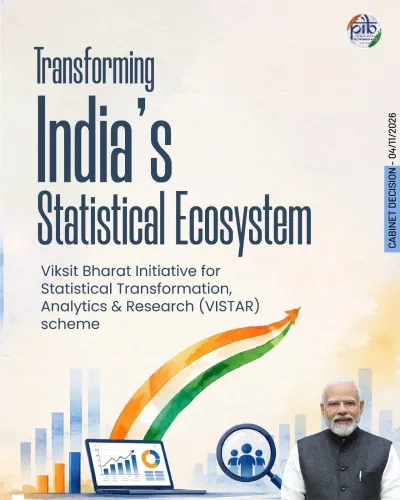
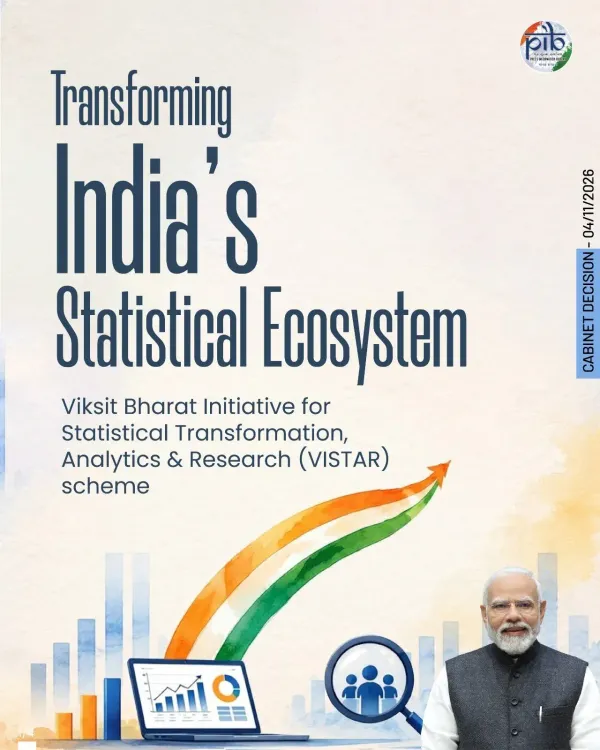
The Union Cabinet approved the VISTAR (Viksit Bharat Initiative for Statistical Transformation, Analytics and Research) scheme on November 4, 2026 .
The scheme runs for five years, covering 2026–27 to 2030–31 .
Its stated goals are to modernise India's official statistical ecosystem, strengthen data-driven policymaking, and enhance the quality, accessibility, and use of statistical information.
The initiative falls under the umbrella of Prime Minister Modi's Viksit Bharat vision of a developed India by 2047.
The National Statistical Commission , constituted in 2005, provides the institutional lineage from which VISTAR's reform ambitions descend.
Budget allocations, implementation roadmaps, and MOSPI coordination mechanisms are yet to be publicly detailed.
India's official data infrastructure is getting its most ambitious overhaul in decades. The Union Cabinet, chaired by Prime Minister Narendra Modi, on Wednesday, November 4, 2026, approved the Viksit Bharat Initiative for Statistical Transformation, Analytics and Research (VISTAR) scheme, a five-year programme running from 2026–27 to 2030–31 aimed at modernising the country's statistical ecosystem and sharpening the evidence base for public policy. Union Minister of State (Independent Charge) for Science and Technology Dr. Jitendra Singh announced the decision on X, calling it 'a significant step towards building a future-ready, data-driven governance ecosystem for a Viksit Bharat.'
What VISTAR Sets Out to Do
At its core, VISTAR targets three interlocking problems that have long dogged India's official statistics: quality, accessibility, and use. Policymakers have frequently had to work around data gaps — lagging census cycles, inconsistent state-level figures, and a statistical machinery that has struggled to keep pace with a rapidly digitising economy. The new scheme is designed to close those gaps by modernising institutional processes, deploying analytics tools, and strengthening the pipeline from raw data collection to decision-ready insight.
The initiative sits squarely within the broader Viksit Bharat framework — Prime Minister Modi's flagship vision of transforming India into a developed nation by 2047, the centenary of Independence. Data, in this architecture, is not a bureaucratic afterthought; it is the navigational instrument for trillion-dollar spending decisions in infrastructure, health, agriculture, and social welfare.
A Statistical Apparatus Long in Need of an Upgrade
India's official statistical system has institutional roots going back decades, with the National Statistical Commission constituted in 2005 to recommend improvements to the apparatus. Progress has been incremental — technology upgrades here, a methodological revision there. VISTAR represents a step-change ambition: a named, time-bound, Cabinet-approved scheme rather than a rolling in-house reform. The Ministry of Statistics and Programme Implementation (MOSPI) is the natural anchor for implementation, though coordination with line ministries — each a producer and consumer of sectoral data — will be the real test of execution.
The 'Analytics and Research' strand of the scheme signals something beyond routine modernisation. Embedding analytical capacity within the official statistical machinery means the government is betting that better-interpreted data, not just better-collected data, is what drives better policy. That is a meaningful shift in institutional philosophy.
What Comes Next
The Cabinet approval sets the direction; the details that will determine VISTAR's real impact — budget envelope, technology partners, inter-ministerial coordination mechanisms, and measurable output milestones for each of the five years — are still to be publicly disclosed. Those specifics will tell observers whether this is a transformational investment or a rebranded continuation of existing statistical modernisation work.
India's ability to make its development ambitions legible to the world — and to its own planners — depends on the credibility of its data. VISTAR has the mandate. Now it needs the machinery to match.
Point of View
Five-year, funded mandate that answers directly to the Viksit Bharat political architecture. For the Modi government, credible official data is not merely administrative housekeeping; it is the evidence layer that legitimises and directs the country's largest development programmes. The real policy test, however, will be whether VISTAR breaks the historical pattern of incremental reform and delivers measurable improvements in data timeliness and cross-ministerial interoperability within the first two scheme years. Dr. Jitendra Singh's high-profile announcement signals that the government intends this to be a visible deliverable, not a quiet bureaucratic exercise.
NationPress
4 Nov 2026
Frequently Asked Questions
What is the VISTAR scheme approved by the Cabinet?
VISTAR stands for Viksit Bharat Initiative for Statistical Transformation, Analytics and Research. It is a five-year scheme approved by the Union Cabinet on November 4, 2026, running from 2026–27 to 2030–31, aimed at modernising India's official statistical ecosystem and improving data quality and use in policymaking.
Which ministry will implement the VISTAR scheme?
The Ministry of Statistics and Programme Implementation (MOSPI) is the natural implementing body for VISTAR, though coordination with other line ministries will be essential given the cross-sectoral nature of official data.
How does VISTAR relate to Viksit Bharat?
VISTAR is explicitly framed as a component of the Viksit Bharat vision — Prime Minister Modi's goal of making India a developed nation by 2047. Reliable, accessible data is seen as a foundational requirement for the evidence-based planning that large-scale development demands.
What was India's earlier effort to reform its statistical system?
The National Statistical Commission was constituted in 2005 to recommend improvements to India's official statistical system. VISTAR represents a more recent and more comprehensive push in that same direction.
What details about the VISTAR scheme are still awaited?
The Cabinet approval has set the direction, but specifics such as the total budget allocation, year-wise implementation milestones, technology partnerships, and inter-ministerial coordination mechanisms have not yet been publicly released.