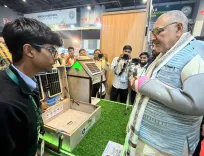
Gadkari: Cabinet clears ₹14,500 cr VGF for 92 GWh storage
Synopsis
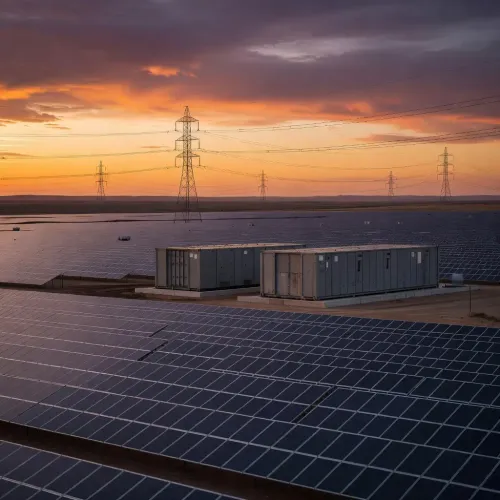
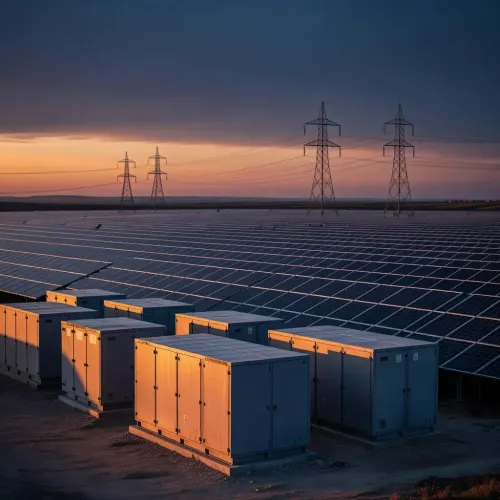
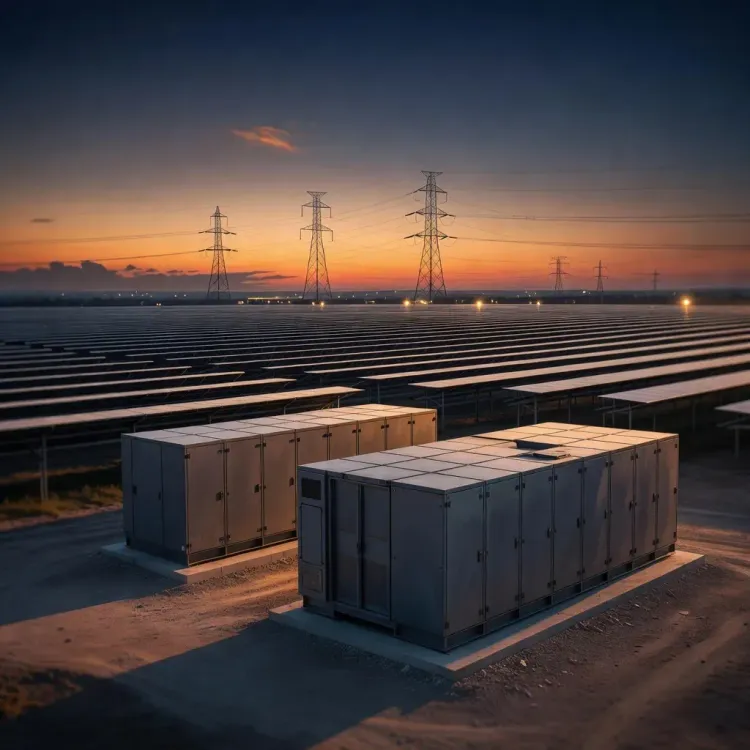
The Union Cabinet approved a ₹14,500 crore VGF scheme to develop 92 GWh of grid-scale battery storage by FY 2030–31 — equivalent to 170 percent of India's existing capacity — to integrate renewables and boost domestic battery manufacturing.
Key Takeaways
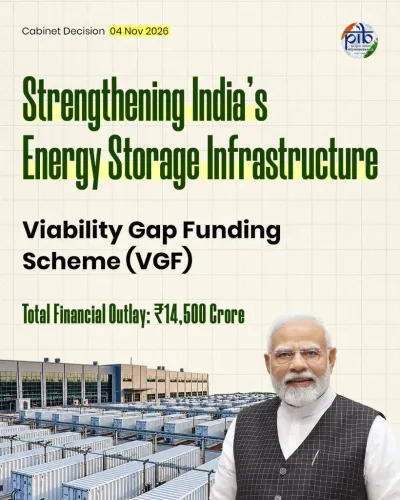
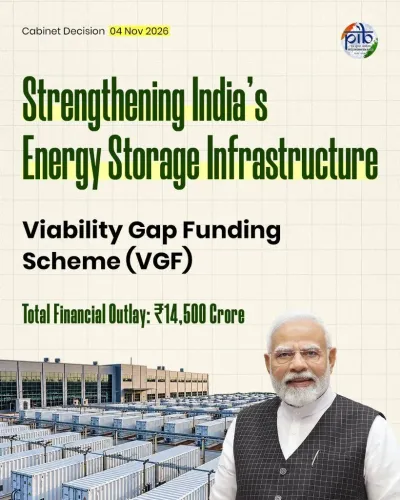
The Union Cabinet has approved ₹14,500 crore in Viability Gap Funding for grid-scale battery energy storage systems.
The scheme targets 92 GWh of new storage capacity — equal to 170 percent of India's current grid-scale storage capacity.
The funding window runs from FY 2026–27 to FY 2030–31 , with India's total projected storage need pegged at 411 GWh by 2031–32 .
The initiative explicitly aims to reduce India's import dependence on battery components and promote domestic manufacturing.
The scheme supports India's broader goal of 500 GW non-fossil fuel capacity by 2030 , announced at COP26 in 2021.
The Ministry of Power must now issue detailed guidelines and bidding documents to trigger the first tranche of projects in FY 2026–27.
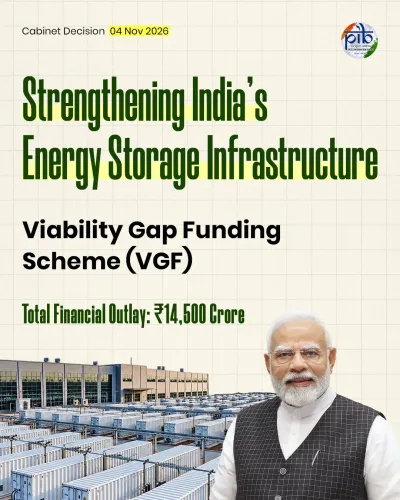
India just placed a ₹14,500 crore bet on the future of its power grid. The Union Cabinet, chaired by Prime Minister Narendra Modi, on Wednesday, 4 November 2026, approved a Viability Gap Funding (VGF) Scheme for Grid-Scale Battery Energy Storage Systems — a move that Union Road Transport and Highways Minister Nitin Gadkari flagged as a defining step toward round-the-clock renewable power for every Indian household.
92 GWh target — and what that number actually means
The scheme's headline target is 92 GWh of new grid-scale energy storage capacity, to be developed between FY 2026–27 and FY 2030–31. To put that in perspective: the government itself pegs it at 170 percent of India's current grid-scale storage capacity — meaning the country intends to more than double what it has built in its entire history, within five years.
That still leaves a gap. India's projected storage requirement by 2031–32 stands at 411 GWh. The scheme is designed to close a substantial portion of that shortfall, but the trajectory signals that this is the opening move in a much larger build-out, not the finish line.
Why VGF — and why now
Grid-scale battery storage is commercially unviable without public support at this stage — costs remain too high for private developers to absorb alone. Viability Gap Funding bridges exactly that gap: the government absorbs enough of the upfront financial risk to make projects bankable, pulling private capital into the sector. The same instrument was used to unlock solar parks and hybrid renewable projects in earlier cycles.
The timing is deliberate. India's renewable capacity has expanded rapidly since the COP26 pledge of 500 GW non-fossil fuel capacity by 2030, but intermittency — the sun doesn't always shine, the wind doesn't always blow — has become an increasingly live problem for grid operators. Storage is the missing piece that transforms variable renewable energy into dispatchable, reliable power.
Domestic manufacturing push woven into the design
The scheme carries an explicit industrial-policy dimension: it is designed to encourage domestic manufacturing of battery energy storage systems and reduce India's import dependence on cells and components, which today flow predominantly from East Asia. This builds on the Production Linked Incentive scheme for Advanced Chemistry Cells, launched in 2021, which aimed to seed local cell manufacturing capacity.
Together, the PLI and VGF instruments represent a two-pronged strategy — supply-side incentives to build domestic factories, demand-side guarantees to ensure those factories have buyers. The energy security argument is as geopolitical as it is economic: a country that cannot store power is a country that cannot fully control it.
What moves next on the implementation clock
The Cabinet approval is the political green light; the operational machinery now shifts to the Ministry of Power, which must issue detailed scheme guidelines and bidding documents. The FY 2026–27 tranche — the first year of the five-year window — becomes the immediate test of execution speed. Renewable energy developers, power distribution companies, and battery manufacturers will all be watching the fine print on eligibility, subsidy disbursement timelines, and domestic content requirements.
India's energy transition has long been strong on announced targets and uneven on delivered gigawatts. This scheme's real legacy will be written in the first round of project commissioning — not in today's Cabinet note.
Point of View
The scheme attempts to solve the intermittency problem and the import-dependence problem in a single instrument, echoing the PLI-plus-demand-guarantee playbook used in semiconductors and solar. The ₹14,500 crore outlay is substantial but the 92 GWh target still covers less than a quarter of the projected 411 GWh need by 2031–32, making this a credibility-building first chapter rather than a comprehensive solution. Execution speed on scheme guidelines and the first round of competitive bidding will determine whether this Cabinet decision translates into commissioned gigawatt-hours — or joins the library of well-intentioned targets.
NationPress
4 Nov 2026
Frequently Asked Questions
What is the VGF Scheme for Grid-Scale Energy Storage Systems?
It is a central government scheme approved by the Union Cabinet that provides Viability Gap Funding of ₹14,500 crore to support private developers in building grid-scale battery energy storage projects across India between FY 2026–27 and FY 2030–31, with a target of 92 GWh of new capacity.
Why does India need grid-scale battery storage?
As India adds large amounts of solar and wind power, the grid needs storage to handle intermittency — storing surplus renewable energy when generation exceeds demand and releasing it when the sun or wind is unavailable, ensuring reliable, round-the-clock power supply.
What is the 411 GWh figure mentioned in the Cabinet approval?
411 GWh is the government's projected total grid-scale energy storage requirement by FY 2031–32. The current scheme targets 92 GWh — roughly 22 percent of that total — representing an important but partial step toward the full requirement.
How does the VGF scheme help domestic battery manufacturing?
By guaranteeing a large pipeline of storage projects, the scheme creates assured demand that makes it viable for Indian manufacturers to invest in battery cell and system production, reducing the country's reliance on imported battery components, primarily from East Asia.
What happens after the Cabinet approves the VGF scheme?
The Ministry of Power must issue detailed scheme guidelines, eligibility criteria, and competitive bidding documents. The first tranche of projects is expected to be tendered in FY 2026–27, and the pace of that process will determine real-world impact.