Cabinet Approves ₹53,428 Cr PM Samajik Sahayata Yojana
Synopsis
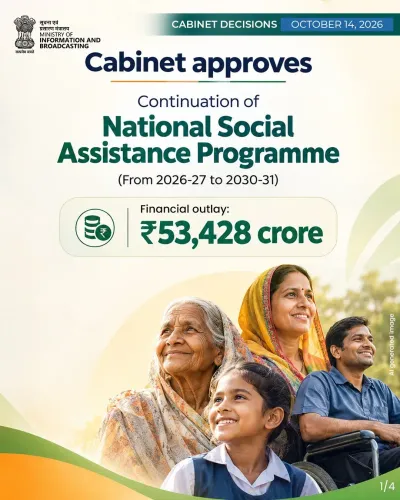
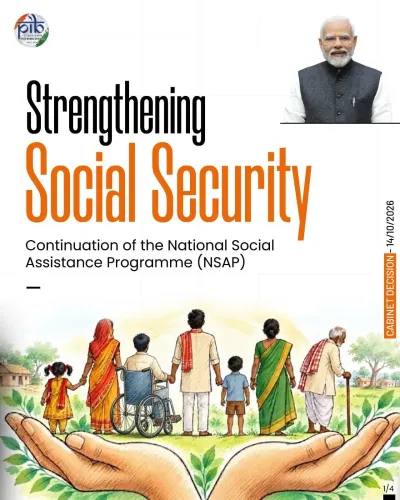
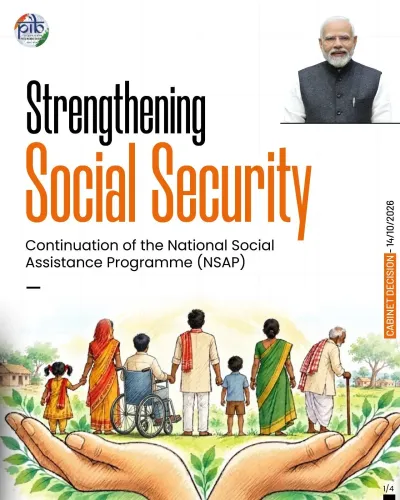
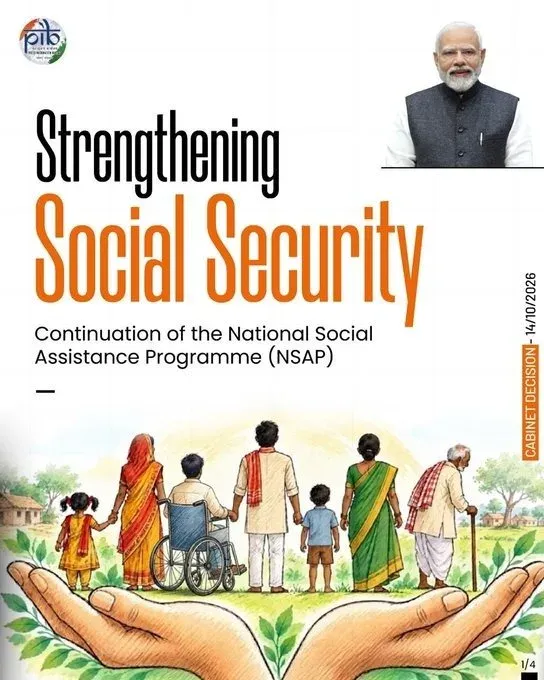
The Union Cabinet on 14 October 2026 approved continuation of Pradhan Mantri Samajik Sahayata Yojana — the rechristened NSAP — with ₹53,428 crore for 2026-31, securing monthly pensions for 3.20 crore elderly, widow and disability beneficiaries across all 36 States and UTs.
Key Takeaways
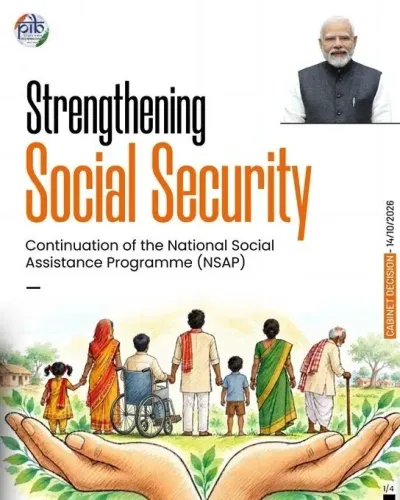
The Union Cabinet approved PM Samajik Sahayata Yojana (PM-SSY) , a continuation of the National Social Assistance Programme (NSAP) launched in 1995 .
Total approved outlay: ₹53,428 crore for the five-year period 2026-27 to 2030-31 .
3.20 crore beneficiaries — elderly citizens, widows, and persons with disabilities — across all 36 States and UTs will be covered.
The scheme delivers direct monthly pension transfers to India's most economically vulnerable populations.
Implementation guidelines and state-wise beneficiary lists will be issued by the Ministry of Rural Development .
The decision aligns with India's broader DBT-based welfare architecture alongside PM-KISAN and Ayushman Bharat.
A welfare commitment measured in decades, not quarters: the Union Cabinet, chaired by Prime Minister Narendra Modi, on Wednesday, 14 October 2026, approved the continuation of the Pradhan Mantri Samajik Sahayata Yojana (PM-SSY) — formerly the National Social Assistance Programme (NSAP) — with a total outlay of ₹53,428 crore for the five-year period 2026-27 to 2030-31, covering 3.20 crore beneficiaries across all 36 States and Union Territories. Union Minister Pralhad Joshi announced the decision on X.
Three Decades of Social Pensions — Now Rechristened
The programme's roots run back to 1995, when the National Social Assistance Programme was launched as one of India's earliest centrally sponsored direct-benefit schemes — delivering monthly pensions to elderly citizens, widows, and persons with disabilities who had little else to fall back on. For over thirty years it has been the quiet backbone of the country's social safety net, periodically renewed with fresh multi-year funding commitments. The renaming to Pradhan Mantri Samajik Sahayata Yojana signals a fresh brand identity, but the core architecture — cash transfers to the most vulnerable — remains intact.
₹53,428 Crore and 3.20 Crore Lives
The approved outlay of ₹53,428 crore across five years represents the government's single largest multi-year commitment to pension-linked social assistance in recent memory under this scheme. The 3.20 crore beneficiaries — elderly persons, widowed women, and individuals with disabilities — span every corner of the country, from remote northeastern states to island Union Territories. The Cabinet decision locks in funding certainty through 2030-31, shielding beneficiaries from the annual budget uncertainty that can disrupt direct-benefit transfer pipelines at the state level.
Where PM-SSY Sits in India's Welfare Architecture
The decision does not exist in isolation. It lands alongside a wider constellation of welfare programmes — PM-KISAN for farmers, Ayushman Bharat for healthcare, and a broadening DBT (Direct Benefit Transfer) infrastructure now capable of reaching hundreds of millions of Jan Dhan accounts. PM-SSY plugs the gap that neither agricultural income support nor health insurance fully addresses: the bare cost of living for those too old, too ill, or too bereaved to earn. The Ministry of Rural Development will be responsible for rolling out implementation guidelines and state-wise beneficiary lists in the coming weeks — that next step will determine how quickly the fresh funding actually reaches accounts.
Point of View
Suggesting institutional continuity rather than a structural reform. The rechristening from NSAP to a 'Pradhan Mantri'-branded identity mirrors the broader NDA playbook of consolidating legacy programmes under a flagship nomenclature, enhancing political visibility. The ₹53,428 crore envelope, spread over five years and 3.20 crore beneficiaries, will be closely scrutinised for any revision in per-beneficiary pension amounts, which critics have long argued remain too modest against inflation. With assembly elections in several states on the horizon through 2027, the timing of the announcement reinforces social welfare as a central plank of the ruling coalition's political messaging.
NationPress
14 Oct 2026
Frequently Asked Questions
What is Pradhan Mantri Samajik Sahayata Yojana?
Pradhan Mantri Samajik Sahayata Yojana (PM-SSY) is the rechristened version of the National Social Assistance Programme (NSAP), a centrally sponsored scheme launched in 1995 that provides monthly pension transfers to elderly citizens, widows, and persons with disabilities.
How much money has the Cabinet approved for PM Samajik Sahayata Yojana?
The Union Cabinet approved a total outlay of ₹53,428 crore for PM-SSY covering the five-year period from 2026-27 to 2030-31.
How many people will benefit from PM Samajik Sahayata Yojana?
A total of 3.20 crore beneficiaries across all 36 States and Union Territories of India will receive support under the scheme.
What is the difference between NSAP and PM Samajik Sahayata Yojana?
PM Samajik Sahayata Yojana is the new name for the National Social Assistance Programme (NSAP). The core architecture — direct pension transfers to elderly persons, widows, and persons with disabilities — remains the same; the renaming aligns the scheme with the government's flagship branding.
Which ministry implements PM Samajik Sahayata Yojana?
The Ministry of Rural Development is responsible for implementing the scheme, including issuing guidelines and managing state-wise beneficiary lists and DBT disbursals.