Cabinet Clears ₹7,145 Cr Kanpur–Kabrai NH-34 Highway
Synopsis
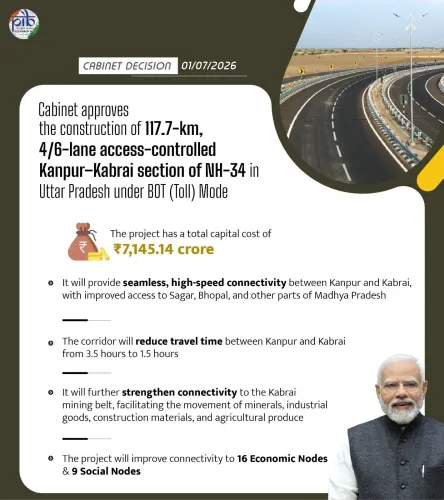
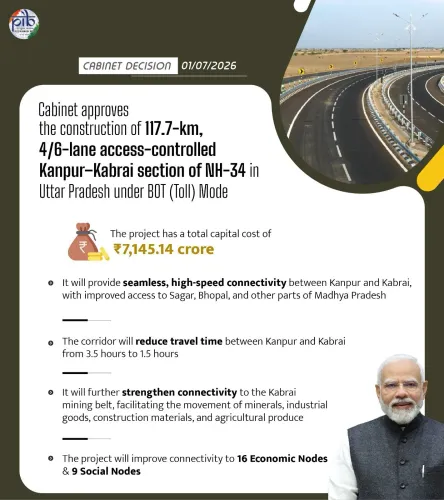
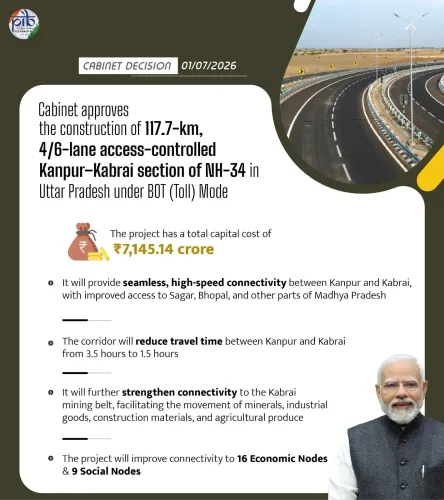
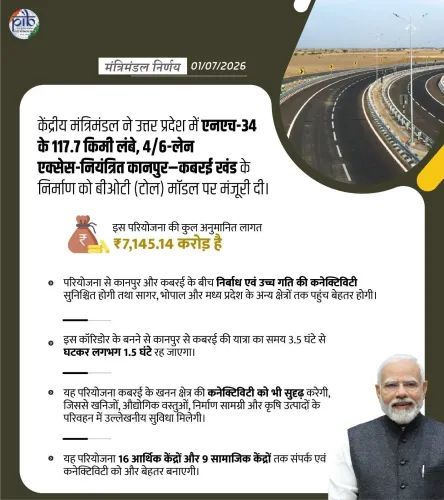
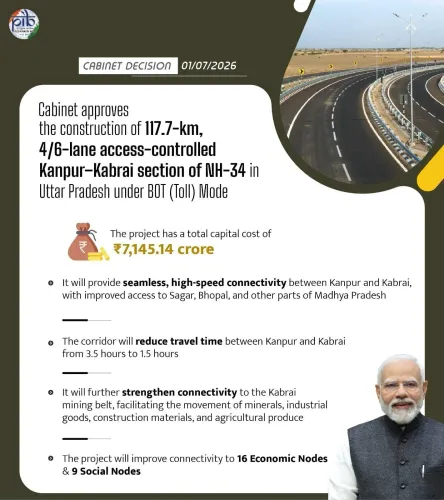
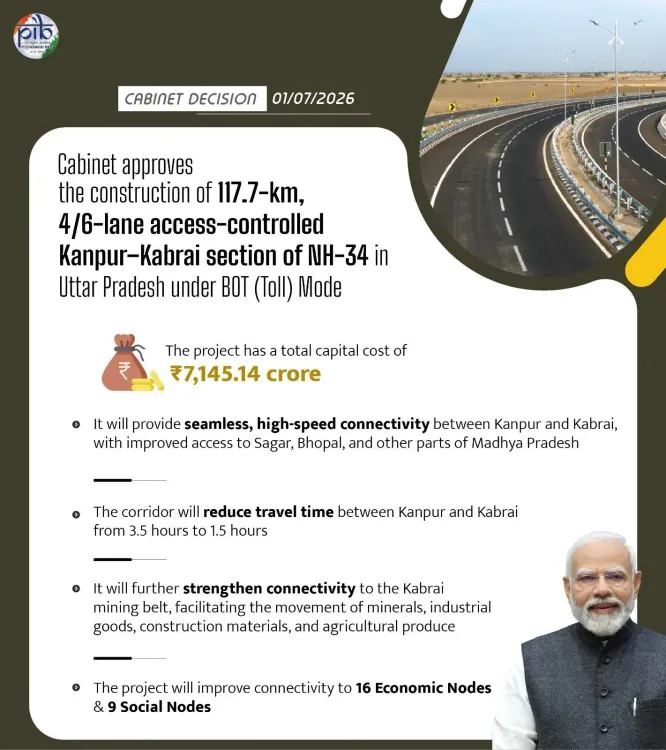
The Union Cabinet has approved a 117.7-km, four- to six-lane access-controlled highway on the Kanpur–Kabrai section of NH-34 in Uttar Pradesh at ₹7,145.14 crore, announced by Minister Dr. Jitendra Singh on 1 July 2026. The project aims to boost connectivity between Kanpur's industrial belt and Bundelkhand.
Key Takeaways
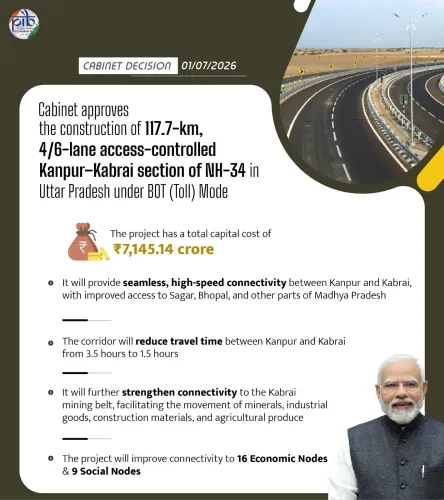
The Union Cabinet approved construction of a 117.7-km access-controlled highway on the Kanpur–Kabrai section of NH-34 in Uttar Pradesh .
The project carries an estimated total capital cost of ₹7,145.14 crore .
The corridor will be developed as a four- to six-lane access-controlled highway, featuring grade-separated interchanges.
The decision aligns with the Bharatmala Pariyojana Phase-I framework launched in 2017 to upgrade over 34,000 km of national highways.
Key beneficiaries include commuters, freight transporters, and communities in the Bundelkhand region, including Mahoba and Hamirpur districts.
NHAI is the expected implementing agency; land acquisition and tendering are the critical next steps.
The Union Cabinet, chaired by Prime Minister Narendra Modi, has approved the construction of a 117.7-km, four- to six-lane access-controlled highway along the Kanpur–Kabrai section of National Highway 34 in Uttar Pradesh, with an estimated capital outlay of ₹7,145.14 crore. Union Science and Technology Minister Dr. Jitendra Singh announced the decision on Wednesday, 1 July 2026, sharing the Cabinet's approval on X.
Context
The approved corridor stretches 117.7 kilometres from Kanpur, one of Uttar Pradesh's largest industrial cities, to Kabrai, a town in the Mahoba district of the Bundelkhand region. The project envisages an access-controlled design — meaning grade-separated interchanges and controlled entry and exit points — on a four- to six-lane carriageway. Such specifications are intended to reduce travel time, lower accident rates, and increase freight throughput on a corridor that links the state's industrial heartland to one of its more economically lagging regions.
Policy Backdrop
The approval fits within the broader Bharatmala Pariyojana Phase-I, sanctioned in 2017, which envisaged the construction or upgrade of over 34,000 km of national highways with a focus on access-controlled corridors and economic corridors. NH-34 in Uttar Pradesh has been a recurring target for capacity upgrades under this framework, as successive Cabinet notes have sought to close connectivity gaps between the densely populated Gangetic plain and the historically underserved Bundelkhand belt.
Since 2014, the central government has steadily raised annual highway construction targets, with high-traffic states such as Uttar Pradesh receiving disproportionately large allocations. The Kanpur–Kabrai approval continues that pattern, addressing a stretch that carries significant inter-district freight and passenger traffic but has historically lacked a divided, access-controlled configuration.
Stakeholders and Impact
The most direct beneficiaries are Uttar Pradesh commuters and freight transporters operating between Kanpur's manufacturing clusters and destinations in Bundelkhand. An access-controlled corridor is expected to cut travel time materially and reduce the incidence of head-on collisions common on undivided stretches. Farmers and small traders in Mahoba, Hamirpur and adjoining Bundelkhand districts stand to gain from faster and cheaper logistics links to Kanpur's markets and rail terminals.
The ₹7,145.14 crore capital cost will also generate construction employment and ancillary economic activity along the alignment during the project's execution phase. The National Highways Authority of India (NHAI) is expected to be the implementing agency, subject to tendering and land acquisition processes.
What's Next
NHAI will now move toward detailed project reports, environmental clearances, and land acquisition notifications under the relevant land laws. The pace of tendering and the progress of land acquisition — historically the most time-consuming element of such projects in Uttar Pradesh — will determine when ground-breaking can begin. Observers will also watch for Cabinet approvals covering adjoining sections of NH-34 or linked expressway corridors that could extend the access-controlled network further into Bundelkhand.
The decision signals continued federal investment in Uttar Pradesh's highway grid ahead of the state's ongoing infrastructure push, reinforcing the Centre's stated commitment to integrating Bundelkhand's economy with the broader national supply chain.
Point of View
Integrating the historically lagging Bundelkhand belt with Uttar Pradesh's industrial core. The ₹7,145.14 crore outlay is substantial, but the real test will be execution speed, given that land acquisition in UP has repeatedly delayed comparable projects. The approval also reinforces the Centre's political calculus in Uttar Pradesh, where infrastructure visibility carries electoral weight. For Bundelkhand, faster freight links to Kanpur could meaningfully alter the economics of agriculture and small-scale industry in the region.
NationPress
1 Jul 2026
Frequently Asked Questions
What is the Kanpur–Kabrai NH-34 highway project?
It is a Cabinet-approved project to build a 117.7-km, four- to six-lane access-controlled highway along the Kanpur–Kabrai section of National Highway 34 in Uttar Pradesh, at an estimated cost of ₹7,145.14 crore.
What is the cost of the Kanpur–Kabrai highway project?
The estimated total capital cost of the project is ₹7,145.14 crore, as approved by the Union Cabinet on 1 July 2026.
Which districts does the Kanpur–Kabrai NH-34 corridor pass through?
The corridor connects Kanpur, a major industrial city, to Kabrai in Mahoba district, passing through parts of the Bundelkhand region of Uttar Pradesh.
What is Bharatmala Pariyojana and how does this project relate to it?
Bharatmala Pariyojana Phase-I is a central government programme approved in 2017 to build or upgrade over 34,000 km of national highways. The Kanpur–Kabrai NH-34 project aligns with its emphasis on access-controlled economic corridors.
Who will implement the Kanpur–Kabrai NH-34 highway project?
The National Highways Authority of India (NHAI) is expected to be the implementing agency, with tendering and land acquisition as the immediate next steps following Cabinet approval.