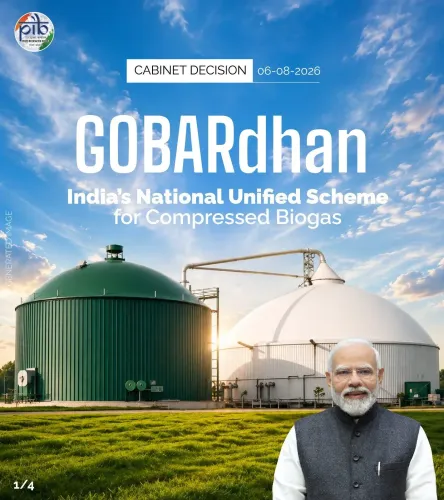
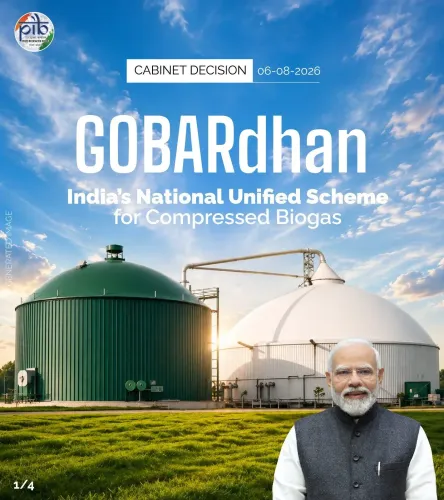
Cabinet Clears GOBARdhan CBG Scheme Worth Rs.23,731 Crore
Synopsis
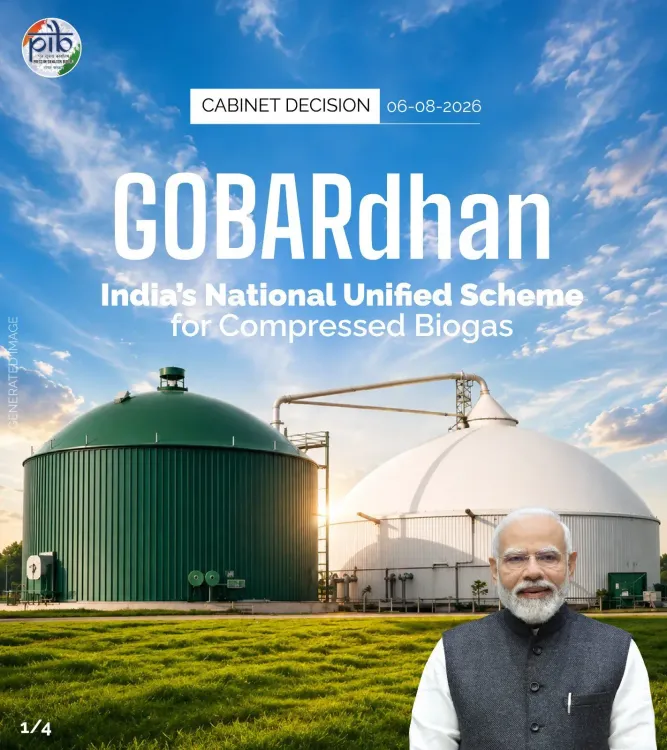
The Modi Cabinet has approved the GOBARdhan National Unified Scheme for Compressed Biogas with an outlay of Rs.23,731 crore, aiming for nearly ten-fold growth in domestic CBG production to strengthen India's energy security and empower rural farmers and entrepreneurs.
Key Takeaways
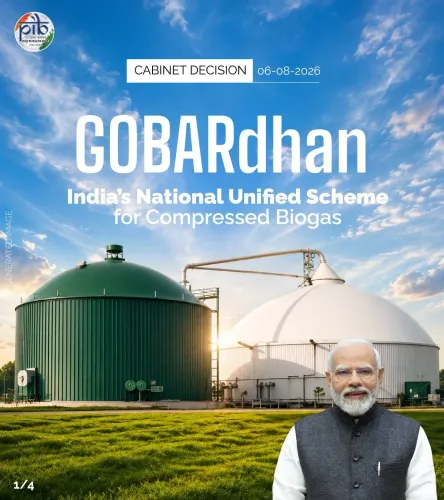
The Union Cabinet under PM Narendra Modi approved the GOBARdhan National Unified Scheme for Compressed Biogas on 6 August 2026 .
The scheme carries an outlay of Rs.23,731 crore , making it one of the largest dedicated bioenergy commitments by the Indian government.
The target is nearly ten-fold growth in domestic compressed biogas (CBG) production.
GOBARdhan was originally launched in Budget 2018 under the Swachh Bharat Mission-Gramin; this Cabinet decision reframes it as a national energy-security instrument.
Primary beneficiaries include small farmers and rural entrepreneurs who supply organic feedstock and can host CBG plants.
State-level rollout, new plant commissioning, and private investment mobilisation will be the key markers of implementation success.
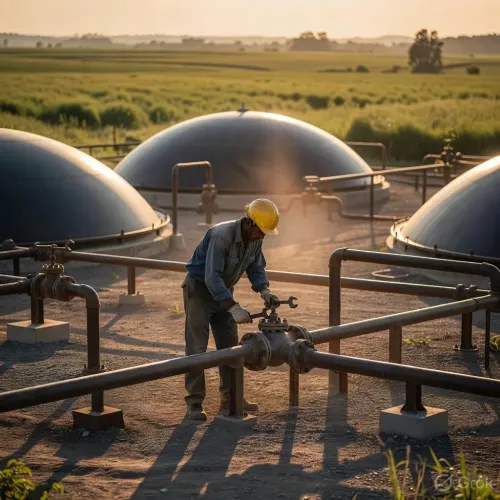
India's waste-to-energy ambitions just got a massive fiscal shot in the arm. The Union Cabinet under Prime Minister Narendra Modi has approved the GOBARdhan National Unified Scheme for Compressed Biogas (CBG), committing an outlay of Rs.23,731 crore to drive what the government describes as nearly ten-fold growth in domestic CBG production — a bet that cattle dung and organic waste can meaningfully dent India's crude oil import bill.
From Swachh Bharat footnote to energy-security centrepiece
GOBARdhan — short for Galvanizing Organic Bio-Agro Resources Dhan — was first seeded in the Union Budget of 2018 as a component of the Swachh Bharat Mission-Gramin, designed to convert cattle dung and agricultural waste into biogas and organic manure for rural households. For years it remained a modest rural-sanitation programme. The Cabinet decision announced on 6 August 2026 reframes it as a national energy-security instrument, now operating under a unified scheme architecture with a dedicated, multi-thousand-crore corpus.
Union Science and Technology Minister Dr. Jitendra Singh shared the Cabinet decision on X, flagging both the outlay and the production target: 'Cabinet under PM Sh @NarendraModi approves GOBARdhan, India's National Unified Scheme for Compressed Biogas, with an outlay of Rs.23,731 crore. Scheme to drive nearly ten-fold growth in domestic CBG production and strengthen India's energy security.'
Why ten-fold CBG growth matters for India's energy calculus
India imports the bulk of its crude oil needs, making every percentage point of domestic energy substitution a strategic gain. Compressed biogas — chemically near-identical to compressed natural gas — can be fed directly into the existing gas distribution grid, used as vehicle fuel, or supplied to industry. The government has pursued CBG alongside ethanol blending and solar expansion as interlocking planks of an energy-security and circular-economy strategy across successive budgets.
A ten-fold production jump, if achieved, would represent a structural shift — not incremental tinkering. The scheme's primary beneficiaries are small farmers and rural entrepreneurs, who supply the organic feedstock and can host or operate biogas plants, creating a decentralised production model that also generates organic manure as a byproduct, reducing chemical fertiliser dependence.
What the rollout will test
The ambition is clear; the execution will be the real story. State-level implementation guidelines, the pace at which new CBG plants come online, and whether private investment is catalysed alongside the government outlay will determine whether the ten-fold target moves from Cabinet resolution to grid reality. Progress against production benchmarks in the coming fiscal years will be the metric to watch.
India has announced large-scale bioenergy targets before — and the gap between announcement and plant commissioning has historically been the sticking point. This time, a unified scheme structure and a named outlay give the programme sharper accountability architecture than its 2018 predecessor ever had.
A programme that began as a rural sanitation initiative is now carrying the weight of national energy strategy. The question is whether Rs.23,731 crore and a unified framework can finally make India's organic waste a genuine fuel source at scale.
Point of View
Success here strengthens its claim of delivering both rural livelihoods and macro energy resilience simultaneously.
NationPress
6 Aug 2026
Frequently Asked Questions
What is the GOBARdhan scheme approved by the Cabinet?
GOBARdhan stands for Galvanizing Organic Bio-Agro Resources Dhan. The Cabinet approved its National Unified Scheme for Compressed Biogas with an outlay of Rs.23,731 crore to convert cattle dung and organic waste into compressed biogas and organic manure, targeting nearly ten-fold growth in domestic CBG production.
How much money has the government allocated for the GOBARdhan CBG scheme?
The Union Cabinet has approved an outlay of Rs.23,731 crore for the GOBARdhan National Unified Scheme for Compressed Biogas.
When was GOBARdhan first launched?
GOBARdhan was first introduced in the Union Budget of 2018 as part of the Swachh Bharat Mission-Gramin to support biogas plants using agricultural and animal waste.
Who will benefit from the GOBARdhan compressed biogas scheme?
The scheme is primarily designed to benefit small farmers and rural entrepreneurs, who can supply organic feedstock and operate biogas plants, while also generating organic manure as a byproduct.
How does compressed biogas help India's energy security?
Compressed biogas is chemically similar to compressed natural gas and can substitute for imported crude oil derivatives in vehicles, industries, and the gas grid, reducing India's dependence on fossil fuel imports.