Cabinet clears ₹62,370 crore fertiliser subsidy for Rabi 2026-27 as global prices spike
Synopsis
India's fertiliser subsidy bill for the Rabi season has jumped by over ₹24,000 crore in a single year — from ₹37,952 crore in 2025-26 to ₹62,370 crore in 2026-27. The Cabinet's approval, driven by a global spike in DAP, MOP, and sulphur prices, signals just how exposed India's farm-support architecture is to international commodity volatility.
Key Takeaways
The Union Cabinet approved ₹62,370.02 crore in P&K fertiliser subsidies for Rabi 2026-27 on 11 November 2026 .
The outlay is ₹24,417.73 crore higher than the ₹37,952.29 crore allocated for Rabi 2025-26.
The subsidy covers 28 grades of P&K fertilisers, including DAP and NPKS grades , valid from 1 October 2026 to 31 March 2027 .
Rising global prices of urea, DAP, MOP, and sulphur were cited as the primary reason for the increased outlay.
Subsidies will be paid directly to fertiliser manufacturers and importers so farmers receive inputs at affordable prices.
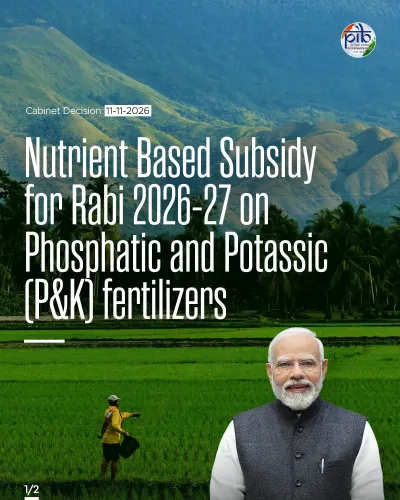
The Union Cabinet, chaired by Prime Minister Narendra Modi, on Wednesday, 11 November 2026, approved the Nutrient Based Subsidy (NBS) rates on phosphatic and potassic (P&K) fertilisers for the Rabi crop season of 2026-27, with a tentative budgetary outlay of approximately ₹62,370.02 crore. The decision is aimed at keeping fertiliser prices affordable for farmers amid rising global commodity costs.
How Much More Than Last Year
The approved outlay represents an increase of ₹24,417.73 crore over the corresponding Rabi 2025-26 allocation, which stood at ₹37,952.29 crore, according to an official government statement. The sharp year-on-year jump reflects the recent surge in international prices of key fertiliser inputs — including urea, DAP, MOP, and sulphur — that have pushed the cost of procuring and distributing P&K fertilisers significantly higher.
What the Subsidy Covers
The NBS rates will be applicable from 1 October 2026 to 31 March 2027, covering the full Rabi season window. The subsidy encompasses 28 grades of P&K fertilisers, including DAP and various NPKS grades, made available to farmers through fertiliser manufacturers and importers at subsidised prices. The NBS Scheme has governed P&K fertiliser subsidies since 1 April 2010, with rates revised periodically in line with global market conditions.
Why Global Prices Drove the Decision
International fertiliser markets have remained volatile, with input costs for phosphatic and potassic compounds rising sharply over the past year. The government's decision to rationalise — and in this case substantially raise — the subsidy outlay is a direct response to those trends, ensuring that the price burden is absorbed by the state rather than passed on to cultivators during the critical Rabi sowing period. Notably, this is consistent with the Centre's broader farmer-first policy stance, which has seen fertiliser subsidies climb over successive seasons.
How Farmers and Companies Benefit
Under the approved framework, subsidy payments will be made directly to fertiliser companies at notified rates, allowing them to sell to farmers at government-capped, affordable prices. This mechanism shields the rural agricultural sector — which is heavily dependent on DAP and NPKS blends for wheat, mustard, and pulse crops — from price shocks originating in global supply chains. The government has reaffirmed its commitment to ensuring smooth fertiliser availability across all states during the Rabi season.
What Comes Next
With the NBS rates now approved and effective from 1 October 2026, fertiliser companies and importers are expected to align their supply chains accordingly ahead of peak Rabi demand in November–December 2026. The Centre's ability to hold retail prices stable through this elevated subsidy will be closely watched, particularly as global commodity markets remain unpredictable heading into 2027.
Point of View
000-crore-plus single-year jump in the fertiliser subsidy bill is not a routine policy revision — it is a signal of how structurally vulnerable India's farm support system is to global commodity cycles. India imports a large share of its DAP and MOP requirements, which means every geopolitical disruption or supply-chain shock in the global fertiliser market translates directly into a larger fiscal burden for the Centre. The NBS mechanism, now over 15 years old, was originally designed to incentivise efficiency and discourage over-use; in practice, repeated upward revisions have made it a price-insulation tool rather than a demand-rationalisation one. The bigger question policymakers have consistently deferred is whether India's dependence on imported phosphatic and potassic fertilisers can be structurally reduced — through domestic capacity creation or crop-specific subsidy targeting — before the next global price spike arrives.
NationPress
11 Nov 2026
Frequently Asked Questions
What is the fertiliser subsidy approved by the Cabinet for Rabi 2026-27?
The Union Cabinet approved a Nutrient Based Subsidy (NBS) outlay of approximately ₹62,370.02 crore for phosphatic and potassic (P&K) fertilisers for the Rabi season of 2026-27. The subsidy covers 28 grades including DAP and NPKS blends and is valid from 1 October 2026 to 31 March 2027.
How much has the fertiliser subsidy increased compared to last year?
The 2026-27 Rabi allocation is ₹24,417.73 crore higher than the ₹37,952.29 crore approved for Rabi 2025-26 — a year-on-year increase of roughly 64%. The government attributed the rise to surging international prices of fertiliser inputs like DAP, MOP, urea, and sulphur.
Who benefits from the P&K fertiliser subsidy and how?
Farmers cultivating Rabi crops — primarily wheat, mustard, and pulses — benefit by receiving DAP and other P&K fertilisers at government-capped, affordable prices. The subsidy is paid directly to fertiliser manufacturers and importers, who then sell to farmers at the lower, government-approved retail price.
What is the Nutrient Based Subsidy (NBS) scheme?
The NBS scheme, in effect since 1 April 2010, governs subsidies on phosphatic and potassic fertilisers in India. Under the scheme, the government fixes per-nutrient subsidy rates annually, and fertiliser companies receive payments at these notified rates, allowing them to sell to farmers at affordable prices rather than at import-cost-linked market rates.
Why have fertiliser subsidies risen so sharply in one year?
Global prices of key fertiliser inputs — including DAP, MOP, urea, and sulphur — have risen significantly, pushing up the cost of procuring and distributing P&K fertilisers in India. Since a large portion of these fertilisers is imported, international price volatility directly inflates the domestic subsidy burden when the government chooses to shield farmers from retail price increases.