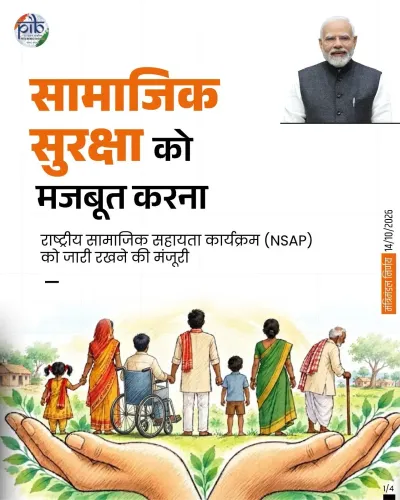
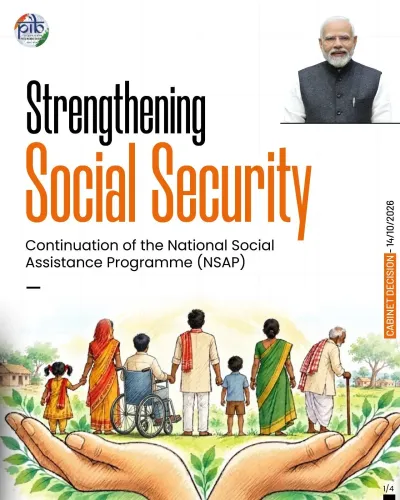
Cabinet Extends Disability Pension Scheme to 3.2 Cr Indians
Synopsis
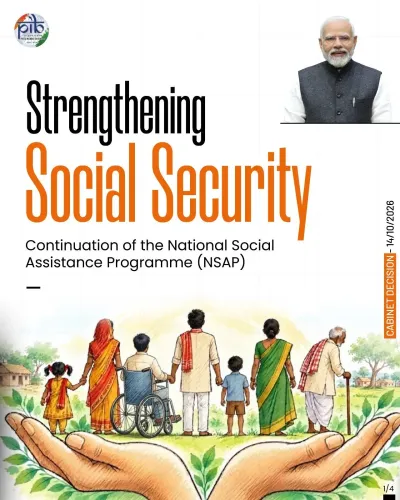
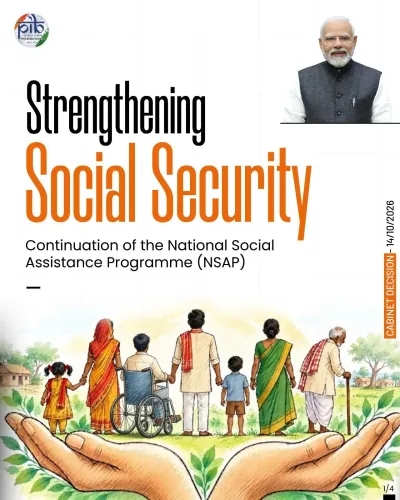
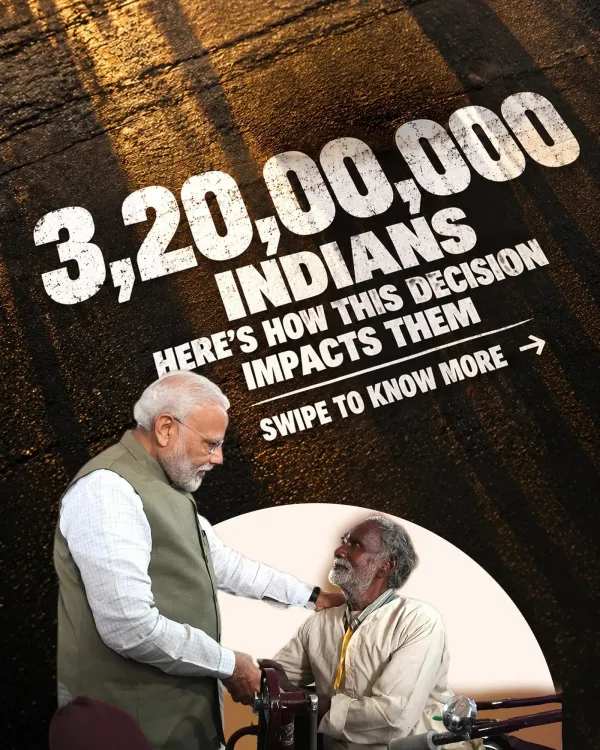
The Modi Cabinet has approved continuation of the National Social Assistance Programme for 2026-31, covering 3.2 crore beneficiaries with a ₹53,428 crore outlay. Disability pension eligibility has been expanded by lowering the threshold from 80% to 40% and removing the minimum age requirement, extending support from birth.
Key Takeaways
3.2 crore Indians are covered under the National Social Assistance Programme continuation approved for 2026–27 to 2030–31 .
Total approved outlay stands at ₹53,428 crore over five years.
Disability pension threshold cut from 80% to 40% , aligning with the Rights of Persons with Disabilities Act, 2016.
Minimum age requirement removed — support under the Indira Gandhi National Disability Pension Scheme now begins from birth.
NSAP was first launched in 1995 ; its disability component, IGNDPS, was introduced in 2009 .
State-level rollout of updated eligibility criteria and budgetary allocations will determine the pace of actual delivery from 2026–27 .
A pension net that once excluded millions by design is now being recast — wider, lower, and earlier in life. Union Coal and Mines Minister G. Kishan Reddy on Saturday, October 17, 2026, announced that the Modi-led Union Cabinet has approved the continuation of the National Social Assistance Programme (NSAP) for the period 2026–27 to 2030–31, with a sweeping expansion of disability pension eligibility that could reshape the lives of 3.2 crore Indians at a total outlay of ₹53,428 crore.
The eligibility wall comes down
At the heart of this Cabinet decision is a structural shift in who qualifies for support under the Indira Gandhi National Disability Pension Scheme (IGNDPS) — the disability arm of NSAP. Since the scheme's introduction in 2009, beneficiaries had to prove a disability severity of at least 80% — a bar so high it locked out the vast majority of persons with disabilities in India. That threshold now drops to 40%, the standard definition of disability used in Indian law, immediately expanding the eligible pool.
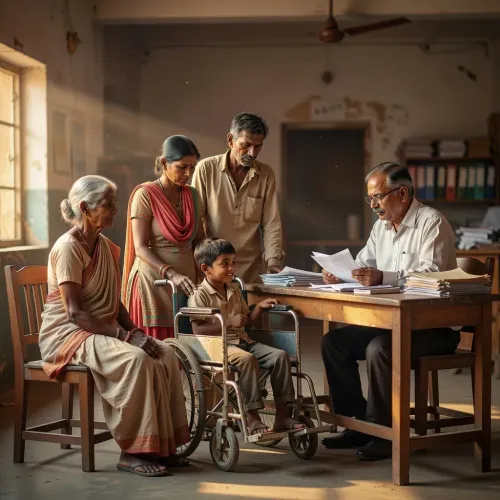
Equally significant: the minimum age requirement has been removed entirely. Support now extends from birth, meaning children born with disabilities will be covered from day one — a provision that did not exist before.
Thirty years of NSAP — and why this revision matters
The National Social Assistance Programme was launched in 1995 as India's central commitment to its most vulnerable citizens — the elderly, widows, and persons with disabilities. Over three decades, successive governments have periodically revised eligibility criteria and benefit levels, but the disability component has remained among the most restrictive. The 80% threshold mirrored an era when disability policy was narrowly defined; the Rights of Persons with Disabilities Act, 2016 has since broadened the legal framework considerably.
This five-year renewal, running through 2030–31, aligns the pension scheme with that broader legal definition — closing a long-standing gap between what the law recognises and what the welfare system actually delivers.
Scale of commitment: ₹53,428 crore over five years
The approved outlay of ₹53,428 crore signals a sustained fiscal commitment across the next five Union Budgets. The beneficiary count — 3.2 crore — reflects the expanded coverage pool across elderly, widow, and disability categories under NSAP. For the disability component specifically, the twin changes — lower threshold and zero age floor — are expected to draw in a significantly larger cohort of new claimants as state-level rollout guidelines take shape for 2026–27.
Minister Kishan Reddy, who also serves as BJP's Telangana state president, framed the decision as 'a major step towards a more inclusive India,' calling it consistent with the government's Viksit Bharat vision for 2047.
What happens next — and what to watch
Cabinet approval is the starting gun, not the finish line. The expansion's real test will come in how quickly states update their beneficiary databases, recalibrate disability assessment processes to accept the 40% threshold, and process claims for beneficiaries of all ages — including newborns. Budgetary allocations at the state level and clarity on centre-state cost-sharing ratios will determine how soon the newly eligible actually receive their first pension credit.
For millions of families who have cared for disabled children without any state support, that calendar matters enormously.
Point of View
2016 — correcting a seven-year policy lag that left millions legally recognised as disabled but welfare-ineligible. The removal of the age floor is arguably the bolder structural move, establishing a cradle-level social floor that India's disability framework has long lacked. Politically, the expansion gives the BJP a tangible welfare deliverable ahead of what remains a contested social policy terrain, and anchors the Viksit Bharat narrative in measurable inclusion metrics. The real accountability test, however, will be state-level implementation speed and whether disability assessment infrastructure can handle the surge in new applicants.
NationPress
17 Oct 2026
Frequently Asked Questions
What is the National Social Assistance Programme and who does it cover?
The National Social Assistance Programme (NSAP) is a central government welfare initiative launched in 1995 that provides monthly pensions to elderly persons, widows, and individuals with disabilities across India. It operates through schemes including the Indira Gandhi National Disability Pension Scheme.
What has changed in disability pension eligibility after the 2026 Cabinet decision?
The Union Cabinet has lowered the disability severity threshold for pension eligibility from 80% to 40%, and removed the minimum age requirement entirely, meaning support now begins from birth. These changes significantly widen the pool of eligible beneficiaries.
How much money has the government approved for NSAP from 2026 to 2031?
The Cabinet has approved a total outlay of ₹53,428 crore for the continuation of NSAP over the five-year period from 2026–27 to 2030–31, covering approximately 3.2 crore beneficiaries.
What was the Indira Gandhi National Disability Pension Scheme before this expansion?
The Indira Gandhi National Disability Pension Scheme was introduced in 2009 as part of NSAP to provide monthly pensions to persons with disabilities. It originally required a minimum disability severity of 80% and had a minimum age restriction, which made it inaccessible to a large portion of disabled Indians.
When will the expanded disability pension scheme come into effect?
The approved programme covers the period 2026–27 to 2030–31, with the expanded eligibility criteria set to apply from the 2026–27 financial year onwards, subject to state-level rollout guidelines and updated beneficiary registration processes.