Giriraj Singh: Cabinet extends SARTHAK-PDS scheme for 5 years, ₹25,530 cr outlay
Synopsis
The Union Cabinet has approved a five-year extension of the SARTHAK-PDS scheme with a ₹25,530 crore outlay, Union Textiles Minister Giriraj Singh announced on 28 May 2026. The decision continues India's pattern of multi-year budgetary support for powerloom weavers and textile MSMEs.
Key Takeaways
The Union Cabinet has approved a five-year extension of the SARTHAK-PDS scheme .
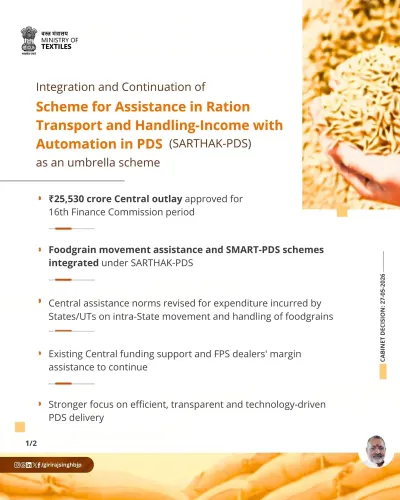
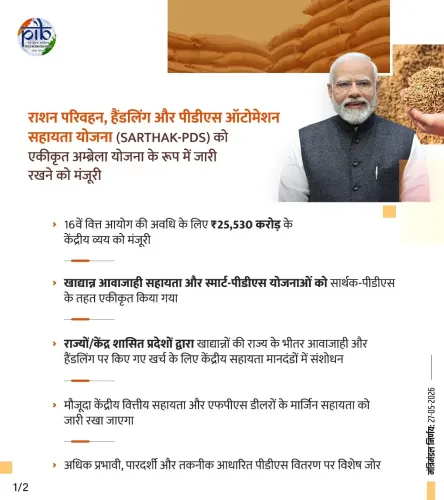
The total financial outlay approved is ₹25,530 crore , averaging approximately ₹5,106 crore per year .
Union Textiles Minister Giriraj Singh made the announcement on 28 May 2026 via the NaMo App.
Primary beneficiaries include powerloom weavers and textile MSMEs across India.
The extension follows a broader government pattern of renewing multi-year support for labour-intensive textile segments, similar to the TUFS model since 1999 .
Operational guidelines and fund-release schedules from the Ministry of Textiles are awaited.
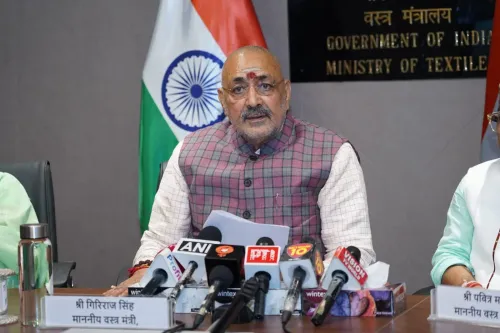
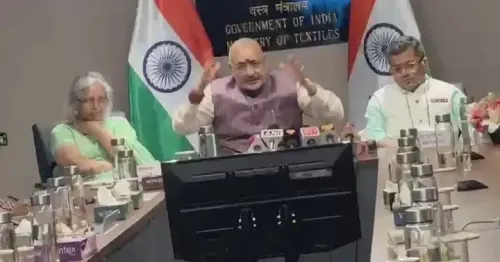
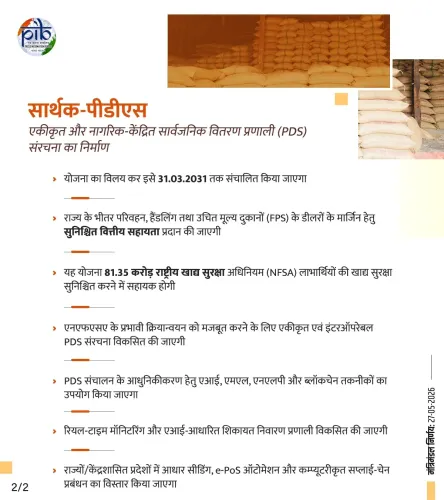
Union Textiles Minister Giriraj Singh on Thursday, 28 May 2026 announced that the Union Cabinet has approved a five-year extension of the SARTHAK-PDS scheme with a financial outlay of ₹25,530 crore, signalling continued government support for the labour-intensive textile sector.
Context
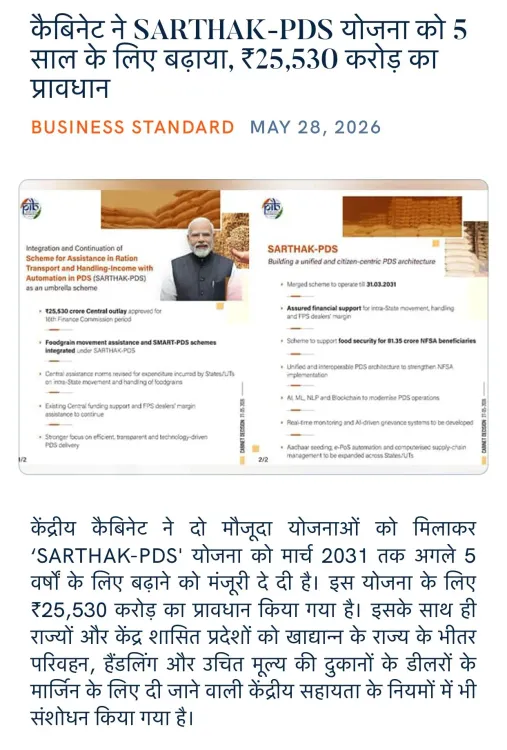
Singh shared the Cabinet decision via the NaMo App, posting: 'कैबिनेट ने SARTHAK-PDS योजना को 5 साल के लिए बढ़ाया, ₹25,530 करोड़ का प्रावधान' ('Cabinet has extended the SARTHAK-PDS scheme for 5 years, with a provision of ₹25,530 crore'). The announcement confirms a multi-year budgetary commitment to a scheme under the Ministry of Textiles.
The Cabinet approval is the apex executive decision required for such scheme extensions in India. Decisions of this scale typically follow inter-ministerial consultations and a formal note to the Cabinet Committee on Economic Affairs or the full Cabinet.
Policy Backdrop
India's textile ministry has a long track record of extending multi-year support programmes for decentralised segments of the industry. The Technology Upgradation Fund Scheme (TUFS), launched in 1999, is among the earliest such instruments and has seen multiple renewals over the decades — establishing a pattern of continuity for capital-intensive and employment-heavy sub-sectors.
The SARTHAK-PDS scheme falls within this broader policy lineage of providing sustained financial support to powerloom weavers and textile MSMEs — segments that together account for a significant share of India's textile employment and export basket. An outlay of ₹25,530 crore over five years translates to an average annual commitment of approximately ₹5,106 crore, underscoring the government's intent to maintain programme momentum.
Stakeholders and Impact
Powerloom weavers and small and medium textile enterprises are the primary beneficiaries of schemes under this architecture. These segments are concentrated in states such as Maharashtra, Tamil Nadu, Gujarat, Uttar Pradesh and Andhra Pradesh, and are significant contributors to rural and semi-urban employment.
Continuity of funding is particularly important for MSMEs that plan capital investment and working-capital cycles around assured government support. A five-year horizon, as approved by the Cabinet, provides the planning certainty that smaller operators require to commit to technology upgrades or workforce expansion.
What's Next
The Ministry of Textiles is expected to release operational guidelines, a fund-disbursement schedule and eligibility criteria for the extended scheme in the coming weeks. Stakeholders and state governments will watch for any revisions to the scheme's component structure or targeting criteria compared to the previous cycle.
Mid-term evaluation reports and quarterly fund-release data, once published, will be key indicators of whether the ₹25,530 crore outlay translates into on-ground impact for weavers and textile enterprises across India's textile belts.
Point of View
530 crore commitment is a clear signal that the government intends to keep large-scale textile support programmes insulated from annual budget uncertainty. For the BJP, anchoring such announcements through senior ministers like Giriraj Singh — who represents a state with a significant weaver and MSME constituency — carries both policy and political logic. The decision fits a well-established arc of successive governments renewing textile schemes to protect employment in decentralised, export-linked segments. The real test will be the speed and targeting of fund disbursement, which has historically been the weak link in similar multi-year textile outlays.
NationPress
11 Oct 2026
Frequently Asked Questions
What is the SARTHAK-PDS scheme?
SARTHAK-PDS is a Central Government scheme under the Ministry of Textiles designed to support powerloom weavers and textile MSMEs. The Cabinet extended it for five years in May 2026 with a ₹25,530 crore outlay.
How much money has the Cabinet approved for the SARTHAK-PDS scheme extension?
The Cabinet has approved a financial outlay of ₹25,530 crore for the five-year extension of the SARTHAK-PDS scheme, averaging approximately ₹5,106 crore per year.
Who announced the SARTHAK-PDS scheme extension?
Union Textiles Minister Giriraj Singh announced the Cabinet's decision on 28 May 2026 via a post on the NaMo App and social media.
Who benefits from the SARTHAK-PDS scheme?
The primary beneficiaries are powerloom weavers and small and medium enterprises in the textile sector, concentrated in states such as Maharashtra, Tamil Nadu, Gujarat, Uttar Pradesh and Andhra Pradesh.
What is the significance of the five-year extension for textile MSMEs?
A five-year funding horizon gives textile MSMEs and weavers the planning certainty needed to invest in technology upgrades and workforce expansion, reducing dependence on annual budget allocations.